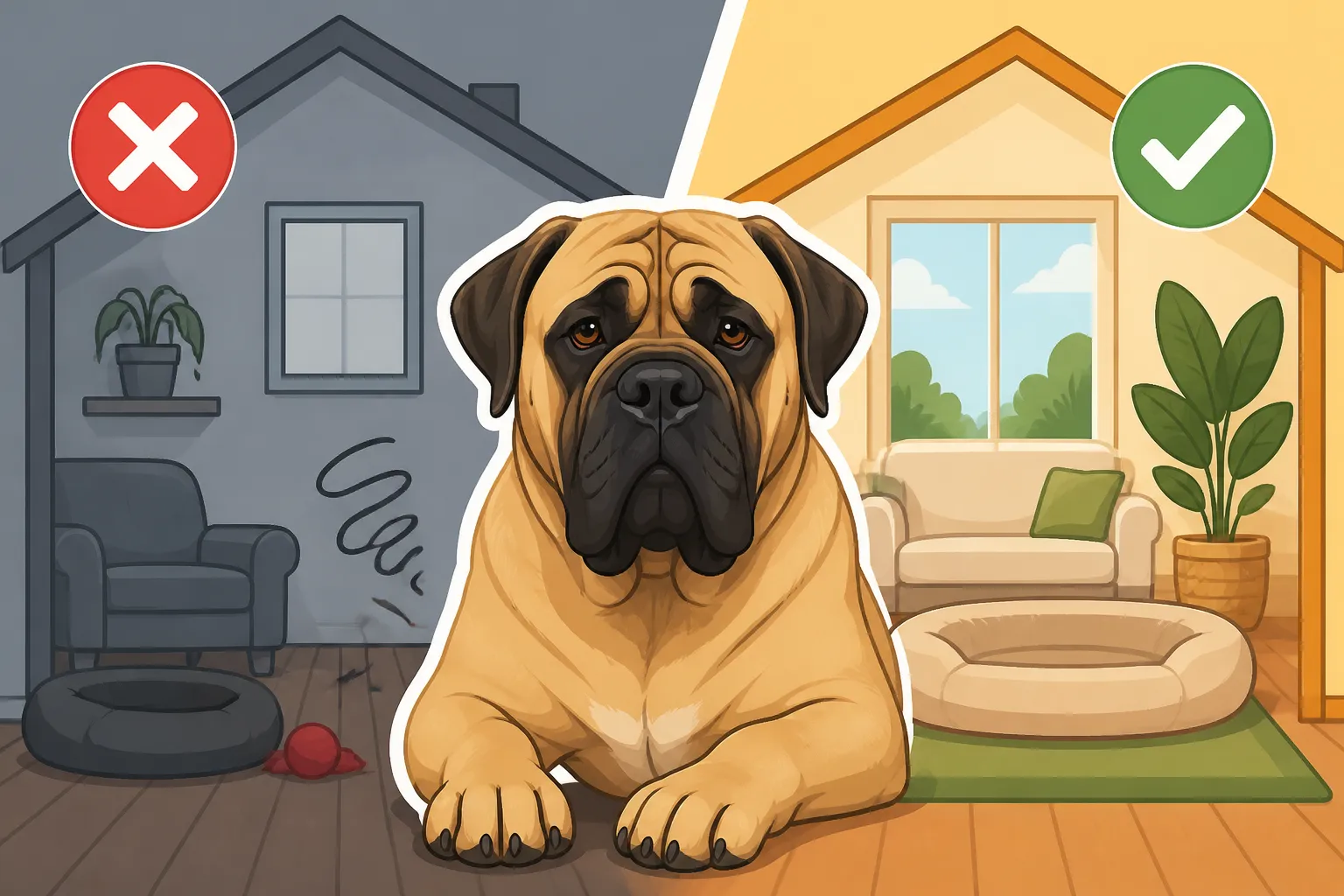
Whether a Mastiff Suits a Small House
A Mastiff can look perfectly content in a small house, then reveal the practical challenges one room at a time: a blocked hallway, a bed that crowds the living room, or a dog too heavy to move easily when it refuses a doorway. This guide explains when a small home can work, what to measure before bringing a Mastiff home, and how to make limited space comfortable and safe.
Can a Mastiff Be Happy in a Small House
Yes, sometimes. A Mastiff does not need a mansion or a huge yard simply because of its size. Many are calm indoors and are content to nap near their people after a modest amount of daily activity. But a quiet temperament does not make a large body disappear: the dog still needs room to turn, stretch, get up without knocking into furniture, and move safely through the home.
A small house is more likely to work when the layout is open, walkways are clear, the dog has a comfortable resting place, and the household can meet its exercise and care needs. A cramped home with narrow passages, steep stairs, and no way to separate the dog from guests may be difficult even if it has a yard.
Think about usable space, not the number of rooms
A home’s layout matters more than its room count. A compact house with a wide main living area and an unobstructed path between the dog’s bed and the door may be easier for a Mastiff than a larger house divided by tight hallways and cluttered corners. The dog needs a place to lie down without being stepped over, as well as enough clearance to stand and turn comfortably.
Picture the route your dog would take on an ordinary day: from its resting spot to the water bowl, from the bowl to the back door, and from the door to the place where you keep its leash. Can it make those trips without squeezing past sharp furniture edges or blocking the whole household? If your current furniture already makes a narrow hallway feel like a single-file passage, a Mastiff can make that pinch point much more noticeable.
Measure doorways and turns, not just floor area. A large crate or dog bed may fit into a room but be difficult to carry through the entryway or around a tight corner. Before buying a crate, check its assembled dimensions against the route it must travel. Whether a Mastiff Crate Fits Through Your Doorway is a useful planning topic if you are comparing crate options or moving into a home with narrow entrances.
A yard helps, but it does not replace walks
A private yard can make toilet breaks easier, especially during bad weather or when a Mastiff is older. Still, having outdoor space does not automatically meet a dog’s needs. Most dogs benefit from supervised time outside, regular walks suited to their age and condition, and opportunities to explore at a comfortable pace. A yard is a convenience, not a substitute for attention and routine.
Likewise, a small house does not necessarily rule out a Mastiff if you can provide safe, steady exercise. The right routine depends on the individual dog, its age, health, and energy level. A young Mastiff puppy should not be pushed into strenuous exercise; a veterinarian can help you plan activity as the dog grows. A low-key adult may be happy with shorter walks and time spent alongside the family, while still needing regular chances to move.
If your house has no yard, plan ahead for the daily reality: where the dog will toilet, how you will manage rainy or icy days, and whether the route outside includes stairs or a long walk through a shared building. For a closer look at outdoor needs, see Whether a Mastiff Needs a Yard and How Much Yard a Mastiff Actually Uses.
What Makes a Small Home Work for a Mastiff
The difference between “small but workable” and “too crowded” often comes down to preparation. A home does not need to be stripped of furniture, but it does need clear routes and sensible places for the dog’s essentials. A Mastiff that cannot pass through a busy room without bumping into people or furniture may become frustrated, and people can feel constantly crowded in their own home.
Set up clear paths and safe resting spots
Choose a resting place that is out of the main traffic lane but close enough for the dog to feel included. A bed tucked beside a frequently used doorway can quickly become an obstacle. A quiet corner in the living room may work better, as long as the dog can stretch out without blocking access to the sofa or kitchen.
Make sure the bed is supportive and large enough for the dog to lie on its side. In a small house, it is tempting to pick a compact bed to save room, but a bed that is too small is unlikely to be comfortable. A durable, washable cover is useful because beds collect hair, dirt, and drool. If you are buying pet supplies online, a retailer such as Chewy may offer a way to have bulky items delivered, but compare the bed’s packed and assembled dimensions with your doorway and intended storage spot first.
Pay attention to footing, too. Slippery floors can make getting up and turning harder, especially for a growing dog or an older Mastiff. Runners and washable rugs can create a safer path between resting areas and exits. They should lie flat and stay put; a rug that slides underfoot can create a new hazard instead of solving one. Whether a Mastiff Needs Runners Through the House covers what to consider when planning traction.
Store food and supplies without taking over the kitchen
A large dog’s supplies take up real space. Food bags, bowls, towels, grooming tools, cleaning products, and medication can turn a small kitchen or utility area into a cluttered storage room if you do not decide where they belong. Keep food in a secure, dry container and put cleaning or medical products where the dog cannot reach them.
Measure the storage area before ordering large bags or bins. Delivery can be convenient when carrying heavy supplies is difficult, and Chewy is one retailer some households use for pet food and everyday products. Still, choose quantities that fit your storage space and suit the dog’s feeding plan; buying more than you can store neatly can make the home harder to manage. Keep bowls somewhere where the dog can eat without blocking a main walkway.
Drool and muddy paws are also part of the space calculation. Keep towels near the entry, and choose a water-bowl location that is easy to clean but not in the middle of a narrow route. Some owners order washable mats and replacement towels through retailers such as Chewy, while others use household items they already have. The important part is having a consistent cleanup spot so that a wet dog and a puddle do not turn the only clear passage into a slippery one.
Practical Checks Before Bringing a Mastiff Home
It is easy to imagine a Mastiff curled up on a rug and forget the less charming logistics. Before committing, try to picture ordinary moments: carrying groceries past the dog, opening the front door when a visitor arrives, getting the dog into a vehicle, and moving through the house if the dog is ill or injured. These details can matter more in a small home than the floor plan suggests.
Use a room-by-room fit check
Walk through your home as if a large dog already lives there. Note tight turns, fragile objects at tail height, narrow staircases, slippery flooring, and spots where the dog would have to lie across a doorway. Think about whether everyone can reach the kitchen, bathroom, and front door without stepping over the dog.
A simple planning table can help you identify problems before they become daily frustrations:
| Home feature | What to check | A workable sign |
|---|---|---|
| Main walkway | Can the dog and a person pass without squeezing? | The route stays clear even when the dog is resting nearby |
| Resting area | Can the dog stretch out without blocking a door? | The bed is out of the main traffic path |
| Flooring | Is the route slippery or uneven? | The dog can stand, turn, and walk with stable footing |
| Stairs | Can the dog use them safely, and can you manage access? | You have a plan that suits the dog’s age and mobility |
| Food and supplies | Is there secure, dry storage? | Bags, bowls, and cleaning supplies have designated places |
| Entry and vehicle access | Can the dog leave the house and get into transport safely? | You have a realistic plan for routine and emergency trips |
If you rent or share the home, consider the people as well as the dog. Everyone needs enough room to move, and guests need a safe way to enter without being crowded or startled. A child should not be expected to control a giant dog by themselves. Baby gates can help create separate zones, but they must be sturdy and placed so that the dog cannot knock them into a person or block an essential exit.
Be realistic about stairs, lifting, and emergencies
Stairs can be a significant issue in a small or multi-level house. A Mastiff that is young and healthy may navigate them differently from a puppy whose joints are still developing or an older dog with mobility problems. Avoid assuming that you can lift an adult Mastiff if it falls or becomes unable to climb. For many households, that is simply not practical.
Consider where the dog will sleep and spend most of its time. If the bedrooms are upstairs but the main living area is downstairs, would the dog be comfortable staying on one floor? Could you manage its needs without repeatedly asking it to climb stairs? Guidance on safe movement is available in Whether a Mastiff Should Use Stairs at All and Whether a Mastiff Needs a Ramp Into the House.
Emergency access deserves the same attention as everyday convenience. Think about which veterinarian or emergency clinic you would use, whether your vehicle can accommodate the dog, and how you would get help if the dog could not walk. Transport and clinic access can be complicated with a giant breed, so it helps to think through options before a crisis. How a Clinic Moves a Collapsed Mastiff explores why planning for this possibility matters.
When a Small House Is a Poor Fit
A small house is not automatically unsuitable, but some living situations make ownership much harder. The key question is not whether the dog can physically squeeze inside. It is whether the dog and the people who live there can share the space comfortably and safely over the long term.
Warning signs that the home may be too crowded
Be cautious if the only place for a bed is directly in a doorway, the dog would need to squeeze through several narrow passages every day, or household members cannot move around without waking or disturbing it. The same goes for a home where visitors must pass close to the dog’s resting place or where there is no safe way to give the dog space when it needs to settle.
A small home can also be a poor fit if the household depends on the dog being quiet and unobtrusive at all times. Mastiffs may be calm, but they still shed, drool, snore, and take up floor space. Their tails can clear low tables, their bodies can crowd a kitchen, and their water bowls can be awkward to place in a narrow room. Owners often find that furniture arrangement changes once the dog arrives. The Furniture, Vehicle and Doors a Mastiff Changes gives a fuller sense of the adjustments giant-breed owners may face.
Another warning sign is a plan that relies on the dog spending most of its time alone in a small room or outside because the rest of the house feels too cramped. A Mastiff needs companionship, routine, and a comfortable place to rest. If the layout means the dog is routinely shut away from family life, the arrangement may not be fair or sustainable.
Compare your lifestyle with the dog’s needs
The right fit is about more than square footage. Consider your ability to provide regular care, handle grooming and cleanup, arrange transportation, and manage a powerful dog on leash. A Mastiff can be difficult to move physically if it plants itself or becomes frightened, so calm handling and early training are important. If you are deciding whether the breed’s size and temperament suit your household, Whether a Mastiff Settles in a Small Space and Whether a Mastiff Suits an Apartment offer related considerations.
You should also think about how your home might change. A current setup may work while the dog is young but become harder as it grows, or the reverse may be true if you can rearrange a room and make an open route. Ask whether you could create a quiet resting zone, add traction to slippery floors, and keep the essentials accessible without turning every room into a storage area.
If the answer is yes, a small house can be a reasonable home for a Mastiff. If the answer depends on constantly shifting furniture, carrying a dog you could not realistically lift, or hoping that size will never affect daily life, pause before deciding. A thoughtful home assessment is kinder to the dog and much less stressful for the people who will share their space with it.
Disclaimer
This article is for general informational purposes only and does not constitute professional advice. Laws, prices and regulations vary by location and change over time. Consult a qualified professional for guidance on your specific situation.