How a Clinic Moves a Collapsed Mastiff
The moment your gentle giant, your beloved Mastiff, suddenly collapses, it's terrifying. Your heart leaps into your throat, and a wave of panic washes over you as you realize the sheer scale of the problem: how on earth do you move a two-hundred-pound dog who can't move themselves? This guide is designed to help you understand the challenge and provide practical steps and insights into how veterinary clinics, and you, can safely move a collapsed Mastiff during an emergency.
The Terrifying Reality of a Collapsed Mastiff
Seeing your Mastiff suddenly go down is an experience no owner wants to face. One minute they might be lumbering around the living room, the next they're a massive, inert mass on the floor. It's not just a heartbreaking sight; it’s an immediate, immense physical challenge.
What "Collapsed" Actually Means for a Giant Breed
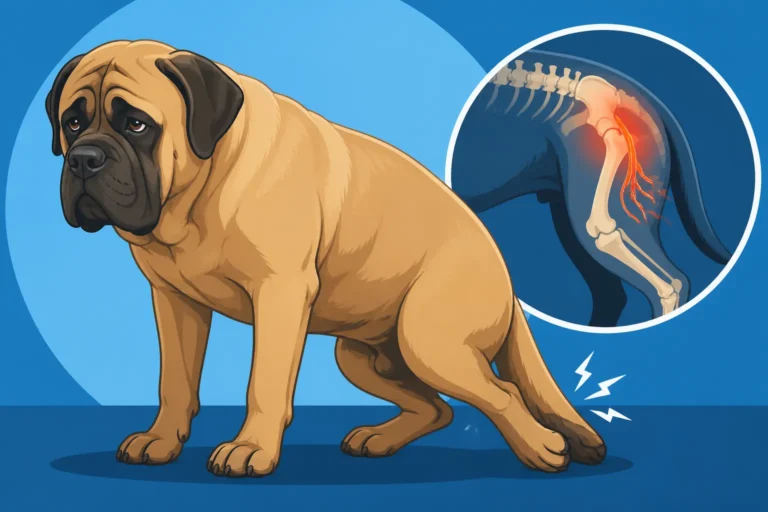
When we talk about a Mastiff "collapsing," it can mean a few different things, from a sudden weakness in the hind end to a complete loss of consciousness. It’s not just a stumble; it’s a sudden inability to bear weight or move voluntarily. This can be due to a myriad of serious issues: a sudden cardiac event, a severe injury, acute bloat (gastric dilatation-volvulus), a stroke, or even a sudden onset of something like Degenerative Myelopathy in a Mastiff, where their hind end fails without warning. The sheer size of a Mastiff means that any collapse is automatically a critical emergency because their weight puts enormous strain on any compromised system, and getting them help becomes an immediate logistical nightmare.
The Immediate Panic and How to Stay Calm
It's natural to panic. This is your family member, and they're in distress, vulnerable, and massive. However, your ability to think clearly and act methodically is paramount. Take a deep breath. Assess the situation quickly: Is your Mastiff responsive? Are they breathing? Are there any obvious injuries or signs of pain? Try to keep other pets and small children away to prevent further stress to your Mastiff and allow you to focus. Your first call, after ensuring their immediate safety, should always be to your veterinary emergency clinic. Describe what happened as calmly and clearly as possible, including your Mastiff's estimated weight. This crucial information allows them to prepare for your arrival, assembling the necessary staff and specialized equipment.
Getting Your Mastiff to the Clinic Safely
Transporting a collapsed Mastiff is arguably the biggest hurdle in the entire emergency. This isn't a small dog you can scoop up; this is a massive animal that could easily injure themselves, or you, if not handled correctly.
The Crucial First Steps at Home
Before you even think about lifting, make sure your Mastiff is as comfortable as possible. If they are conscious and appear in pain, try to gently stabilize any obvious injury, but do not try to reset bones or apply tight bandages unless you are specifically instructed by a vet. For issues like suspected bloat, you need to move fast, and stabilization is less critical than immediate transport. If your Mastiff is struggling to breathe, ensure their airway is clear. Pull their tongue forward gently if it's obstructing, and look for any foreign objects.
Next, you need to create a transport plan. Do you have help available? You will almost certainly need at least two, if not three or four, able-bodied adults to safely move a two-hundred-pound dog. Call a neighbor, a friend, or another family member. If you're alone, explain the situation to the emergency clinic, they might have suggestions or even be able to dispatch personnel if you're close enough and they have the resources, though this is rare.
Improvised Stretchers and Teamwork
Forget trying to lift a Mastiff with just two people unless they're a very small female Mastiff and you're both very strong. You need a stretcher. What do you have around the house that could serve this purpose?
- A sturdy blanket or quilt: Fold it in half or quarters to make it more rigid. Position it alongside your Mastiff, then gently roll or slide your Mastiff onto it. Each person grabs an end and a side, trying to keep the weight distributed.
- A bath mat or small rug: Similar to a blanket, these offer a bit more rigidity.
- A plywood board or old door: If available and manageable, this is ideal. Slide it under your Mastiff. You'll still need several people to lift the board and carry it.
- A sturdy tarp: Tarps often have grommets, allowing multiple people to get a good grip, and their inherent strength is a huge asset.
The key is even distribution of weight. Designate one person as the "caller" who gives commands ("Lift on three! One, two, three, LIFT!"). Move slowly and deliberately to avoid jostling your Mastiff unnecessarily, which could exacerbate an injury or cause further panic. Remember, your goal is to move them as a single unit, not to bend or twist their body.
| Improvised Stretcher Type | Pros | Cons | Ideal For |
|---|---|---|---|
| Sturdy Blanket/Quilt | Readily available, soft, conformable | Lacks rigidity, can bunch up, difficult to maintain even support | Smaller/lighter Mastiffs, short distances, soft tissue injuries |
| Bath Mat/Small Rug | More rigid than a blanket, good grip | Still can bunch, limited size, less durable | Medium Mastiffs, very short distances to car |
| Heavy-Duty Tarp/Canvas | Very strong, multiple grip points, large | May need to be retrieved from shed/garage, not always soft | All Mastiffs, especially heavier ones, longer distances |
| Plywood Board/Old Door | Excellent rigidity and support | Heavy, awkward to maneuver, can be difficult to slide under | Suspected spinal injuries, very heavy Mastiffs, readily available |
Securing Your Mastiff in the Vehicle
Once you have your Mastiff on an improvised stretcher, the next challenge is getting them into your car. Ideally, you’ll have an SUV or a minivan with a flat-folding rear seat or a cargo area large enough for them to lie completely flat. A regular sedan trunk or back seat is almost certainly out of the question for a large adult Mastiff due to space constraints.
Slowly and carefully, with multiple people, lift and slide the stretcher and your Mastiff into the vehicle. Position them so they are stable and won't shift around during transit. If they are unconscious, ensure their head is positioned to prevent aspiration if they vomit. If they are conscious, try to make them as comfortable as possible. Keep talking to them in a calm, reassuring voice. Some owners even use a large dog bed or a thick blanket in the car to provide extra cushioning and absorb any bodily fluids that might occur during the stressful journey. Ensure the vehicle's air conditioning is on, especially if it's warm, as a Mastiff can overheat quickly due to their sheer bulk, as discussed in Heat and a Mastiff That Cannot Shed Its Own Bulk.
How Veterinary Clinics Prepare and Respond
When you call ahead, you're not just letting them know you're coming; you're allowing them to activate their "giant breed emergency protocol." This is where the magic (and immense effort) happens on the clinic's side.
The Alert Call: What to Tell the Vet
Your phone call is critical. When you explain that you have a collapsed Mastiff, the emergency clinic staff immediately understands the scale of the situation. Provide:
- Your dog's breed and estimated weight: This helps them understand the physical challenge.
- Brief description of symptoms: "He just collapsed, unresponsive," or "He's trying to get up but his back legs aren't working."
- Your estimated time of arrival (ETA): This gives them time to prepare.
Many emergency clinics, like those supported by Healthy Paws policyholders, are well-versed in handling these situations. They know that a dog of this size can be prone to serious conditions and requires swift, coordinated action. They’ll start preparing their team and equipment immediately.
Specialized Equipment for Giant Breeds
Standard examination tables and gurneys at a typical veterinary clinic might not be rated for a two-hundred-pound Mastiff. Emergency and specialty clinics often have specialized equipment designed for giant breeds. This can include:
- Heavy-duty gurneys or carts: These are often low to the ground and can support immense weight, sometimes with wheels that lock for stability.
- Lift slings or harnesses: Some clinics have large slings that can be positioned under a dog and then attached to a hoist or several team members to facilitate lifting.
- Wide, low-entry kennels: For after-care, a collapsed Mastiff needs a spacious, easy-access kennel or run.
- Large-animal scales: Crucial for accurate medication dosing, especially when considering Why a Mastiff Is Dosed by Lean Weight and Not Scale Weight.
Without this specialized equipment, moving a Mastiff within the clinic becomes incredibly difficult and risky for both the dog and the staff. This is why calling ahead is so vital. You don't want to arrive only to find they aren't equipped to handle your dog's size. Asking, "Whether an Emergency Clinic Will Take a Mastiff at All" before you start your journey is a reasonable question to ensure they are prepared.
Team Approach to Moving a Downed Mastiff
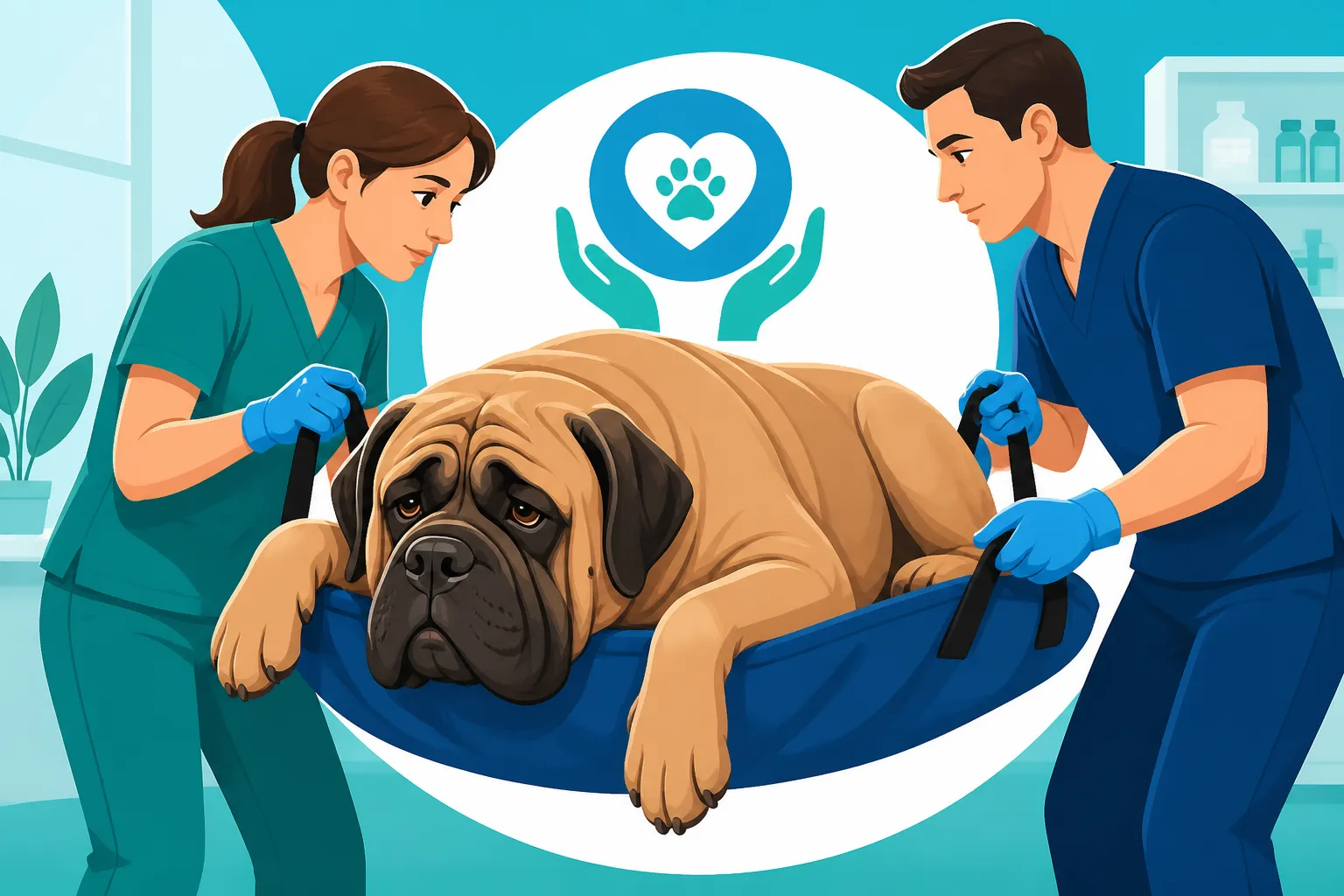
Once you arrive at the clinic, the veterinary team will swing into action. This isn't a one-person job. Expect a coordinated effort involving multiple veterinary technicians, assistants, and sometimes even the veterinarian.
They will often use a large, strong stretcher, often with handles or bars along the sides for several people to grip securely. They might also employ a "rescue glide" or similar device – a robust, rigid sheet designed to slide under a downed animal. The technique usually involves gently rolling the Mastiff onto its side, sliding the device underneath, and then rolling them back onto it. Then, with everyone positioned and ready, they'll lift and carry the Mastiff into the examination area. This process is about precision, communication, and brute strength, all aimed at minimizing further stress or injury to your dog. Clinics understand the immense challenge, and their teams are often drilled for these kinds of emergencies, ensuring they can safely move a collapsed Mastiff from your vehicle to their treatment area.
What to Expect During and After Arrival
Bringing a collapsed Mastiff into the vet is a whirlwind of activity, but knowing what to anticipate can help alleviate some of your stress.
The Initial Assessment Without Further Stress
Once inside, the priority is a rapid, but gentle, initial assessment. The vet and technicians will want to check vital signs – heart rate, respiratory rate, temperature, and mucous membrane color. They'll also perform a quick neurological check if appropriate and look for obvious injuries or causes for collapse. This often happens right on the stretcher or a padded mat on the floor, rather than trying to force a two-hundred-pound dog onto a high examination table, especially if the clinic isn't equipped with a table that can support a Mastiff. Minimizing movement is crucial at this stage. They might start an IV catheter right away to administer fluids or emergency medications. If you have pet insurance through providers like Healthy Paws, this is when knowing your policy details can really help, as you can focus on your dog's care rather than immediate costs.
Moving from Transport to Examination and Treatment
After the initial assessment, depending on the suspected cause of collapse, your Mastiff may need to be moved for diagnostics like X-rays, ultrasound, or blood tests. This again requires the coordinated effort of the veterinary team. For X-rays, for instance, they'll likely use a special gurney or a team of people to carefully position your Mastiff on the imaging table. The goal is always to get the necessary information while causing the least amount of discomfort or risk. For conditions like bloat, time is of the essence, and they’ll move swiftly to imaging and then potentially surgery, often preparing their large surgical suite and the necessary anesthesia protocols, given that Why Anesthesia Is Riskier in a Mastiff is a significant consideration.
If your Mastiff is suffering from a condition like How a Mastiff's Hind End Fails With DM, the initial movement might be less urgent but still requires careful handling to prevent further injury or pain. The clinic staff will use the same principles of teamwork and specialized equipment to ensure a smooth transition through all stages of diagnosis and treatment.
Financial Considerations and Emergency Planning
Emergency veterinary care, especially for a giant breed like a Mastiff, can be incredibly expensive. Procedures for bloat, for example, can run into thousands of dollars. Having an emergency fund or, better yet, comprehensive pet insurance can make a world of difference. Companies like Healthy Paws offer plans that can cover a significant portion of emergency care, allowing you to make medical decisions based on what’s best for your Mastiff, not just your wallet.
It's also worth discussing with your regular veterinarian what their recommendations are for emergency clinics that are equipped to handle large breeds, especially if you live in a rural area. Knowing "Whether a Practice Has a Table That Holds a Mastiff" or if "Whether a Mastiff Needs a Referral Hospital for Surgery" could save precious time when seconds count. Planning for these emergencies, even if it’s just having a list of contacts and a rough idea of how you’d move your dog, can significantly improve the outcome.
Disclaimer
The information provided in this article is for general educational purposes only and should not be considered a substitute for professional veterinary advice. Always consult with a qualified veterinarian for any health concerns or emergencies involving your Mastiff.