How a Mastiff’s Weight Compares With a Saint Bernard’s
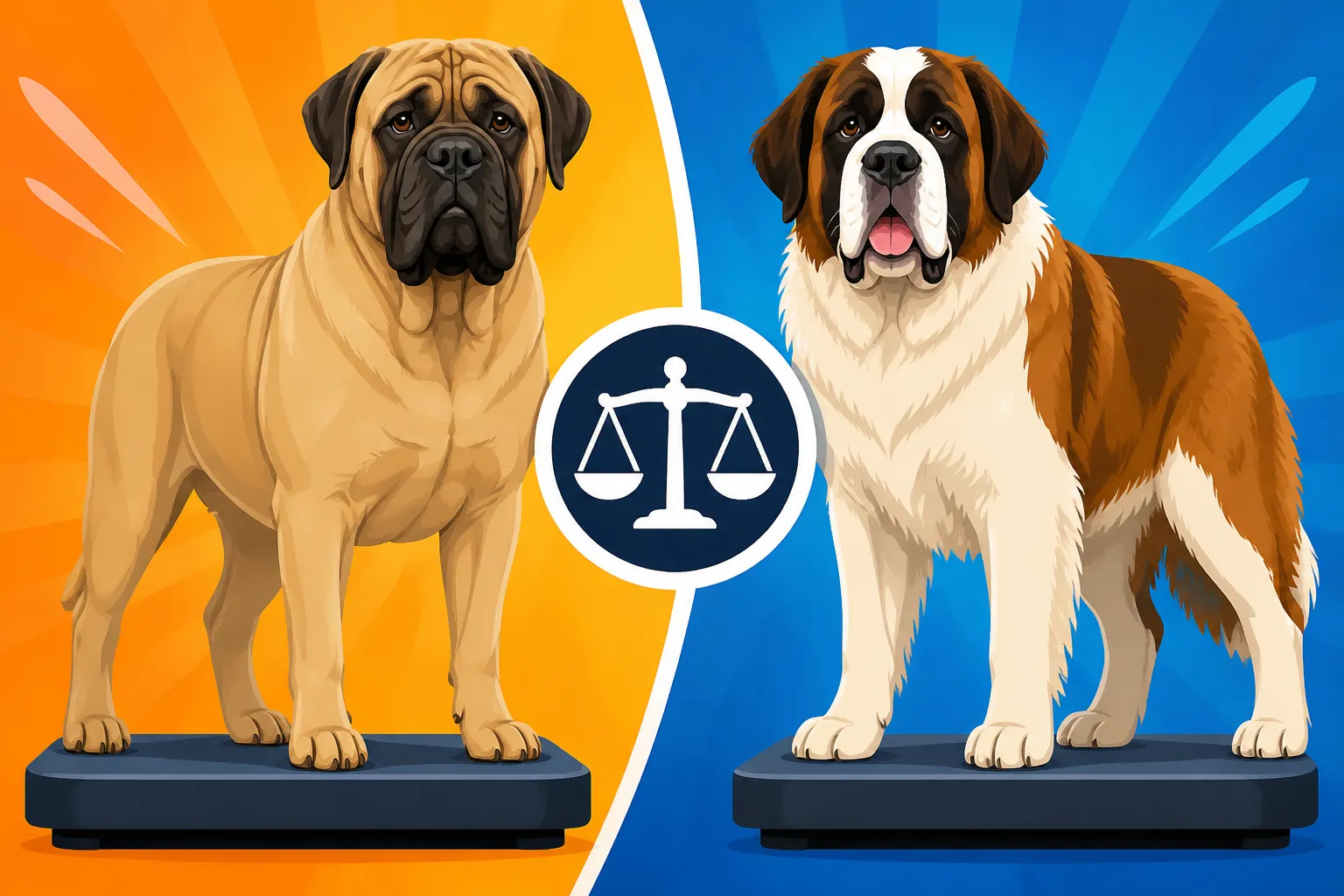
A Mastiff and a Saint Bernard can both fill a doorway, but they are not usually the same weight. Adult male Mastiffs often outweigh Saint Bernards, while females of the two breeds may overlap considerably. That range can make shopping, travel, feeding, and even judging whether a dog is carrying extra weight surprisingly confusing. Here’s how to compare them fairly—and why the number on the scale is only part of the picture.
Mastiff and Saint Bernard weight ranges
Typical adult weights
As a broad guide, adult Mastiffs tend to have a higher weight range than Saint Bernards. Breed standards and commonly cited breed profiles give useful reference points, but they are not a promise that every healthy dog will land at a particular number.
| Breed and sex | Common adult weight range |
|---|---|
| Male Mastiff | About 160 to 230 pounds |
| Female Mastiff | About 120 to 170 pounds |
| Male Saint Bernard | About 140 to 180 pounds |
| Female Saint Bernard | About 120 to 140 pounds |
The ranges overlap, particularly for females. A large female Saint Bernard could weigh more than a smaller female Mastiff, and a male Saint Bernard may weigh more than a Mastiff who is naturally lighter-framed. The comparison describes typical ranges, not a rule for identifying a dog’s breed or assessing its health.
For a closer look at the figures by sex, see How Much a Male Mastiff Weighs and How Much a Female Mastiff Weighs. The individual dog’s build, height, age, and body condition matter alongside its breed.
Why Mastiffs often weigh more
Mastiffs are exceptionally substantial dogs, with a broad chest, heavy bone, and a large, muscular frame. That combination helps explain why their typical upper weight range extends above the Saint Bernard’s. Their appearance can also make it difficult to tell at a glance whether a Mastiff is simply powerfully built or carrying excess fat.
Saint Bernards are also large, powerful dogs, but their expected weight range is generally narrower and lower. Their coat can make them look bulkier than they are, especially when it is full or thick. A fluffy outline is not a reliable way to estimate what the scale will say.
Size within either breed varies. Genetics, sex, growth, muscle, and overall health all play a part. A dog’s weight should be interpreted in context rather than judged against the largest dog someone has seen at a park or in a photo.
Weight is not the same as height
Weight alone does not tell you how tall a dog is, how much space it needs, or whether it is at a healthy size. A Mastiff may carry more weight in a broad, low-set frame, while a Saint Bernard may appear taller or more leggy. Even within one breed, dogs of similar weight can look quite different.
That distinction matters when you are planning for daily life. A dog’s height affects whether it can reach a counter, fit comfortably into a vehicle, or climb onto a bed. Its width and length may matter more than its weight when you are measuring a crate, doorway, or sleeping space.
If you are comparing giant breeds more broadly, How a Mastiff's Weight Compares With a Great Dane's can help show why weight and stature do not always go together. The useful question is not simply, “Which breed is bigger?” It is, “What are this particular dog’s dimensions, movement, and needs?”
How body shape changes the comparison
Frame, muscle, and coat can fool the eye
A Mastiff’s dense frame and loose skin can make it look enormous even when its weight is appropriate. A Saint Bernard’s coat can add visual volume, particularly around the neck, chest, and hindquarters. Those features make casual comparisons unreliable: one dog can look larger while actually weighing less.
Muscle adds another layer. Two dogs with the same weight may have different body compositions, just as two people at the same height and weight can have different builds. A lean, muscular dog may weigh more than a less muscular dog without being overweight. Conversely, a dog can have a large frame and still carry excess fat.
Photos can be misleading too. Perspective, coat, posture, and the size of nearby people or objects all change how a dog appears. A dog photographed sitting beside a child may look especially massive, while one standing next to another giant breed may seem comparatively small. Neither image tells you whether its weight is healthy.
How to tell whether a dog is carrying extra weight
A scale is useful for tracking changes, but body condition is a better way to understand whether a dog is at a suitable weight. Veterinary teams commonly assess how easily the ribs can be felt, whether there is a visible waist from above, and whether the abdomen tucks up behind the rib cage when viewed from the side.
For a giant breed, these checks can feel less obvious than they do on a smaller dog. Thick skin, a broad rib cage, and a heavy coat may make visual assessment tricky. Use gentle palpation rather than pressing hard: you should be able to feel the ribs beneath a layer of tissue, without them being sharply prominent.
A veterinarian can help you establish a body-condition baseline and decide whether a particular dog should gain, lose, or maintain weight. That is especially helpful for a growing puppy, an older dog, or a dog whose activity level or appetite has changed. For practical guidance, see How to Tell a Heavy Mastiff From a Fat One and Feeling for a Mastiff's Ribs Under Its Bulk.
Why the “biggest possible” weight is not the goal
It can be tempting to think that a Mastiff or Saint Bernard should be as heavy as possible. In practice, a higher number is not automatically a sign of better health, stronger bones, or a more impressive dog. Extra weight puts more load on joints and can make ordinary activities—getting up, walking, turning, and climbing into a vehicle—harder.
This is particularly important for giant breeds, which already carry substantial weight. If a dog is gaining rapidly, tiring more easily, or becoming reluctant to move, it is worth discussing the change with a veterinarian rather than assuming it is simply “filling out.” Weight changes can have several explanations, and a professional can help distinguish normal development from a concern.
A healthy target is individual. The range for a breed gives you a starting point, not a target to chase. Your vet can consider body condition, frame, age, and medical history together.
Weight through puppyhood and adulthood
Puppies do not grow at a steady, predictable rate
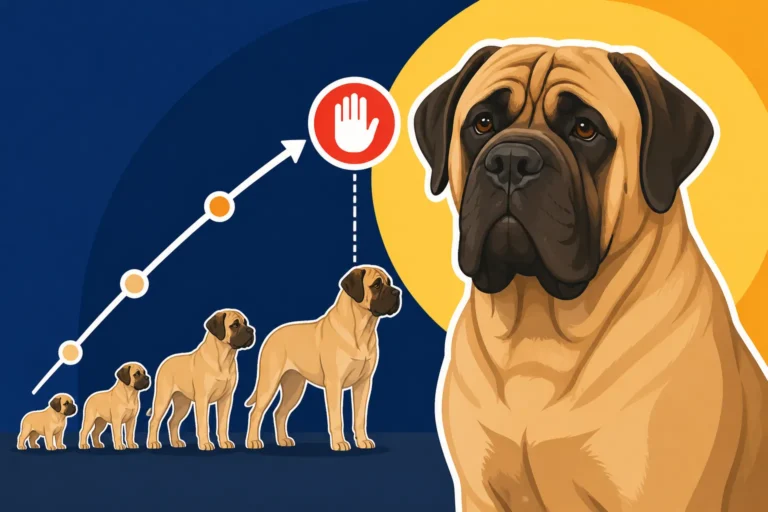
Mastiff and Saint Bernard puppies grow into giant adults, but that growth does not happen in a neat straight line. A puppy may gain quickly for a stretch and then appear to slow down. Littermates may also develop at different rates despite having the same parents and similar care.
The scale can be useful for tracking a puppy over time, but a single weekly number does not tell the whole story. How the puppy moves, eats, and develops matters too. A sudden or sustained change in growth should be discussed with the breeder and veterinarian, particularly if it comes with discomfort, limping, or a change in appetite.
Avoid trying to make a puppy reach an adult size sooner by feeding extra food or choosing a richer diet without veterinary advice. Giant-breed puppies need careful growth management, and more calories are not a shortcut to a healthier adult. For more on feeding and growth, see How Fast a Mastiff Puppy Puts On Weight and Why a Mastiff Puppy Must Not Be Exercised Hard.
Adult weight can still change over time
An adult dog’s weight may shift when its exercise routine changes, after illness or surgery, or as it gets older. Neutering can also affect appetite and energy needs for some dogs, so it is sensible to keep an eye on body condition after a change in reproductive status. A gradual increase can be easy to miss when the dog is already very large.
For ongoing care, weigh the dog in a consistent way when possible and keep a record of results. A veterinary clinic can weigh a giant dog safely if home equipment is too small or inaccurate. If you cannot lift your dog onto a scale, do not risk hurting yourself or the dog trying to force the measurement.
Food portions should be adjusted with guidance, not guessed from a breed’s maximum weight. A Mastiff who needs less exercise than another Mastiff may need a different feeding plan, even if the two dogs are similar in size. The Weight Range a Male Mastiff Should Hold and The Weight Range a Female Mastiff Should Hold offer related context for thinking about appropriate adult size.
What the weight difference means for everyday care
Feeding needs depend on the individual dog
It is reasonable to expect that many Mastiffs will need more food than many Saint Bernards, but weight alone does not determine a daily portion. Food type, calorie density, age, activity, body condition, and health all influence how much a dog should eat. Follow the food’s feeding guidance as a starting point and ask your vet how to adjust it for your dog.
For either breed, measuring meals helps you notice gradual changes. If a dog’s weight is creeping up, the portion, treats, table scraps, or activity routine may need a closer look. If the dog is losing weight unexpectedly, do not simply increase food and wait; a veterinary check can identify whether there is an underlying issue.
Buying food and storing it can also be a practical consideration in a giant-breed household. When comparing large-bag options through retailers such as Chewy, consider whether you can store the food in a cool, dry place and use it while it is fresh. If you are budgeting for a Mastiff’s meals, How Much a Mastiff Eats in a Month provides a related look at food planning.
Equipment should be measured, not guessed
A weight range does not tell you whether a dog will fit in a crate, car, or bed. Measure the dog’s length and height, then compare those dimensions with the space available. For vehicles, also consider how the dog will get in and out; a dog that weighs well over 100 pounds may be difficult to lift safely.
A bed should support the dog’s full body without leaving the hips or shoulders hanging off the edge. When comparing giant-dog beds at places such as Chewy, check the usable sleeping surface and the product’s size guidance rather than relying on a label like “large.” The same practical approach applies to harnesses, ramps, and vehicle barriers.
Think about floors and access, too. A very heavy dog may have trouble on slippery surfaces, particularly when getting up or turning. Runners, secure footing, and clear pathways can help make the home easier to navigate. For a senior dog or one with mobility trouble, ask your veterinarian before adding stairs or encouraging jumping.
Plan for handling before there is an emergency
A dog’s weight affects more than feeding and equipment. It can shape how easily a family member, pet sitter, groomer, or veterinary team can safely handle the dog. Before adopting a giant breed, consider who could help if the dog could not climb into the car or needed assistance standing.
A household does not need to be able to lift a healthy dog every day, but it should have a realistic plan for mobility emergencies. A properly sized ramp, non-slip flooring, and a veterinarian who understands giant-breed handling may make a meaningful difference. For supplies, Chewy can be one place to compare product dimensions, but verify that any item is suitable for your dog’s actual measurements and weight.
In the end, a Mastiff will often weigh more than a Saint Bernard, especially among males, but the ranges overlap and individual dogs vary. Use breed figures as orientation, then judge the dog in front of you by its frame, body condition, comfort, and veterinary guidance.
Disclaimer
This article is for general informational purposes only and does not constitute professional advice. Laws, prices and regulations vary by location and change over time. Consult a qualified professional for guidance on your specific situation.