Whether a Mastiff Needs a Ramp Into the House
Bringing a Mastiff home, whether a rambunctious puppy or a dignified senior, means carefully considering every aspect of their physical well-being and long-term health. One challenge many Mastiff owners face is navigating steps or vehicle entry points, which can pose significant risks for these heavy-boned giants. This guide aims to help you understand why a ramp can be an invaluable addition to your home and lifestyle, ensuring the safety and comfort of your beloved Mastiff.
The Unique Joint Vulnerabilities of the Mastiff
Mastiffs are magnificent, but their sheer size and rapid growth put immense strain on their joints from a very young age. Unlike smaller breeds, a Mastiff's weight is a double-edged sword: it contributes to their impressive presence but also makes them highly susceptible to orthopedic issues throughout their lives. Avoiding repetitive impact and awkward movements, especially on stairs or into high vehicles, is critical for their long-term health.
Protecting Delicate Puppy Joints
It might seem counterintuitive, but a Mastiff puppy's joints are even more vulnerable than an adult's. Their bones and growth plates are still developing, making them highly susceptible to damage from excessive or incorrect exercise. Allowing a young Mastiff to repeatedly jump off steps, or leap into an SUV, can contribute to conditions like hip and elbow dysplasia down the line. We talk a lot about Why a Mastiff Puppy Must Not Be Exercised Hard, and using a ramp is a natural extension of that careful management. It’s not just about avoiding immediate injury; it’s about laying the groundwork for a healthier adult life. Think of a ramp as a preventative measure, akin to feeding them a carefully balanced large breed puppy food to control their growth rate.
A seemingly innocuous step can become a major stress point. Imagine a two-month-old Mastiff puppy, already a hefty bundle of fluff, attempting to bound off a porch step that's proportionally a small cliff face to their little legs. The jarring impact on their still-soft growth plates is something we really want to avoid. A ramp allows them to smoothly transition, minimizing stress and preserving those crucial developing structures.
Easing the Burden on Adult and Senior Joints
Even a healthy adult Mastiff can benefit from a ramp. The cumulative effect of jumping in and out of a car or up and down a few porch steps, day after day, year after year, adds wear and tear to their joints. As they age, this can exacerbate existing conditions or hasten the onset of new ones. Many Mastiffs struggle with conditions like arthritis, and a ramp can significantly improve their quality of life, allowing them to remain mobile and independent for longer.
For a senior Mastiff, a ramp transitions from a helpful tool to an absolute necessity. You'll often notice an older Mastiff starting to struggle with stairs or getting into the car. They might hesitate, move slower, or even whine. This isn't stubbornness; it's often pain. Arthritis in a Mastiff at Four can be a reality for some, and by the time they're in their golden years, it's a near certainty. Trying to lift a two-hundred-pound Mastiff can be a monumental task, even for two strong adults, and it risks injury to both dog and human. A ramp provides a dignified and safe alternative. Imagine the relief your older Mastiff will feel, no longer needing to brace for impact or struggle with slippery surfaces. It truly becomes an assistive device, much like we might use a cane or walker.
Evaluating Your Needs: When is a Ramp Essential?
Deciding whether a ramp is a "need" versus a "nice-to-have" depends heavily on your specific circumstances, your Mastiff's current health, and the layout of your home and vehicle. It's not a one-size-fits-all answer, but for most Mastiff owners, a ramp will eventually become an indispensable tool.
Home Entry Points: Steps, Porches, and Thresholds
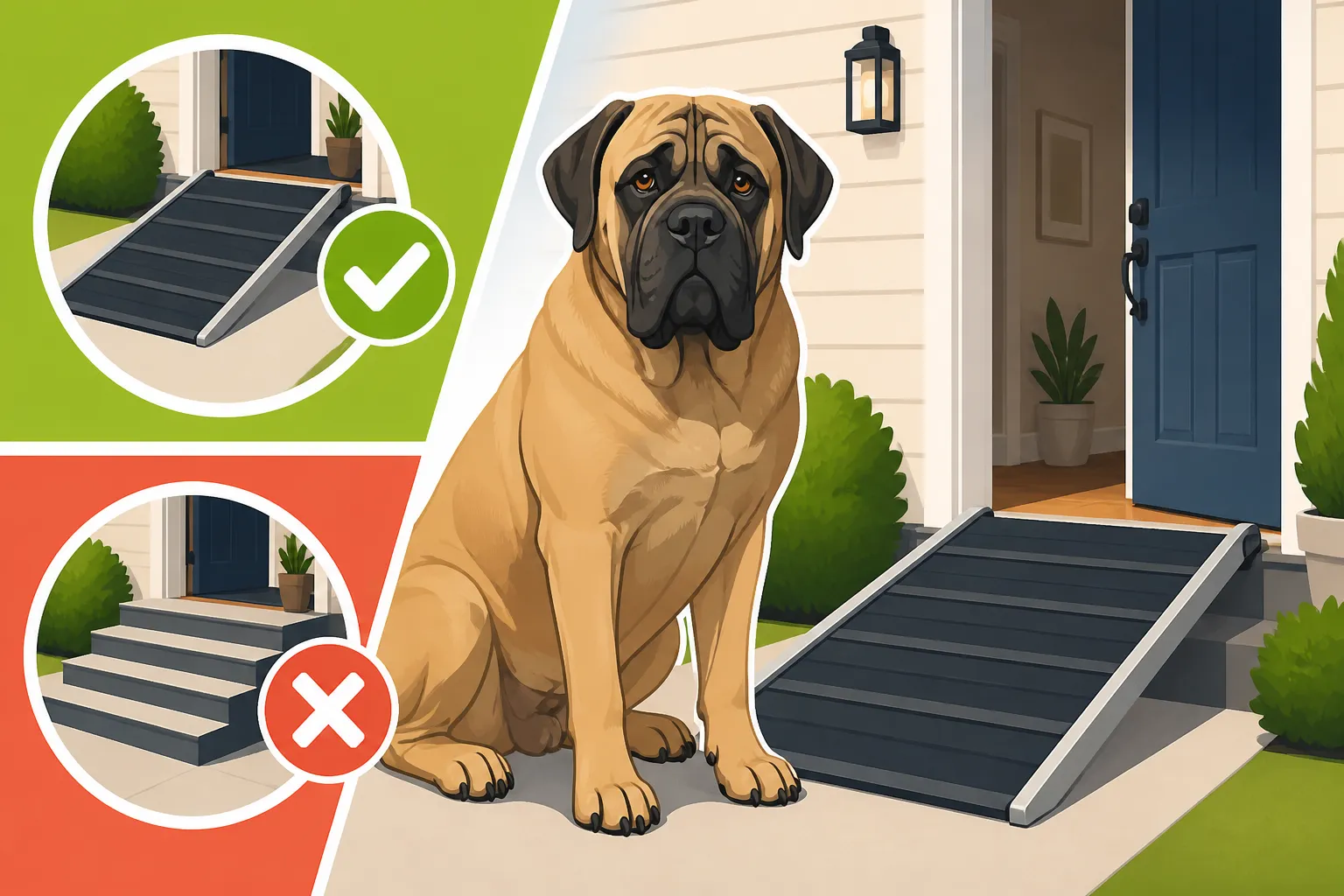
Consider all the places your Mastiff regularly enters and exits your home. Do you have a single step up to the back door? A multi-step porch leading to the front? Even a raised threshold can be an awkward hurdle for a Mastiff, particularly one with joint issues. What Bare Floors Do to a Growing Mastiff also applies here; a slick step can be terrifying and dangerous. The goal is to create seamless transitions that don't involve jumping up or down.
For homes with just a step or two, a sturdy, low-incline ramp might be sufficient. If you have a higher porch or several stairs, a longer ramp will be necessary to achieve a gentle slope. Short, steep ramps, while space-saving, can be just as difficult and potentially dangerous for a Mastiff as stairs themselves. The longer the ramp, the less steep the incline, which is always preferable for heavy dogs. Think about the path your Mastiff takes most often, perhaps the backyard door, and prioritize that area first. You might find you need more than one ramp for different areas of your home.
Vehicle Access: Cars, SUVs, and Trucks
Transporting your Mastiff is another area where ramps shine. Getting a full-grown Mastiff into an SUV or truck bed can be a real workout, and an accident waiting to happen. Forcing a Mastiff to jump can lead to strains, sprains, or even more severe injuries like cruciate ligament tears. Moreover, as your Mastiff ages, jumping becomes impossible, leaving you with the difficult task of trying to hoist them. Lifting an Old Mastiff That Cannot Get Up is a stark reality for many, and a vehicle ramp prevents this scenario entirely.
A portable ramp for your vehicle can be a game-changer for vet visits, trips to the park, or any adventure you share. When choosing a vehicle ramp, consider the height of your vehicle's cargo area, the space you have to deploy the ramp, and its weight capacity. Some ramps are specifically designed to fold compactly for easy storage in the car, while others might be more robust and better suited for a permanent setup if you frequently travel with your Mastiff in the same vehicle. Always practice using the ramp at home before your first real outing to ensure your Mastiff is comfortable and confident.
Preventative Care for Life
Even if your Mastiff is currently young and healthy, proactive use of a ramp can pay dividends over their lifespan. By minimizing the impact on their joints from puppyhood, you are actively working to preserve their mobility and potentially delay the onset of common Mastiff orthopedic issues. Think of it as an investment in their longevity and comfort, much like investing in a high-quality orthopedic dog bed.
This isn't just about avoiding injury; it's about fostering confidence. A Mastiff who learns to use a ramp from a young age will see it as a normal, safe part of their routine. This prevents the fear and anxiety that can develop in older dogs who suddenly find themselves unable to manage steps and are faced with a new, unfamiliar device. By integrating a ramp early, you're giving your Mastiff the tools for a lifetime of comfortable access.
Choosing the Right Ramp for Your Mastiff
Selecting the perfect ramp involves more than just picking the first one you see. You need to consider factors like material, length, weight capacity, and portability. The right ramp will be safe, durable, and comfortable for your Mastiff to use.
Material and Durability
Ramps come in various materials, each with its own benefits and drawbacks. Aluminum ramps are often lightweight, making them easier to maneuver and store, yet they're incredibly strong and durable. Plastic ramps can also be lightweight and are typically more affordable, but might not offer the same rigidity or longevity as metal options, especially under the immense weight of a Mastiff. Wood ramps are robust and can be attractive for fixed installations at home but are generally heavy and not portable.
The surface of the ramp is perhaps the most critical feature. It must provide excellent traction. Look for surfaces with high-grip textures, rubberized coatings, or even sandpaper-like finishes to prevent slips. A heavy dog like a Mastiff needs maximum stability underfoot, especially when going up or down an incline. Ramps marketed for very small dogs with smooth plastic surfaces are absolutely out of the question for a Mastiff. Imagine trying to walk up a slippery slide with an extra hundred pounds on your back – that’s what it feels like for them.
Length, Incline, and Weight Capacity
The length of the ramp directly correlates to its incline. A good rule of thumb for large, heavy breeds like Mastiffs is to aim for the lowest possible incline. For every foot of height you need to clear, you ideally want at least five feet of ramp length. So, if your SUV cargo area is two feet off the ground, you'd want a ramp at least ten feet long to achieve a gentle slope. While this might seem excessive, it minimizes strain on your Mastiff’s joints and makes them much more confident.
The weight capacity is non-negotiable. Your ramp must be rated to safely support your Mastiff's full adult weight, plus a generous buffer. A male Mastiff can easily exceed 200 pounds, with some reaching What a Mastiff Actually Weighs near 250 pounds or more. Skimping on weight capacity can lead to the ramp buckling, which is a terrifying and dangerous situation for both you and your dog. Always check the manufacturer's specifications carefully. When you're looking at options on sites like Chewy or Amazon, read reviews specifically mentioning large breed dogs to get a sense of real-world performance.
Portability and Storage
If you need a ramp for vehicle access, portability is key. Look for ramps that fold in half, telescope, or collapse into compact units. This makes them much easier to store in your car, truck, or garage when not in use. However, often the most portable ramps sacrifice some length or width, so it's a balance. A ramp that's too heavy or cumbersome for you to easily deploy won't get used.
For home use, you might prioritize a fixed, heavier ramp that can withstand the elements if it's outdoors. Indoor ramps can be lighter but should still be stable and non-slip. Consider where you will store the ramp when not in use. Do you have a spot in the garage, a utility closet, or will it need to remain deployed? Your practical storage solutions will influence your ideal ramp type.
Ramp Types Comparison
Here's a quick look at common ramp types and their suitability for a Mastiff:
| Ramp Type | Pros | Cons | Best Use Case |
|---|---|---|---|
| Folding Ramp | Folds in half for easier storage, often portable | Can still be bulky when folded, may have a seam in the middle | Vehicle access, moderate home steps |
| Telescopic Ramp | Slides down to a compact size, no middle seam | Can be heavier due to locking mechanisms, might have finger pinch points | Vehicle access, moderate home steps, slightly higher clearances |
| Bi-fold Ramp | Wider surface for stability, folds in half | Wider footprint, can be cumbersome to store | Vehicle access for very large dogs, wider home steps |
| Fixed/Modular Ramp | Most stable, customizable incline, permanent | Not portable, requires installation, often made of wood/heavy duty materials | Permanent home entry, deck access |
When browsing for options, you'll find plenty on online retailers. Always read reviews for experiences from other large breed owners. Many platforms provide comprehensive product descriptions and customer feedback, helping you make an informed decision about something as vital as What a Ramp Rated for a Mastiff Costs.
Training Your Mastiff to Use a Ramp
Introducing a ramp to your Mastiff requires patience, positive reinforcement, and a gentle approach. A Mastiff’s thoughtful nature means they might be hesitant about new, unstable-feeling surfaces. Never force them; build their confidence gradually.
The Power of Positive Reinforcement
Start by introducing the ramp on flat ground, not at an incline. Let your Mastiff sniff it, walk around it, and investigate it at their own pace. Use highly motivating treats – think delicious, high-value rewards – and praise to encourage any interaction with the ramp. Toss a treat onto the ramp, then a little further, slowly encouraging them to walk across it. What Actually Motivates a Mastiff is often food and affection, so lean into that!
Once they are comfortable walking on the flat ramp, introduce a very slight incline. Place one end on a low step, not your car. Keep sessions short and positive, ending before your Mastiff gets bored or frustrated. If they show any hesitation, go back a step. The goal is for them to associate the ramp with good things, not fear or anxiety. Consistency is key here. Practice regularly, even if it's just for five minutes a day.
Safety First: Non-Slip Surfaces and Stability
Before you even begin training, ensure the ramp is absolutely stable. Wobbly or shifting ramps will immediately erode your Mastiff's confidence and can be dangerous. Secure the ramp firmly against the surface it's resting on, whether it's your porch or your vehicle. Some ramps come with rubberized feet or safety latches to prevent movement.
Double-check the ramp’s surface. If it feels remotely slick, or if your Mastiff’s paws slide even slightly, consider adding anti-slip adhesive strips or a rubber mat. Their paws need to feel secure with every step. Remember, a Mastiff is heavy, and a slip on a ramp could lead to a serious injury. Their natural instinct is to be careful, and we want to reinforce that by making the ramp as safe as possible.
Integrating the Ramp into Daily Routines
Once your Mastiff is confidently using the ramp for a specific purpose, like getting into the car, make it a consistent part of that routine. Always use the ramp, even if you think you could manage without it. This reinforces the behavior and protects their joints. For example, if you always use the ramp for car rides, they will eventually see the ramp as the natural, expected way to get in, rather than waiting for you to try to lift them.
Consider installing permanent ramps for high-traffic areas at home, like a porch, if practical. If you have steps leading into a yard, for instance, a sturdy, fixed ramp can save countless impacts on their joints over the years. You might find yourself needing a few different solutions, perhaps a permanent ramp at the back door and a portable one for the car. Think about where your Mastiff needs help most, and prioritize those points of access. This careful approach to daily care can significantly impact their long-term well-being and is a small but mighty part of Caring for a Mastiff Past Five.
Disclaimer
This article is for general informational purposes only and does not constitute professional advice. Laws, prices and regulations vary by location and change over time. Consult a qualified professional for guidance on your specific situation.