How to Tell a Heavy Mastiff From a Fat One
It's a common dilemma for Mastiff owners: staring at your magnificent, undeniably massive dog and wondering, "Are you just naturally heavy, or have we let you get a little… portly?" With their incredible bone structure and sheer bulk, it can be genuinely challenging to discern if your Mastiff is at a healthy, lean weight or if they're carrying a few too many pounds. This guide is here to walk you through the subtle, and not-so-subtle, indicators to help you confidently tell the difference between a naturally heavy Mastiff and one that might benefit from a bit less on the dinner plate.
The Natural Bulk of a Mastiff: What "Heavy" Really Means
Mastiffs are, by definition, heavy dogs. This isn't just about their overall size; it's about the very architecture of their breed. They possess a substantial bone structure and a deep, broad chest that gives them a naturally imposing presence. Understanding this inherent "heaviness" is the first step in assessing your dog's true condition.
Breed Standard and Expected Weight
When we talk about a Mastiff being "heavy," we're often referring to their expected, healthy weight, which is significantly more than almost any other dog breed. These aren't delicate creatures; they are robust and powerfully built. An adult male Mastiff can easily weigh in the range of 160 to 230 pounds, sometimes even more, while females typically range from 120 to 170 pounds. This isn't just fat; it's dense bone, powerful musculature, and substantial organ weight. A lean Mastiff will still feel incredibly heavy when you try to budge them, simply because their framework is so solid. This impressive heft is a hallmark of the breed, a testament to their history and purpose. It's crucial not to confuse this natural, healthy mass with excess adipose tissue. You can learn more about what to expect with The Weight Range a Male Mastiff Should Hold and The Weight Range a Female Mastiff Should Hold.
The Difference Between Bone and Fat
To truly understand if your Mastiff is heavy or fat, you need to get hands-on. Imagine trying to feel the frame of a large, sturdy piece of furniture versus a beanbag chair. A lean, healthy Mastiff will have a solid, unyielding feel when you palpate their ribs, spine, and hip bones. You're feeling dense bone and firm muscle underneath a thin layer of skin and healthy coat. There's a certain firmness to their bulk.
Conversely, an overweight Mastiff will have a noticeable layer of soft, spongy tissue over these bony landmarks. It's like trying to feel the frame of that sturdy furniture through several layers of thick, plush blankets. Their natural deep chest and broad frame can sometimes make it tricky to spot excess weight visually, as the fat can distribute broadly across their body rather than creating obvious rolls. This is why the tactile assessment is so vital. You're looking for the substantial feel of bone and muscle, not the yielding softness of fat.
Feeling for Ribs and Hip Bones: The Hands-On Assessment
This is where the rubber meets the road, or rather, where your hands meet your Mastiff. Visual inspection can only tell you so much, especially with a breed designed for sheer mass. Learning to properly feel your dog's body condition is the most accurate way to assess their weight.
The Rib Test: A Reliable Indicator
The rib test is perhaps the most reliable, and often overlooked, method for determining if your Mastiff is at a healthy weight. Forget what the scale says for a moment; what your hands tell you is far more important.
Here's how you do it:
- Place your thumbs on your Mastiff's spine at their mid-back, just behind the shoulder blades.
- Spread your fingers down over their rib cage on both sides.
- Gently run your hands along their sides, applying light pressure, as if you're stroking them.
What you should feel on a healthy-weight Mastiff is the distinct, individual ridges of their ribs. You shouldn't have to press hard to find them, but they also shouldn't be visibly prominent like washboards. The sensation should be easy to feel, almost like feeling your knuckles when you gently clench your fist. There's a minimal, perhaps paper-thin, layer of fat over them.
If your Mastiff is overweight, you'll find yourself pressing harder and harder to detect those ribs. It will feel like trying to find small bumps beneath a thick, squishy blanket. The distinct ridges will be obscured by a generous cushion of fat, making them difficult or impossible to count or feel individually. This is a clear red flag. On the other hand, if your Mastiff is underweight, their ribs will be sharply visible and easily felt without any pressure, often making their skin feel loose over the bones. You can get more details on Feeling for a Mastiff's Ribs Under Its Bulk.
Assessing the Spine and Hip Bones
Beyond the ribs, checking the spine and hip bones provides further clues to your Mastiff's body condition. These areas are often key indicators of where fat accumulates or dissipates.
When you run your hands along your Mastiff's spine, you should be able to feel the individual bumps of the vertebrae with a little bit of pressure. They shouldn't be sharp or sticking out, but you should definitely be able to distinguish them. On an overweight Mastiff, the spine will feel like a smooth, unbroken line, completely cushioned by fat. It will be challenging, if not impossible, to discern the individual vertebrae.
Similarly, move your hands to their hip bones, located just in front of the tail. On a healthy Mastiff, you should be able to feel these prominent points without much effort, though they won't necessarily be sharp or poking out. There will be a slight, firm covering. When a Mastiff is carrying too much weight, these hip bones can become completely buried under fat, making the area feel rounded and broad rather than angular. If you can't easily locate these bony landmarks, it's a strong indicator that your Mastiff is carrying excess fat. This subtle loss of definition in key areas is a tell-tale sign that their "heaviness" is veering into "fatness."
Visual Cues Beyond the Scale: Observing Body Shape
While hands-on assessment is paramount, visual cues also play a significant role, especially when you know what to look for. A Mastiff's sheer size can trick the eye, but there are specific areas where excess weight becomes apparent, even on such a massive breed.
The Tucked Abdomen and Waistline
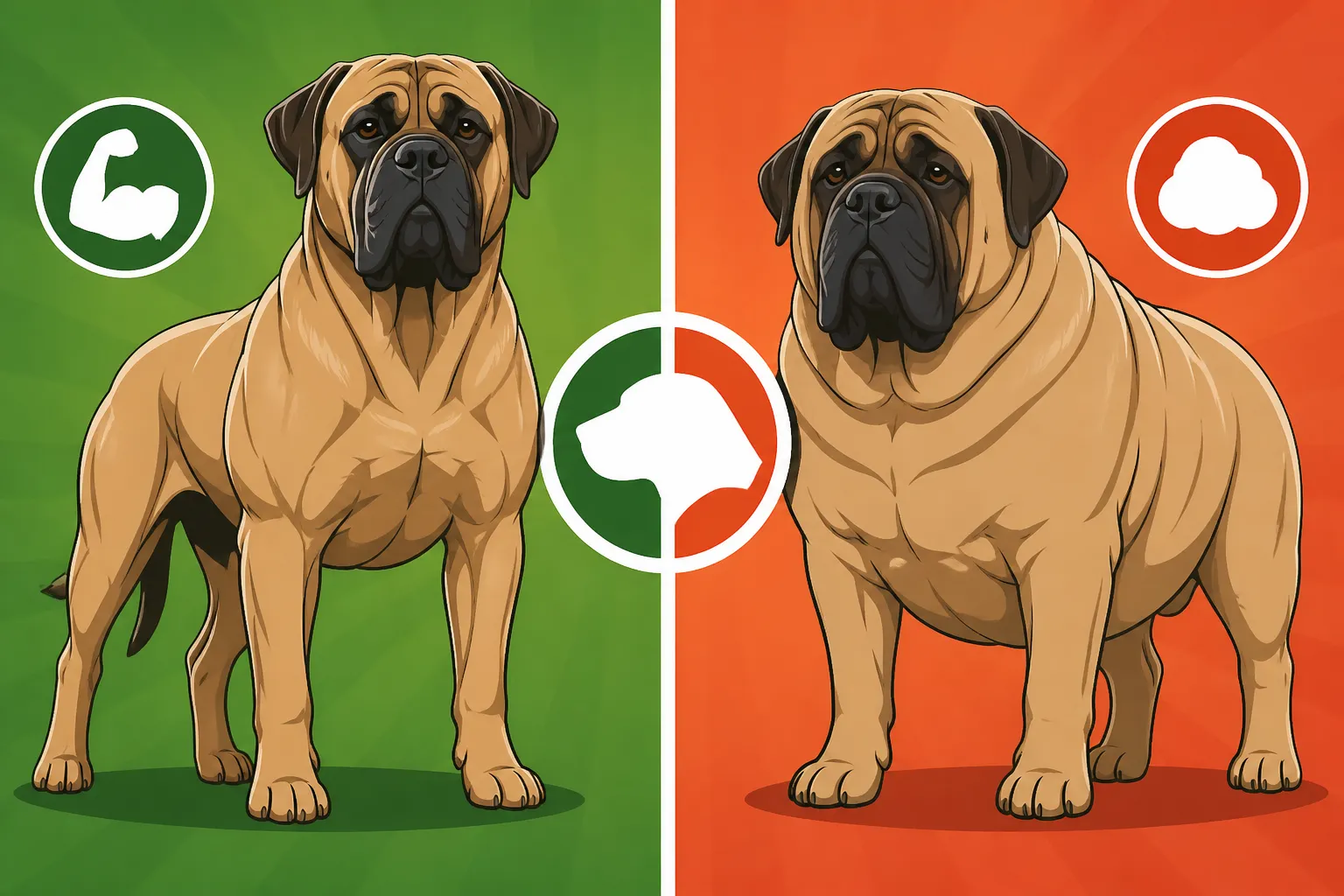
Even a Mastiff, with its massive frame, should possess a discernible waistline and a modest abdominal tuck-up. This isn't about looking like a svelte sighthound, but rather having a gentle curve, not a straight or bulging line.
To assess this, observe your Mastiff from two angles:
- From above: Stand over your Mastiff while they are standing squarely. Look down at their back. You should see a slight indentation or narrowing just behind their rib cage, before their hips. It won't be dramatic, but it should be present. An overweight Mastiff will typically appear more barrel-shaped, with little to no waist definition; their body will form a relatively straight line from their rib cage back to their hips, resembling a "loaf of bread" or a sausage.
- From the side: Watch your Mastiff in profile. Their belly line should gently rise from the bottom of their chest to their hind legs, creating a subtle "tuck." It shouldn't hang low or be distended. A fat Mastiff often has a straight or even sagging abdominal line, sometimes with a pronounced paunch. There's no athletic grace to the belly; it simply hangs.
These visual checks, combined with your tactile assessment, provide a comprehensive picture. If you can't spot even a hint of a waist or a slight tuck, it's highly probable your Mastiff is carrying more than just natural heft.
Muscle Definition and Overall Condition
A Mastiff, regardless of its size, should exhibit good muscle tone and definition. These dogs were historically bred for protection and strength, and that requires substantial, functional musculature. When a Mastiff is at a healthy weight, you should be able to appreciate the broad, powerful muscles over their shoulders and hindquarters. While not ripped like a greyhound, there should be a visible firmness and shape, particularly when they move.
An overweight Mastiff, however, tends to lose this definition. Their body becomes smoother, rounder, and less contoured. The muscles become obscured by a layer of soft fat, giving them a more uniformly bulky appearance rather than one of powerful, defined strength. You might notice a lack of spring in their step or a more cumbersome gait. Their movements might seem labored, and getting up from a lying position could require more effort. A Mastiff that is merely "heavy" will still move with a deliberate, powerful stride, indicative of the muscle mass supporting their frame. One that is "fat" will often move with less grace and more strain. Keeping your Mastiff lean on purpose helps to preserve this vital muscle structure and overall mobility. Keeping a Mastiff Lean on Purpose is absolutely paramount for their long-term health and comfort.
The Impact of Excess Weight on a Mastiff's Health and Longevity
The consequences of an overweight Mastiff extend far beyond aesthetics. For a giant breed with an already predisposed list of health concerns and a heartbreakingly short average lifespan, every extra pound is a burden that significantly impacts their quality of life and longevity.
Joint Stress and Mobility
This is perhaps the most immediate and devastating impact of excess weight on a Mastiff. These dogs are prone to orthopedic issues such as hip and elbow dysplasia due to their rapid growth and immense size. Adding even a few extra pounds puts enormous, unnecessary stress on their joints, accelerating the degeneration of cartilage and bone. Imagine carrying an extra 20-30 pounds on your own frame all day, every day; now multiply that burden for a dog already managing a naturally heavy load.
An overweight Mastiff will struggle more with mobility. Getting up from a lying position, climbing stairs, or even just walking can become painful and difficult. This reduced mobility often leads to a vicious cycle: pain discourages movement, which leads to more weight gain, which exacerbates the pain. It's a heartbreaking situation to watch a once-powerful Mastiff become a prisoner of its own body. Preventing obesity is a cornerstone of managing these inherent breed predispositions, such as Why a Mastiff's Hips Fail Under Its Own Weight and Elbow Dysplasia Affects One Mastiff in Seven.
Other Health Risks and Quality of Life
Beyond joint issues, being overweight significantly increases a Mastiff's risk for a host of other serious health problems. They are more susceptible to conditions like diabetes, heart disease, and certain types of cancer. The extra insulating layer of fat also makes them less tolerant to heat, increasing their risk of overheating during even moderate activity.
Perhaps one of the most frightening risks for a deep-chested breed like the Mastiff is bloat, or gastric dilatation-volvulus (GDV). While not directly caused by obesity, an overweight condition can contribute to overall lethargy and health issues that may complicate recovery or overall gut health. Bloat in the Deepest Chest of Any Breed: the Mastiff is a constant concern for owners, and maintaining a healthy weight supports their general well-being.
Tragically, Mastiffs already have a short lifespan, typically only Why a Mastiff Only Gets Six to Ten Years. Carrying excess weight can significantly shorten this already limited time. Studies have shown that Whether an Overweight Mastiff Dies Younger is a grim reality for many large and giant breeds. Every year, every month, every day counts with these magnificent dogs. By keeping them at a lean, healthy weight, you're not just improving their comfort; you're giving them the best possible chance at a longer, happier life. Consider what How Much an Adult Mastiff Eats by Weight Each Day and adapt as needed, and for older dogs, pay close attention to What Changes in an Old Mastiff's Bowl. If you find your Mastiff is indeed carrying too much, addressing Taking Weight Off a Mastiff That Barely Exercises will be crucial, often requiring professional guidance and a careful diet adjustment. Finding appropriate food and measuring cups can be a breeze on sites like Chewy or Amazon, while specialized fresh food options like Ollie might offer tailored nutrition plans if you're prepared for the volume.
Here's a quick comparison to help solidify your understanding:
| Feature | Healthy Heavy Mastiff | Overweight/Fat Mastiff |
|---|---|---|
| Ribs | Easily palpable with gentle pressure, not visible. | Difficult to feel, requires firm pressure, obscured by fat. |
| Spine | Individual vertebrae detectable with slight pressure. | Feels smooth and rounded, vertebrae indistinct. |
| Hip Bones | Easily palpable, firm covering, not overly prominent. | Buried under fat, area feels broad and rounded. |
| Waistline | Slight tuck visible from above, gentle rise from the side. | Barrel-shaped from above, straight or sagging from the side. |
| Muscle Tone | Firm, powerful musculature, good definition, moves deliberately. | Muscles feel soft and indistinct, movements often labored. |
| Energy Level | Playful and active within breed norms, gets up easily. | More sedentary, struggles to get up, less enthusiastic about play. |
| Coat/Skin | Healthy, elastic skin, minimal skin folds beyond breed standard. | More pronounced skin folds, potential for skin issues in folds. |
Disclaimer
This article is for general informational purposes only and does not constitute professional advice. Laws, prices and regulations vary by location and change over time. Consult a qualified professional for guidance on your specific situation.