The Weight Range a Male Mastiff Should Hold
It's incredibly common for Mastiff owners, especially those new to the breed, to feel a bit lost when it comes to their dog's weight. These magnificent giants are supposed to be big, but how big is too big, or not big enough? This guide will walk you through what a healthy weight truly looks like for a male Mastiff, helping you understand their unique needs and how to keep them thriving.
Understanding the Mastiff's Build: More Than Just "Big"
When we talk about a Mastiff, we're not just talking about a large dog; we're talking about a dog with a specific kind of large. They aren't meant to be lean and athletic like a sighthound, nor are they supposed to be round and chunky. It's a fine line to walk, and often, what people perceive as "healthy" for a Mastiff can actually be detrimental to their long-term health. The sheer scale of these dogs means that every extra pound puts significant stress on their joints, heart, and other organs.
The Gentle Giant's Frame
A male Mastiff's build is fundamentally heavy-boned and muscular, designed for power and presence rather than speed or agility. Their deep chests, broad shoulders, and substantial hindquarters speak to their heritage as guardians. When you look at your Mastiff, you should see a dog with a robust frame. This isn't just about their overall size, but how that size is distributed. You shouldn't see extreme definition, but rather a smooth, powerful outline. A Mastiff's body should convey strength and substance, not a delicate, lithe form. Understanding this foundational structure is key to evaluating their weight.
Many new owners might see a slightly underweight Mastiff and worry, trying to "fatten them up," when in reality, that leaner body might be far healthier. Conversely, an overweight Mastiff might just be seen as "big and cuddly," masking serious health risks. It's a common misconception that more weight equals more impressive, but for a Mastiff, it's quite the opposite in terms of health and longevity.
Why Visual Cues Matter More Than the Scale Alone
While the scale gives you a number, it doesn't tell the whole story for a Mastiff. Their sheer size means that a few pounds up or down can be significant for a smaller breed but might not drastically change a Mastiff's overall health picture. What's far more important is their body condition score (BCS), which relies on visual and tactile assessment. Two Mastiffs weighing the exact same might have vastly different body compositions – one could be lean and muscular, the other carrying too much fat.
Think of it like this: if you have a 200-pound male Mastiff, and he gains 10 pounds, that's only a 5% increase. For a smaller dog, that could be a huge percentage gain. This is why relying solely on a number can be misleading. A vet will always use BCS alongside the scale weight. They'll look at your dog's profile, feel their ribs, and check their waistline. These physical assessments provide a much more accurate picture of their health than a simple number on a scale. It's crucial for owners to learn how to do this simple assessment at home regularly.
The Ideal Weight Range for a Male Mastiff
So, what exactly is the target? It's not a single, hard-and-fast number, but rather a healthy range that allows for individual variation in genetics, bone structure, and muscle mass. Generally, a healthy adult male Mastiff will fall into a specific weight bracket, but it’s always accompanied by a proper body condition.
Puppyhood to Adulthood: A Journey of Growth
A male Mastiff's weight journey begins as a tiny, rapidly growing pup and continues for quite some time. They don't finish growing until much later than most breeds, often continuing to fill out until they are two or even three years old. During puppyhood, controlled growth is paramount. Overfeeding a Mastiff puppy, especially with high-calorie or inappropriate protein levels, can lead to serious developmental orthopedic issues like hip and elbow dysplasia. You want slow, steady growth, not rapid bulk. You can learn more about this by reading The Feeding Chart a Mastiff Puppy Should Follow.
- Puppy Phase (0-12 months): Expect exponential growth, but it's vital to keep them lean. A male Mastiff puppy should gain weight consistently but should never look fat or overly padded. You should always be able to feel their ribs easily. This period is delicate, and managing their diet is key to preventing future problems. Don't push for maximum size too soon; it actually harms their adult frame.
- Adolescence (12-24 months): They continue to grow in height and length, but they really start to fill out. Muscle mass increases, and they begin to achieve that characteristic Mastiff substance. Their weight will steadily climb, but again, aim for lean growth. Their frame is still developing, and excess weight places undue stress. You might notice them getting taller and then, almost suddenly, wider.
- Adulthood (24-36+ months): While much of their height is reached by 18-24 months, they often continue to "mature" and add muscle and chest depth until three years old. This is when they truly reach their adult weight. The goal here is to maintain a healthy, stable weight through proper nutrition and moderate exercise.
A fully mature, healthy male Mastiff typically weighs between 160 and 230 pounds (72-104 kg). Some might be slightly above or below this, depending on their individual lineage and height, but this range is a solid guideline for a dog with a proper body condition score. It’s important to remember that pushing for the absolute heaviest weight can severely shorten their already precious Six to Ten Years Is What a Mastiff Gets.
Factors Influencing a Male Mastiff's Healthy Weight
Several elements play a significant role in where your male Mastiff falls within that healthy weight range:
- Genetics and Lineage: Just like people, some Mastiffs are naturally larger-boned and more substantial than others. If your Mastiff comes from a line of smaller, leaner dogs, it's unlikely he'll reach the upper end of the weight spectrum healthily. Conversely, a Mastiff from a line of very large dogs might naturally be at the higher end. A good breeder will be able to show you the parents and even grandparents, giving you an idea of the genetic potential for size.
- Age: As mentioned, puppies and adolescents will weigh less, with their weight steadily increasing until full maturity at around three years. An older Mastiff, particularly if activity levels decrease or health issues arise, might naturally lose some muscle mass, which can affect their overall weight. Conversely, an older, less active Mastiff can easily pack on pounds if their diet isn't adjusted.
- Activity Level: A Mastiff that gets consistent, moderate exercise will have more lean muscle mass than one who is largely sedentary. While Mastiffs are not marathon runners, regular short walks and playtime are important. Why One Hour a Day Is Enough for a Mastiff clarifies their exercise needs. A working Mastiff, if such a role is appropriate, might also carry more muscle and therefore more weight.
- Diet and Nutrition: The quality and quantity of food are paramount. Feeding a high-quality, large-breed specific formula that supports their joint health and controlled growth is essential. Portion control is vital; Mastiffs, despite their size, can easily become overweight if overfed. Consulting your vet on the best diet and portion sizes for your individual dog is always a smart move. Many owners find value in specialized giant breed formulas, available from retailers like Chewy, which are formulated to meet these specific needs.
- Health Conditions: Underlying health issues can certainly impact weight. Conditions like hypothyroidism can lead to weight gain, while dental problems, digestive issues, or certain cancers might cause weight loss. Regular veterinary check-ups are crucial to catch these issues early.
Assessing Your Mastiff's Body Condition Score
Forget the absolute number on the scale for a moment; the most reliable way to know if your Mastiff is at a healthy weight is to assess their Body Condition Score (BCS). This is what your vet does, and it's a skill every Mastiff owner should master. It involves looking and feeling.
The Rib Test: A Hands-On Approach
This is often the first and most critical step in assessing your Mastiff's condition. You should be able to easily feel, but not necessarily see, your Mastiff's ribs.
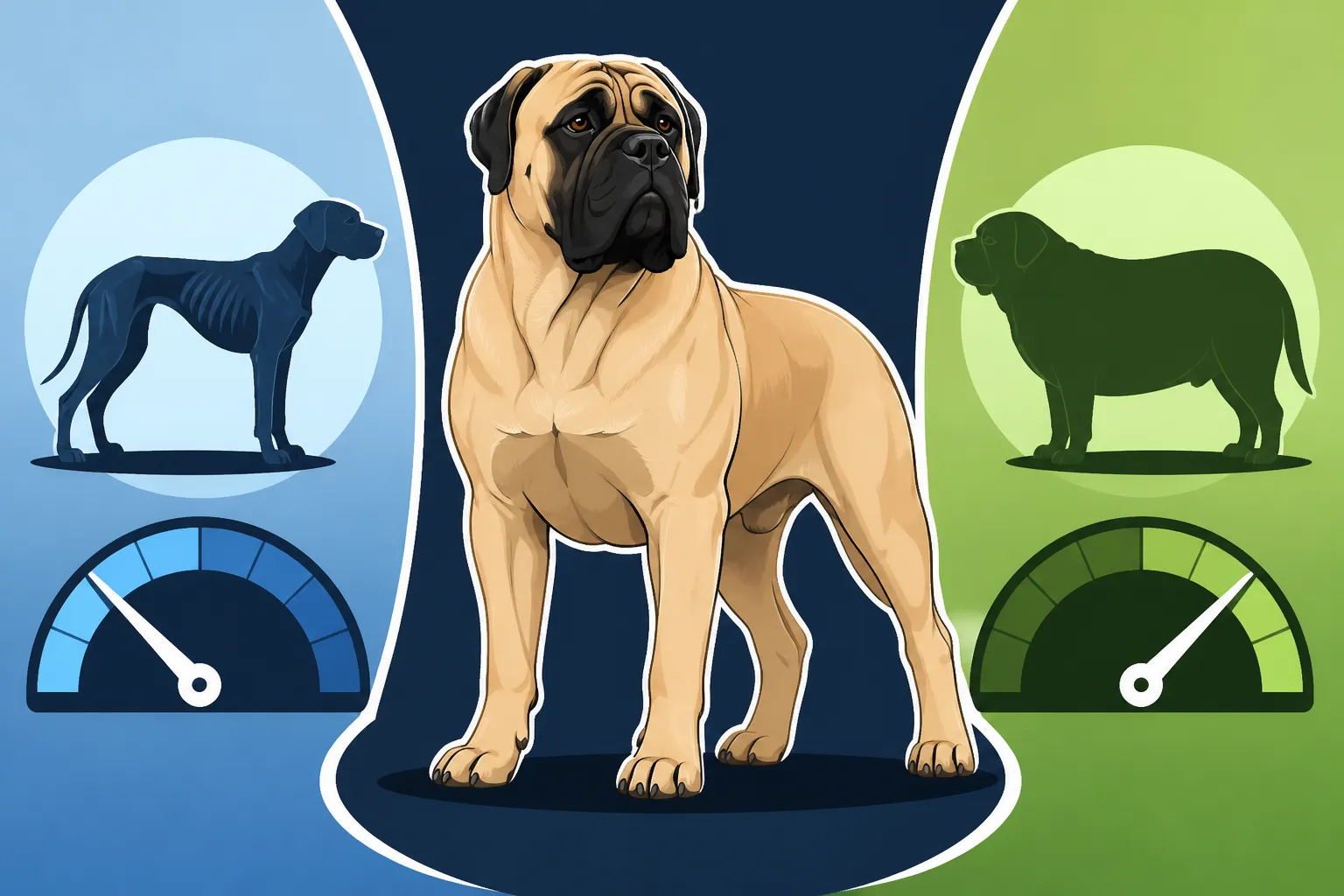
- Ideal Condition: Gently run your hands along your Mastiff's sides. You should be able to feel each rib bone distinctly, without pressing hard. It should feel like there's a thin layer of fat and muscle covering them, similar to feeling the back of your hand. You shouldn't see individual ribs clearly protruding (unless they've just inhaled deeply or are stretching), but you also shouldn't have to push through a thick layer of fat to find them.
- Overweight: If you have to press firmly to feel the ribs, or if you can't feel them at all, your Mastiff is likely carrying too much weight. This extra padding is often most noticeable over the ribs and along the spine.
- Underweight: If the ribs are visibly prominent, sticking out sharply, or if there's no noticeable padding over them, your Mastiff is too thin. This could indicate insufficient food intake, a medical condition, or perhaps they're simply not filling out as expected.
Remember, a slightly lean Mastiff is almost always healthier than a slightly overweight one, especially concerning their joints. It’s a common goal for responsible Mastiff owners to keep them on the leaner side of healthy. This is why practices like Keeping a Mastiff Lean on Purpose are so important.
The Waistline and Tummy Tuck
Beyond the ribs, look at your Mastiff's overall profile.
- From Above: When looking down at your Mastiff from above, you should see a discernible waistline. It might not be as dramatic as in a sighthound, but there should be a gentle inward curve behind the rib cage, just before the hips. If they look like a continuous barrel from shoulders to tail, they're likely overweight.
- From the Side: Look at their belly. There should be a slight "tuck up" where the abdomen rises from the bottom of the rib cage to the groin. It shouldn't be a dramatic tuck, but the belly shouldn't hang low or be parallel to the ground like a straight line from chest to hind legs. If their belly sags or appears rounded, it's a sign of excess abdominal fat.
The Mastiff's massive build can sometimes mask these cues, making it harder to spot issues without regular checks. A useful tool is the Body Condition Score chart, which provides visual examples, often on a 1-5 or 1-9 scale, to help you determine where your dog fits. Comparing your dog to such a chart, available from many veterinary resources or online retailers like Amazon, can be very enlightening.
Maintaining a Healthy Weight for Your Male Mastiff
Achieving and maintaining a healthy weight for your male Mastiff is a lifelong commitment that involves consistent effort in several key areas. It's not just about what they eat, but how they live.
Nutrition Tailored for Giants
Feeding a Mastiff isn't simply about volume; it's about balance and quality. Their diet needs to support their immense size without promoting rapid, unhealthy growth in puppies, or excessive fat accumulation in adults.
- High-Quality Large Breed Food: Invest in a premium large-breed specific dog food. These formulas are often designed with moderate protein and fat content, along with appropriate calcium and phosphorus levels to support bone health in growing giants. Overfeeding a puppy protein or calcium can lead to orthopedic problems. For adult Mastiffs, these foods provide the necessary nutrients for maintenance without excessive calories.
- Portion Control is Key: Free-feeding a Mastiff is generally not recommended. Measure their food according to the guidelines on the food bag, adjusting based on their activity level and individual metabolism. Your vet can give you specific calorie recommendations. Split their daily ration into two or even three meals to prevent bloat, a life-threatening condition for deep-chested breeds like Mastiffs. Retailers like Chewy offer a wide array of giant breed foods, and even fresh food options like Ollie are designed with nutritional balance in mind, though their volume for a Mastiff can be substantial. You can delve deeper into daily food needs by reading How Much an Adult Mastiff Eats by Weight Each Day.
- Limit Treats and Table Scraps: Treats should be given sparingly and ideally be healthy options. Avoid feeding human food, which can be high in calories, fat, and ingredients harmful to dogs. If you do give treats, factor them into their daily calorie intake.
- Consider Supplements: Discuss joint supplements with your vet, especially as your Mastiff ages. Glucosamine and chondroitin can help support joint health, which is critical for a dog carrying so much weight. Omega-3 fatty acids are also beneficial.
Appropriate Exercise Without Overdoing It
Mastiffs are not endurance athletes, and their exercise needs are unique. Too much, especially in puppyhood, can be just as damaging as too little.
- Moderate, Regular Activity: Adult Mastiffs benefit from consistent, moderate exercise. Daily walks of a reasonable length, along with some playtime in a securely fenced yard, are usually sufficient. Avoid long-distance running, intense jumping, or activities that put excessive strain on their joints. Think leisurely strolls, not marathons. You can find more specific guidance in Why a Mastiff Puppy Must Not Be Exercised Hard.
- Heat Management: Mastiffs, due to their sheer bulk and sometimes shorter muzzles, can overheat easily. Always exercise them during cooler parts of the day and ensure they have access to plenty of fresh water.
- Mind the Surfaces: Hard, slippery surfaces like tile or hardwood floors can be challenging for Mastiffs, especially as they age, increasing the risk of slips and falls. Providing rugs or runners can help.
Regular Veterinary Check-ups and Monitoring
Your veterinarian is your best partner in managing your Mastiff's health and weight.
- Scheduled Exams: Regular check-ups allow your vet to monitor your Mastiff's weight and body condition, catch any potential health issues early, and adjust their diet or exercise recommendations as needed. They can also provide a professional opinion on your dog's The Age a Mastiff Finishes Filling Out and general development.
- Open Communication: Don't hesitate to discuss any concerns you have about your Mastiff's weight, appetite, or activity level with your vet. They can rule out underlying medical conditions that might be affecting their weight.
- Lifelong Commitment: Maintaining a healthy weight is a continuous effort. As your Mastiff transitions from a boisterous adolescent to a serene senior, their needs will change. Being proactive and adaptable ensures they live the longest, healthiest, and most comfortable life possible.
Disclaimer
This article is for general informational purposes only and does not constitute professional advice. Laws, prices and regulations vary by location and change over time. Consult a qualified professional for guidance on your specific situation.