How Far Mastiff Numbers Fell After the First World War
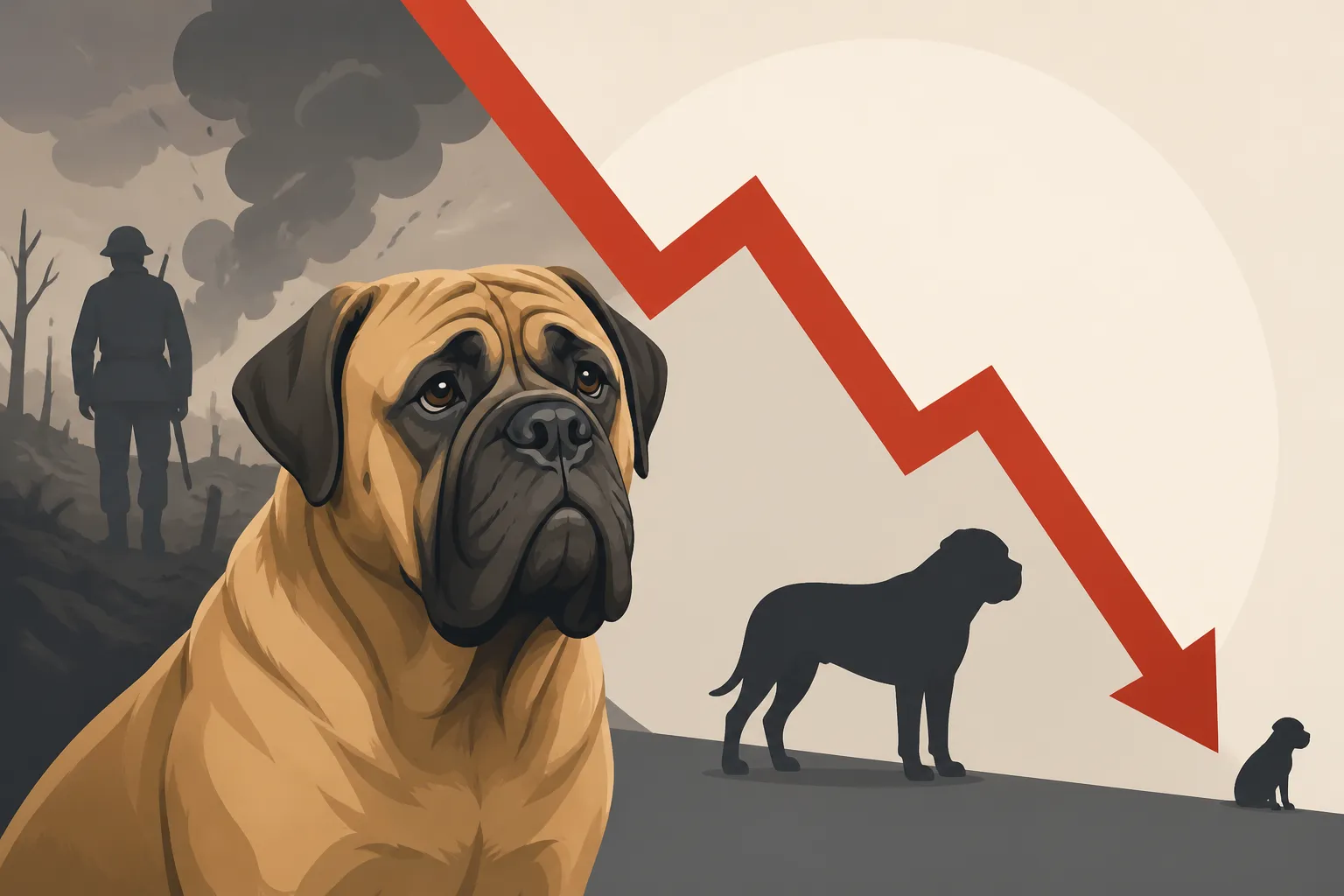
The First World War put real pressure on Britain’s Mastiff population, but there is no dependable census showing exactly how many dogs were lost or what percentage numbers fell. The clearest answer is that breeding and registrations were disrupted, while the breed’s later near-extinction is more strongly associated with the Second World War and its food shortages.
What we can say about Mastiff numbers after the First World War
There is no reliable percentage decline
It is tempting to look for a neat figure: a number of Mastiffs before 1914, another just after 1918, and a percentage decline between them. But the historical record does not provide a trustworthy population census that supports that calculation. Kennel registrations can show whether fewer dogs were being recorded, but they are not the same thing as counting every living Mastiff in Britain.
That distinction matters. A dog might not be registered, a litter might not be recorded consistently, and wartime records may be incomplete. Registration figures also measure breeding activity as much as they measure the number of dogs still alive. A downturn in registrations can signal that fewer litters are being produced without telling us exactly how many adult Mastiffs remain in homes and kennels.
So the most responsible answer is not that the breed lost a particular percentage. It is that the First World War interrupted the conditions that supported breeding, but the available evidence does not establish a precise, nationwide numerical fall.
War made breeding harder, even without a single documented count
Mastiffs are large dogs, and keeping them requires room, food, and money. During wartime, those resources become harder to spare. Owners may have had less time for kennel work, fewer opportunities to plan litters, and more urgent demands on household budgets. Food shortages and rising costs could make it difficult to maintain a large dog, let alone several breeding animals.
Those pressures do not have to eliminate a breed immediately to change its future. If fewer litters are bred for several years, there are fewer young dogs to replace older ones. If breeders are separated, leave the work, or lose access to particular dogs, the number of available breeding choices can narrow. Even when some Mastiffs survive, a smaller breeding pool can leave the breed more vulnerable to the next crisis.
The First World War should therefore be understood as a period of disruption, not as a clearly measured one-time population crash. For more background on the breed’s longer history, How the Mastiff Was Bred Away From Fighting explores how its role changed over time, while How Narrow the Mastiff Gene Pool Is helps explain why a relatively small breeding population can matter beyond its head count.
Why the First World War is not the whole near-extinction story
The Second World War brought a more severe crisis
When people describe the Mastiff as having come close to disappearing, they are usually referring to the Second World War and its aftermath. Food rationing and shortages made it especially difficult to feed large dogs, and maintaining a breeding kennel could become an unrealistic burden. The breed’s survival was then threatened not simply by lower interest in breeding, but by the practical problem of keeping very large animals alive during severe scarcity.
That later crisis is often described in dramatic shorthand, but the exact figures depend on what is being counted and which records are used. A number referring to registered dogs, known breeding animals, or dogs remaining in one country may not mean the same thing as a count of every living Mastiff. It is wise to treat sweeping claims about a precise surviving population with care.
The First World War weakened the conditions around breeding; the Second World War created a more acute survival problem. Those events belong in the same long history, but they should not be collapsed into one claim that the breed nearly vanished immediately after 1918. The related histories Why Food Shortages Nearly Ended the Mastiff and Why Mastiffs Were Euthanized During Rationing focus on the later food crisis and its consequences.
The dates and the causes should not be mixed together
A common source of confusion is that accounts of the breed’s near-extinction sometimes jump from one war to the other without explaining the gap. That can make it sound as if Mastiff numbers fell to a tiny handful right after the First World War. The evidence supports a more careful distinction: the First World War disrupted breeding, while the much more severe population emergency is associated with the Second World War.
It also helps to separate a fall in registrations from a fall in living dogs. A registry may show fewer litters or fewer recorded puppies during a difficult period. That is meaningful evidence of reduced breeding activity, but it cannot by itself prove the exact number of dogs that died or the total size of the population.
| Question | What the historical record can support | What it cannot establish by itself |
|---|---|---|
| Did the First World War disrupt Mastiff breeding? | Wartime conditions made breeding and keeping large dogs more difficult | The exact number of Mastiffs lost |
| Did registrations reflect every Mastiff alive? | Registrations can indicate recorded breeding activity | A complete count of registered and unregistered dogs |
| Was the breed’s most severe survival crisis after the First World War? | The more widely recognized near-extinction crisis is tied to the Second World War | A precise percentage decline from 1914 to 1918 |
| Did the Mastiff recover through breeding after the later crisis? | Breeders in Britain and North America helped rebuild the population | That modern Mastiffs are genetically identical to every prewar line |
For the wartime story after 1918, Fewer Than Twenty Mastiffs Survived the Second World War and How Many Mastiffs Were Left in Britain in 1945 address the period most often associated with the breed’s sharpest survival threat. Their subject is different from the First World War, even though both conflicts affected the breed.
How to interpret historical population claims
A registration total is not a census
Kennel club records are useful, but they answer a narrower question than many readers expect. They can tell us how many dogs were entered into a registry or how many litters were recorded in a given period. They do not necessarily tell us how many Mastiffs lived in Britain, how many were kept outside the registry, or how many dogs were no longer used for breeding.
That limitation becomes more important during periods of upheaval. Records may be interrupted, owners may not prioritize paperwork, and breeding may take place on a smaller scale. A low registration total can reflect a genuine decline in breeding, incomplete reporting, or both. Without additional evidence, it should not be converted into a confident population percentage.
A careful historical account therefore distinguishes between three things: the number of Mastiffs alive, the number available for breeding, and the number of puppies officially recorded. These figures can move in the same direction, but they are not interchangeable. When a source says that only a small number of dogs remained, check whether it is describing registered animals, known breeding stock, or a broader population estimate.
The breeding pool can shrink faster than the visible population
A breed can still be seen in homes while its future becomes fragile. If only a limited number of dogs are used for breeding, the effective breeding population may be much smaller than the number of living dogs. That matters because breeders have fewer unrelated pairings to choose from, and the loss of even a few important animals can narrow options further.
This is one reason population history is more complicated than simply asking how many dogs were alive at the end of a war. A Mastiff kept as a companion might survive, but not contribute to the next generation. Conversely, a small number of breeding animals may have an outsized effect on the breed’s later direction if they produce many descendants.
The postwar rebuilding story also involved dogs and breeders on both sides of the Atlantic. The American Kennels That Sent Mastiffs Back to Britain and How American and Canadian Dogs Rebuilt the Mastiff describe that transatlantic contribution. The rebuilding helped restore numbers, but rebuilding a population does not automatically mean restoring every line or every trait that existed before a crisis.
What the First World War decline means for the breed today
A population rebound does not erase a genetic bottleneck
When a breed recovers in numbers, it can look secure again. But population size and genetic breadth are different measures. If many later dogs descend from a limited group of survivors, the number of registered Mastiffs may rise while some lines remain underrepresented or absent. That does not mean every modern Mastiff has the same ancestry, but it does show why a simple “the breed recovered” statement leaves out important detail.
For breed history, the question is not only whether Mastiffs returned to kennels and show rings. It is also how they were rebuilt, which dogs contributed to later generations, and what diversity remained. How the Modern Mastiff Differs From the Prewar Type offers a useful companion topic for readers interested in how a breed can change after major population disruptions.
This distinction is relevant to responsible breeding now, too. Historical losses cannot be undone, but breeders can pay attention to health, temperament, and the breadth of the dogs they choose to pair. A larger number of registrations alone does not guarantee that a population is thriving in every meaningful sense.
The fairest answer is a qualified one
So, how far did Mastiff numbers fall after the First World War? The evidence supports saying that war disrupted breeding and likely reduced the number of litters and registered dogs. It does not support a confident, exact percentage drop in the total Mastiff population. Claims that imply a precise post-1918 count should be treated cautiously unless they clearly explain what was counted and where the figure came from.
The breed’s most severe and widely discussed population emergency came later, during the Second World War, when food shortages made keeping and breeding giant dogs exceptionally difficult. That later crisis is the source of many of the strongest survival claims. Keeping the two wars distinct gives a more accurate picture: the First World War strained the breed, and the Second World War brought a far more dramatic threat to its continued existence.
Disclaimer
This article is for general informational purposes only and does not constitute professional advice. Laws, prices and regulations vary by location and change over time. Consult a qualified professional for guidance on your specific situation.