The American Kennels That Sent Mastiffs Back to Britain
After the Second World War, Britain’s Mastiff population had fallen so sharply that rebuilding the breed required help from abroad. American-bred dogs contributed to that recovery, but the story is less tidy than a list of famous kennels: surviving accounts often focus on individual dogs, pedigrees and imports rather than a complete roster of U.S. breeders.
Why Britain Needed Mastiffs From America
War and rationing left the British breed vulnerable
The British Mastiff population was already small before the war. During wartime, food shortages, upheaval and the practical difficulty of keeping very large dogs made breeding especially difficult. A Mastiff needs more space and food than many breeds, and those demands became harder to meet when resources were scarce. The result was a severely reduced population and a narrow base from which to rebuild.
Historical accounts commonly describe fewer than twenty Mastiffs surviving in Britain after the war. That figure conveys the scale of the crisis, but it should not be treated as a precise count of dogs that were all healthy, fertile or suitable for breeding. A dog surviving the war did not automatically represent a viable breeding line. See Fewer Than Twenty Mastiffs Survived the Second World War for more on the scale of the decline.
This was a genetic problem as well as a numbers problem. When only a small number of dogs remain, breeders have fewer choices for pairings, and close relationships between prospective mates become harder to avoid. American and Canadian imports helped widen the options available to British breeders. They were part of a broader recovery effort, not a simple replacement of one population with another.
North American dogs offered a lifeline, not a complete reset
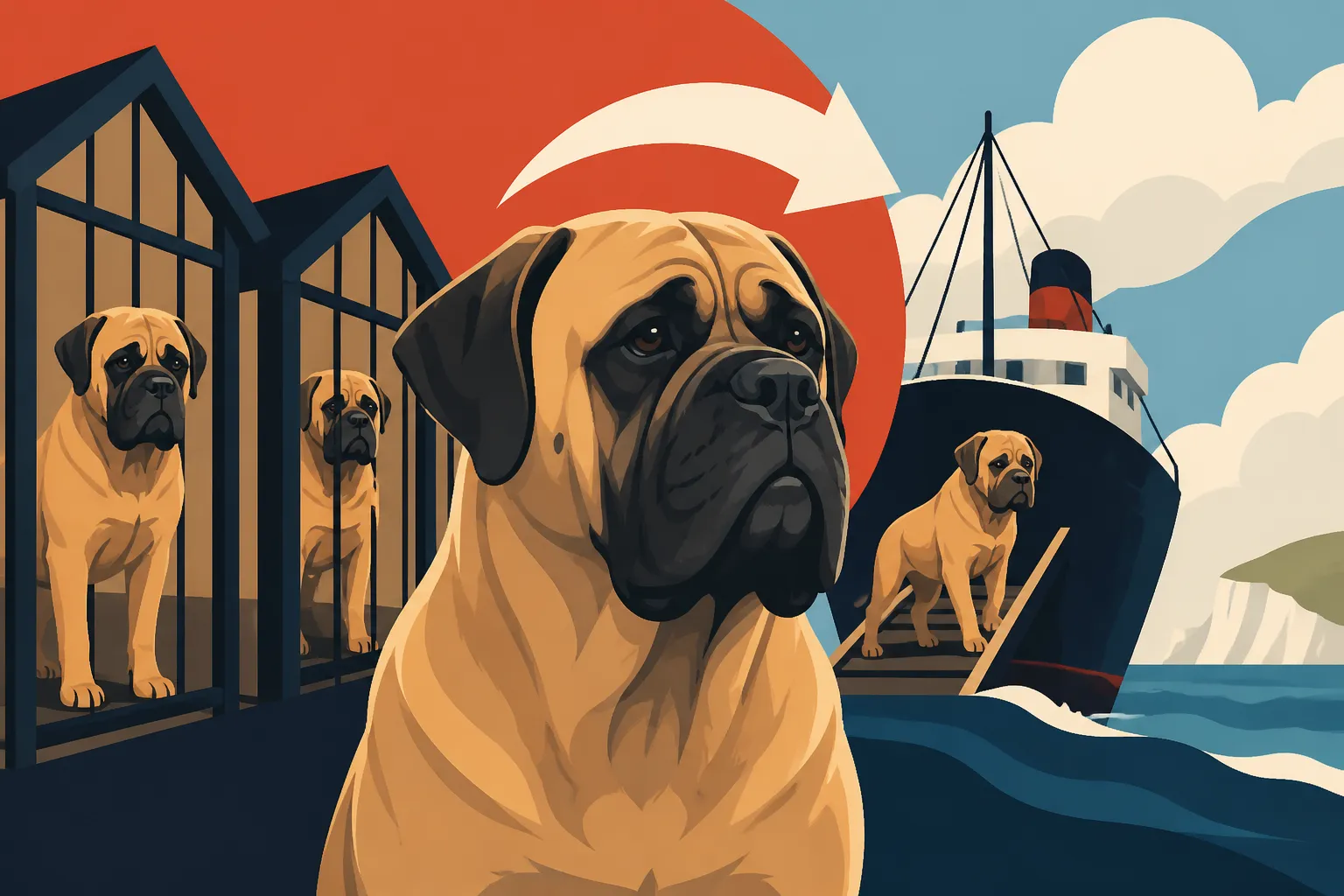
Mastiffs had already been bred in North America for generations, so breeders there could provide dogs with useful bloodlines when Britain’s population was depleted. Imports gave British breeders additional animals to consider and, in some cases, brought in ancestry not readily available at home.
That does not mean American dogs alone rebuilt the British Mastiff. Canadian dogs also contributed, and British breeders continued working with the dogs and lines that had survived locally. The recovery was a gradual effort involving available animals, breeding choices and the exchange of dogs across borders. How American and Canadian Dogs Rebuilt the Mastiff looks at that wider contribution.
It is also worth separating the idea of “sent back” from the idea of a coordinated national program. Individual breeders and owners could arrange an export or lend a dog for breeding; clubs could encourage cooperation; and the receiving breeder made decisions about how an imported dog fit into a particular line. Those are related actions, but they are not the same thing as one kennel organization sending a formal team of dogs to Britain.
What We Can Say About the American Kennels
Why a definitive kennel roster is difficult to give
The question “Which American kennels sent Mastiffs back to Britain?” sounds as if there should be a straightforward list. In practice, the historical record is often easier to follow through individual dogs and their pedigrees than through a complete, verified list of American kennel names.
A kennel name is not necessarily the name of a company or a formal institution. It can be a prefix or suffix used in a registered dog’s name, and a dog might be bred by one person, owned by another, and exported through a third. An American kennel name in a British pedigree may identify where a dog was bred, but it does not, by itself, prove that the kennel arranged a postwar export or took part in a coordinated rescue effort.
There is another complication: a British pedigree may show an imported dog’s registered name without preserving the full story of who selected it, paid for its transport, or negotiated its use in a breeding program. Meanwhile, a kennel that helped privately may be less visible in later summaries than a breeder whose dogs left a clearer paper trail. This is why a confident roster should be based on pedigrees and import records, not on a kennel name that merely sounds familiar.
How to identify a kennel responsibly
A useful starting point is the name of a specific Mastiff recorded as American-bred or imported into Britain. From there, trace the dog’s pedigree and registration details. Look for the breeder’s name, the kennel prefix, the owner at the time of export, the country of birth and any notes about importation. These details can help distinguish a true American-bred dog from a British-born dog with American ancestors several generations back.
Then compare the pedigree with the historical claim you are trying to check. A dog may appear in a British line because it was imported after the war, but that alone does not tell you whether its breeder deliberately sent it to support recovery, whether a British breeder bought it independently, or whether it arrived later. The distinction matters if the goal is to credit a particular kennel accurately.
| Record detail | What it can help establish | What it does not prove on its own |
|---|---|---|
| American breeder or kennel prefix | Where a dog was bred or registered | That the breeder arranged its export |
| British pedigree listing an import | That a dog from abroad entered a British line | The full purpose or circumstances of the import |
| Import or registration record | The dog’s movement or registration history | Its eventual influence on the breed |
| Descendants in British pedigrees | That the dog contributed to later breeding | That the line remained genetically distinct |
| A club or breeder’s historical account | How participants described the effort | A complete list of every dog or kennel involved |
For a reader researching a particular kennel, the safest wording is specific: name the dog, give the evidence that connects it to the kennel, and describe the kennel’s contribution only as far as that evidence supports. That approach may feel less dramatic than crediting a handful of celebrated names, but it avoids turning an incomplete record into false certainty.
How Imports Changed British Mastiff Breeding
A dog’s contribution is measured through its descendants
An imported Mastiff could matter in several ways. It might be bred directly to a surviving British dog, contribute a line that breeders used over several generations, or add traits that were valued in a particular mating. But the fact that an imported dog entered Britain does not automatically mean that it had a lasting impact. Its influence depends on whether it bred, whether its offspring were retained, and whether descendants continued into later pedigrees.
This is one reason an imported dog can be historically significant even when its kennel is not widely remembered. Breed histories often preserve the dog’s name and descendants more consistently than details about the kennel’s day-to-day role. To understand the lasting effect, it helps to examine pedigrees across multiple generations rather than focus only on the first cross. Which British Mastiff Lines Survived Unbroken provides useful context for the lines that remained in Britain through the disruption.
The process also required judgment. Breeders were not simply looking for the biggest dog or the most impressive photograph. They needed to consider temperament, soundness, type, health and how a particular animal complemented the dog they already had. In a population that had become small, every pairing had added importance. An imported dog could expand options, but responsible breeding still depended on the quality of the individual and the compatibility of the match.
Recovery did not preserve a frozen prewar type
A population rebuilt from a limited number of survivors and overseas imports will not necessarily look exactly like the population that existed before the war. Breed type changes over time, and the available dogs influence which traits are passed forward. Imports can introduce variation, but later selection also shapes which characteristics become more common.
That does not mean the modern Mastiff is simply an American dog transplanted into Britain. British breeders had their own goals, preferences and surviving lines, and North American dogs were part of a shared breeding history. It is more accurate to think of postwar recovery as a meeting of lines, with breeders on both sides of the Atlantic making choices that influenced later generations. The longer story of those changes is explored in How the Modern Mastiff Differs From the Prewar Type.
The breed’s population history remains relevant today because a small founding base can leave a long shadow. Even when a breed’s numbers grow again, its ancestry may still come from a restricted set of dogs. How Narrow the Mastiff Gene Pool Is explains why population size and genetic diversity are not the same thing: a breed can have many living members while still sharing ancestry through a relatively small group of founders.
How to Read the “Sent Back to Britain” Story
Separate the people, the dogs and the organizations
When a history says that American kennels “sent Mastiffs back,” ask what “sent” means in that account. Was a dog donated, sold, loaned for breeding, exported by its owner, or selected through a club’s appeal? Was the kennel the breeder, the owner at export, or simply the name recorded in the dog’s pedigree? Those details can change who deserves credit.
It is also useful to distinguish a breed club from an individual kennel. A club may encourage communication or help breeders locate dogs, while the actual breeding and export decisions remain in the hands of individual people. The existence of a club does not automatically show that it coordinated every postwar import. For background on the American breed community, see Whether the Mastiff Club of America Predates the Wars and The Year the AKC Recognized the Mastiff.
A careful account can still recognize the generosity and foresight of North American breeders without claiming more than the evidence supports. The essential point is that North American dogs helped British breeders restore options at a time when the local population was dangerously reduced. The finer details—exact kennel names, individual transactions and the contribution of each dog—need to be tied to particular records.
A practical checklist for family and breed-history research
If you are researching a Mastiff’s ancestry, start with the dog’s registered name and work backward through each generation. Record where each dog was bred, who bred it, who owned it and whether the pedigree marks it as imported. Keep the kennel prefix separate from the breeder’s personal name; they may be related, but they are not always interchangeable.
Next, look for evidence that the dog actually entered a British breeding line. A U.S.-born ancestor in a pedigree is not the same as a direct postwar import. The dog may have been imported years later, or its American ancestry may have been carried through Canadian or British-born descendants. Pinning down the dates and generations prevents the broad label “sent back” from obscuring what happened.
Finally, be cautious with online retellings that list a kennel without naming the dog or showing how the claim is supported. A strong historical claim should connect the kennel to a specific animal and explain the animal’s route into Britain. If that chain is missing, it is better to describe the contribution as uncertain than to turn a plausible story into a definite fact.
The American kennels behind Britain’s postwar Mastiff recovery deserve recognition, but the most accurate account is not always a short roll call of names. The documented story is a network of breeders, owners and dogs crossing the Atlantic, with individual pedigrees offering the clearest way to trace who contributed and how. That broader context is essential to understanding How Lyme Hall Mastiffs Appear in Modern Pedigrees and the way historic lines are followed in later generations.
Disclaimer
This article is for general informational purposes only and does not constitute professional advice. Laws, prices and regulations vary by location and change over time. Consult a qualified professional for guidance on your specific situation.