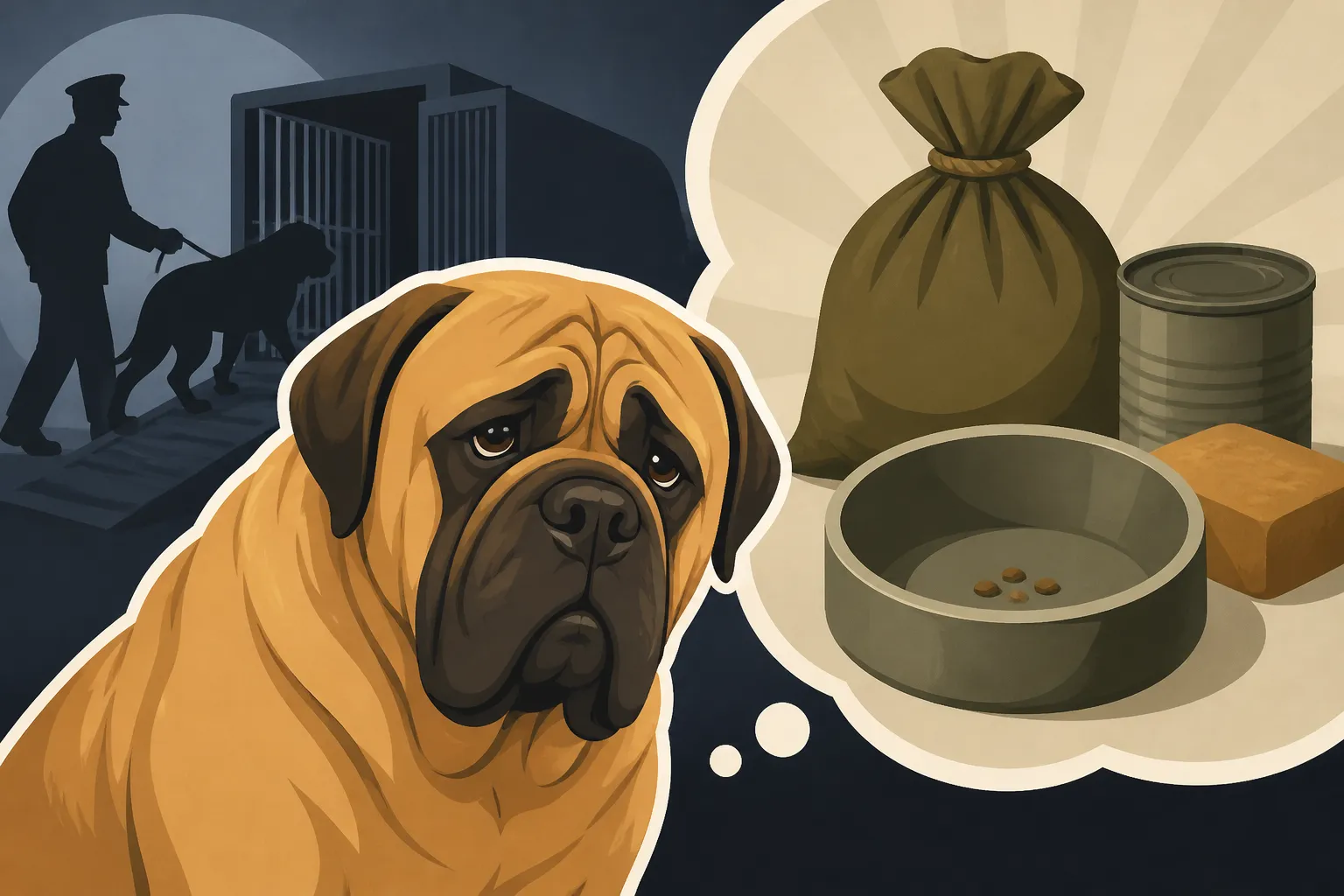
Why Mastiffs Were Euthanized During Rationing
A Mastiff’s size made it especially difficult to keep fed when wartime Britain faced severe food shortages. During the Second World War, rationing and disruption squeezed household budgets and supplies, and some owners made the heartbreaking decision to have their dogs put down. This guide explains the pressures behind those choices—and why this was not a government order targeting Mastiffs.
Why wartime rationing put large dogs at risk
Food was scarce, and feeding a giant dog was costly
Britain entered the Second World War in 1939, and rationing followed as the country tried to manage limited supplies. The restrictions affected people’s everyday choices, while war also disrupted imports, transport and the availability of ingredients used for animal feed. For many households, providing enough food for a large dog became a serious practical and financial strain.
A Mastiff’s appetite made that strain more pronounced than it was for someone keeping a small dog. Food that might have seemed manageable in a household with a terrier could become a substantial, ongoing commitment when the animal was a giant breed. Owners who were already stretching meals and household resources faced a painful question: could they continue to feed a dog properly while meeting their family’s needs?
That question was not just about finding a bowlful of food on a given day. A dog needed reliable nutrition over time, and an owner unable to secure enough suitable food might feel there was no humane way to keep it. Mastiffs did not have a special place in rationing rules; their size simply made the consequences of scarcity more difficult to manage.
Rationing affected pets even when they were not the focus
Rationing is often remembered through the food people had to manage at home. But pets depended on the same strained supply chains, and their needs competed with other demands on family resources. Even when pet food was available, the ingredients and transport behind it could be affected by wartime conditions.
This is an important distinction: the hardship was not necessarily that every dog received a formal ration card or that the government ordered owners to destroy pets. Rather, household food controls and broader shortages created pressure that could reach animals indirectly. Owners had to make decisions within a system where supplies, money and time were limited.
The experience also varied from one family to another. A rural household might have had different access to food than a family in London or another crowded city, while an owner with savings or a reliable source of feed could be in a different position from someone already struggling. There was no single wartime story shared by every Mastiff owner.
Mastiffs were vulnerable because of their scale
A Mastiff’s size brings practical needs that cannot simply be scaled down when circumstances become difficult. It takes more room, larger equipment and a consistent food supply to care for a giant dog than for a small companion breed. Those demands may have looked manageable before the war, then become overwhelming as shortages and household pressures accumulated.
The breed’s gentle reputation did not protect it from that arithmetic. A devoted owner could love a Mastiff deeply and still feel unable to provide what it needed. In a crisis, people do not always have a good option: they may be choosing between inadequate care, rehoming in a difficult situation, or euthanasia arranged with a veterinarian.
It is also worth avoiding a simplified picture of every large-dog owner making the same choice. Some people kept their Mastiffs through years of hardship, while others rehomed dogs or could not maintain them. The historical record is more complicated than a single explanation, even though food scarcity was a major pressure.
What euthanasia meant in this history
It was an individual decision under pressure, not a breed-specific order
When discussing the euthanasia of Mastiffs during wartime, it is easy to assume there was a formal policy aimed at the breed. That is not the right way to frame the issue. The more careful explanation is that some owners, facing limited food and resources, arranged to have their dogs put down. Mastiffs were among the dogs affected by the wider crisis, not a specific target of government policy.
Euthanasia could be presented as a decision to prevent an animal from enduring hunger or neglect. That does not make it easy to judge from a distance. Owners were dealing with conditions that could change quickly, and options for rehoming or obtaining food may have been limited. A decision made under severe pressure is different from an official instruction that all dogs of a certain breed be destroyed.
Historical accounts can also blur the reasons. A dog might be put down because the owner could not feed it, because the household was moving or facing other disruption, or because the animal had an illness or other care need. Food shortage belongs in the explanation, but it should not automatically be treated as the sole cause in every individual case.
The decline involved more than one wartime hardship
The Mastiff population had faced serious difficulties before and during the Second World War. A large, expensive-to-keep dog was particularly exposed when ordinary life became unstable, but the breed’s numbers were shaped by several pressures rather than one event alone. Earlier declines, changing circumstances for breeders and the demands of keeping a giant dog all matter to the wider history.
That broader context helps explain why the war’s effect was so consequential. When a breed already has relatively few dogs, losing even a portion of its breeding population can make recovery harder. Fewer suitable breeding dogs mean fewer opportunities to maintain healthy, diverse lines and rebuild numbers after conditions improve.
For a more detailed look at the wider food crisis and the breed’s decline, see Why Food Shortages Nearly Ended the Mastiff. The related account Fewer Than Twenty Mastiffs Survived the Second World War focuses on the scale of the breed’s near-collapse, while How Many Mastiffs Were Left in Britain in 1945 explores the population question more directly. These topics connect the individual hardship faced by owners with the larger consequences for the breed.
The emotional cost should not be left out
A discussion of rationing can become a list of policies, supplies and population figures. But behind those facts were people who had formed attachments to their dogs. For many owners, a Mastiff was not an expendable possession; it was a household companion. Losing one under circumstances they could not control could be distressing even if the decision was made to prevent suffering.
That emotional reality matters because it prevents us from treating euthanasia as a simple, detached response to a shortage. People may have felt guilt, grief and uncertainty, particularly if they believed there was no safe way to find another home or enough food. The difficulty of caring for a large dog did not mean its owner cared less.
It is also possible to acknowledge that some animals may have suffered when resources ran low. The humane intentions of an owner do not guarantee that every dog received ideal care, just as the existence of hardship does not mean every owner abandoned an animal. A balanced history can hold both truths: the conditions were severe, and the consequences for dogs and their families were painful.
How the Mastiff population was rebuilt
A small surviving population made recovery difficult
After the war, the Mastiff faced the challenge of rebuilding from a much smaller population. That meant there were fewer dogs available to form breeding lines, and careful breeding became important to restoring the breed. Rebuilding is not simply a matter of producing more puppies; breeders also have to consider temperament, health and the preservation of the breed’s defining traits.
A limited population can narrow the choices available to breeders. When there are fewer unrelated dogs, it becomes harder to maintain genetic variety while selecting for soundness and the desired type. That challenge is one reason the story of the Mastiff’s survival is not only about numbers. It is also about how a breed can recover responsibly after a sharp decline.
For a companion account of that recovery, read How American and Canadian Dogs Rebuilt the Mastiff. The breed’s wartime history also sits alongside the longer story told in The Mastiff That Stood Over Sir Piers Legh at Agincourt, which traces how much farther back the Mastiff’s place in British history reaches.
Rebuilding did not mean returning unchanged
A breed emerging from a small surviving population may not look or function exactly as it did before the crisis. Breeding choices, the dogs available and changing expectations all influence the modern type. A recovery can preserve the identity of a breed while still producing differences in appearance, structure or population health.
For Mastiffs, this is a useful reminder that breed history is not a straight line from an ancient dog to a modern one. Wars, economic shifts and the decisions of individual breeders can change which dogs contribute to future generations. Those changes may be subtle in a single dog but significant across a population.
The related article How the Modern Mastiff Differs From the Prewar Type considers some of those changes. The question of population health is also closely tied to How Narrow the Mastiff Gene Pool Is, because the loss of breeding animals can have consequences that last beyond the immediate crisis.
Historical survival depended on people’s choices
The breed’s recovery depended on people willing to preserve and breed the dogs that remained. That work required more than affection: breeders needed time, space, knowledge and the resources to care for large animals. Their efforts helped prevent the Mastiff from disappearing, though rebuilding could not erase what had been lost.
The story is therefore both a warning about how vulnerable a breed can become and an account of how human decisions shape its future. A population may shrink during a crisis and recover later, but the road back depends on the dogs still available and on careful choices made by breeders and owners.
It is tempting to imagine that survival was inevitable once the war ended. It was not. Food and other conditions might improve, but a breed with very few remaining dogs still needs deliberate support. The history of recovery deserves recognition alongside the painful story of wartime loss.
What modern Mastiff owners can take from the history
Planning for a giant dog means planning for disruption
The wartime experience is a reminder that responsible dog care involves more than everyday feeding. Owners can think ahead about what would happen if work, household income, housing or access to supplies changed. A plan may include identifying a trusted person who could help, keeping veterinary records accessible and knowing how to contact reputable rescue organizations.
For food planning, it helps to understand what a dog normally eats and to avoid abrupt changes whenever possible. Retailers such as Chewy may be one part of how an owner sources routine supplies, but no retailer can replace a practical backup plan or veterinary guidance. In a disruption, owners should check product availability and ingredient labels rather than assume that a familiar item will always be on hand.
The same principle applies to the wider costs of a giant breed. Food is only one consideration; transport, veterinary care, suitable bedding and safe handling also take planning. A Mastiff’s size can make a sudden move or emergency arrangement harder than it would be with a small dog, so thinking through those details in advance can reduce stress for both the dog and the household.
Seeking help early can preserve options
When someone begins to struggle with a dog’s care, asking for help early is often better than waiting until the situation becomes urgent. A veterinarian may be able to discuss safe adjustments to feeding or care, while a reputable rescue group may offer advice about temporary support or rehoming pathways. The right option depends on the circumstances, but it is easier to explore choices before a crisis becomes immediate.
For example, an owner who has lost access to a usual food may be tempted to make a sudden switch to whatever is available. A veterinarian can advise on an appropriate alternative for that particular dog. Chewy can be useful to some households for checking whether familiar supplies are available, but it should not be treated as a source of medical advice or as a guarantee of supply.
If rehoming becomes necessary, honesty about the dog’s age, temperament, health and daily needs helps a potential adopter make an informed decision. A Mastiff may be a wonderful companion, but it needs a home prepared for its size and care requirements. Early communication can give an animal a better chance of finding a suitable placement than a rushed decision made at the last moment.
Remembering the history without judging every owner
The question “Why were Mastiffs euthanized during rationing?” deserves a factual answer, but it also deserves care. Scarcity placed extraordinary pressure on households, and the demands of feeding a giant dog could make that pressure especially acute. Some owners made the painful decision to have their dogs put down; others found ways to keep them or sought new homes.
It is possible to remember the dogs that were lost without assuming that every owner was careless or that every decision had the same cause. Historical circumstances can explain why choices were made without making those choices painless. They also show why practical support, accessible advice and thoughtful planning matter when families face hardship.
Mastiffs survived the war because enough dogs remained and people worked to preserve the breed. Remembering that recovery alongside the losses gives a fuller account: rationing and food shortages helped place the breed at risk, but the history also includes commitment, rebuilding and the difficult choices made by owners during a time of real scarcity.
Disclaimer
This article is for general informational purposes only and does not constitute professional advice. Laws, prices and regulations vary by location and change over time. Consult a qualified professional for guidance on your specific situation.