Whether the Mastiff Was Ever a Herding Dog
A Mastiff’s size can make it look like a natural farm dog, but size alone does not tell us what a breed was developed to do. This guide explains whether Mastiffs were ever herding dogs, how herding differs from guarding livestock, and what the breed’s historical roles can—and cannot—tell us about Mastiffs today.
Were Mastiffs bred to herd livestock
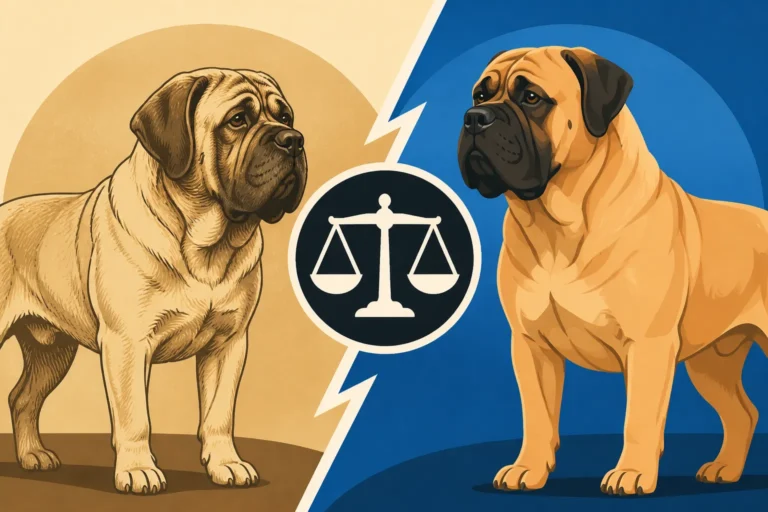
Herding and guarding are different jobs
A herding dog influences livestock movement. Depending on its type and training, it may gather animals, drive them toward a gate or pen, or keep them moving along a route. The work calls for a particular kind of response to movement: the dog watches the animals, reacts to their position, and helps direct where they go.
A livestock guardian has a different task. Instead of moving sheep or cattle from one place to another, a guardian stays near them and helps protect them from threats. A guardian may deter an unfamiliar person or predator simply by being present. It does not need to circle a flock or guide it through a field to do that job.
That distinction matters when asking whether the Mastiff was a herding dog. Historical references to a dog guarding property, accompanying people, or protecting animals do not automatically mean it herded those animals. A dog could have lived on a farm and been useful around livestock without being bred specifically to move a flock.
What the historical record supports
The Mastiff is most closely associated with guarding, protection, and, in some accounts, fighting roles—not with the specialized work of herding. Historical descriptions and stories about Mastiff-type dogs are not always precise by modern breed standards, so it is wise to avoid treating every old reference to a large dog as a record of today’s registered Mastiff.
Accounts of the breed’s past often focus on its imposing build and its association with people, estates, and conflict. Those themes fit a powerful dog used as a deterrent or guardian more readily than a dog selected for gathering and directing livestock. For more background on the breed’s early history, see Where the Mastiff Came From Before Britain and What Caesar Wrote About British Mastiffs.
This does not prove that no Mastiff ever helped move animals on a farm. In earlier centuries, dogs could have been used for practical tasks without belonging to a formal, narrowly defined breed or leaving a detailed written record. The more careful conclusion is that herding is not a defining historical purpose of the Mastiff, and there is no strong basis for presenting the breed as a traditional herding specialist.
Why the question is easy to mix up
People often use “farm dog” as if it described one job. In reality, a farm dog might guard a yard, accompany a farmer, warn of visitors, keep vermin away, or help manage animals. Those jobs are not interchangeable. A dog that spends time near sheep is not necessarily a sheepdog, just as a dog that protects a property is not necessarily a herder.
A Mastiff’s scale can also encourage the assumption that it would have been useful for pushing or controlling large livestock. But a dog’s working role depends on more than its size. Herding relies on traits such as responsiveness to movement, sustained focus, and the ability to influence animals without simply overwhelming them. A very large dog could be physically capable of affecting livestock while still being poorly suited to the careful, repeated movement involved in herding.
| Role | Main purpose | What the dog typically does | How the Mastiff is historically associated |
|---|---|---|---|
| Herding | Move or gather livestock | Watches and directs animal movement | Not a defining traditional role |
| Livestock guarding | Protect livestock from threats | Stays near animals and deters danger | Possible in practical settings, but not the breed’s best-established purpose |
| Property guarding | Protect a home, estate, or other place | Watches, warns, and deters intruders | A longstanding association |
| Companionship | Live alongside people | Provides company and may share household life | A role Mastiffs can fill today |
What roles are Mastiffs better known for
Guarding people and property
The Mastiff’s strongest historical association is with guarding and protection. Its imposing presence could make it a deterrent even without any active confrontation. A large dog standing near an estate entrance or household might communicate that the property was watched, while its presence could also give the people living there a sense of security.
That should not be confused with assuming every Mastiff was trained as an attack dog. Guarding can involve alertness, watchfulness, and deterrence; it does not require a dog to be encouraged to bite. Historical roles varied, and stories about past dogs sometimes mix fact, legend, and later retelling. The broader relationship between the breed and estate protection is explored in Whether Mastiffs Guarded English Estates.
For a related look at the breed’s martial reputation, Whether Mastiffs Were Used as War Dogs considers how Mastiffs and Mastiff-type dogs came to be associated with conflict. Those accounts are part of the larger history, but they do not turn the breed into a herding dog. Guarding, accompanying people, and participating in conflict are distinct from directing livestock.
A dog shaped by changing human needs
A breed’s reputation can shift as people’s needs change. Mastiff-type dogs have been described in connection with protection and combat, while later households have valued them for their presence and companionship. Those changes do not mean that every Mastiff in every era performed the same job. They do show why a simple label such as “working dog” can hide a complicated history.
In the English past, large dogs could be useful in settings where people wanted a visible guardian. The breed’s association with the story of Sir Piers Legh, for example, is one of the best-known historical narratives connected with the Mastiff. The details of that story should be read with care, but it illustrates how the breed’s image became tied to loyalty and protection. You can explore that tradition in The Mastiff That Stood Over Sir Piers Legh at Agincourt.
Over time, breeding and ownership priorities changed too. The modern Mastiff is not simply a working estate dog carried forward unchanged from earlier centuries. For a closer look at how selective breeding altered the breed’s purpose and appearance, see How the Mastiff Was Bred Away From Fighting. That history helps explain why modern expectations should be based on the dog in front of you, not on a dramatic story about a distant ancestor.
Could an individual Mastiff help with livestock
Practical experience is not the same as breed purpose
An individual Mastiff might learn to live calmly around livestock. It might accompany a person through a field, remain near a barn, or be trained to respond to basic cues around animals. Those experiences would make that particular dog useful in a particular setting, but they would not establish that Mastiffs as a breed were developed to herd.
Imagine a family with a Mastiff on a small rural property. The dog lies near the gate while sheep graze nearby and barks when a stranger approaches. The dog is part of farm life and may be protecting the property. But if the sheep are moved by a person or another trained dog, the Mastiff is not herding them simply because it is present.
Another dog might be taught to walk beside livestock or respond to a handler’s directions. Training can build useful behaviors, but it cannot guarantee that a large dog will be safe around every animal. Livestock can be startled, and a dog can accidentally injure an animal through exuberant movement, chasing, or simply its weight and strength. Careful introductions and supervision matter more than assumptions based on breed name.
Why a Mastiff is not a substitute for a herding specialist
A dog selected for herding work is generally expected to notice and respond to livestock movement in a particular way. Mastiffs are not commonly described as specialist herding dogs, and owners should not expect the breed to instinctively gather sheep or drive cattle. Some individuals may be attentive and trainable, but that is different from a reliable, inherited working style.
If you live around livestock, focus on the individual dog’s temperament, training, and behavior rather than asking only whether the breed has a historical farm connection. Teach reliable responses to cues, prevent chasing, and keep the dog physically separated when you cannot supervise. A calm dog can still create risk if it rushes toward animals, blocks their path, or becomes excited by movement.
This is especially important because a Mastiff’s size can make mistakes consequential. A small dog darting among sheep may cause distress; a very large dog can add substantial physical force even without intending harm. If your goal is to manage livestock, seek guidance from an experienced trainer familiar with both dogs and farm animals rather than treating a Mastiff as an automatic working solution.
What this history means for Mastiff owners today
Expect a companion and guardian, not a sheepdog
For most owners, the useful takeaway is straightforward: do not choose a Mastiff expecting the breed to herd livestock. The Mastiff’s history is more strongly linked to guarding and protection, while its modern life is often centered on companionship. Individual personalities vary, and a well-socialized Mastiff may be perfectly content to share a home with other animals, but calm coexistence is not the same as herding ability.
If you are considering a Mastiff for a rural home, think through everyday management. Can you safely introduce the dog to livestock? Do you have secure fencing and a way to keep animals separated when needed? Can everyone in the household follow the same rules about gates, leashes, and supervision? These practical questions are more useful than relying on a broad claim that the breed is—or was—a farm dog.
The breed’s traditional household role is explored further in The Household a Mastiff Was Built For. That perspective can help distinguish the breed’s historical reputation from the responsibilities of caring for a giant dog in a modern home.
Read the dog in front of you
A Mastiff’s behavior is shaped by its temperament, experiences, socialization, health, and training. One dog may be relaxed around sheep behind a fence; another may become intensely interested in animals that run. Breed history offers context, but it cannot predict exactly how an individual dog will behave around livestock.
Introduce animals gradually and at a safe distance. Use secure barriers, reward calm behavior, and end an interaction if the dog becomes difficult to redirect. Never assume that a dog is safe simply because it has lived near livestock before. A new animal, an unfamiliar setting, or a sudden burst of movement can change the situation quickly.
So, was the Mastiff ever a herding dog? Individual Mastiffs may have helped with farm tasks, and some may have lived alongside livestock. But herding was not the breed’s defining traditional purpose. The historical picture points much more clearly toward guarding and protection, and that is the distinction worth keeping in mind when considering a Mastiff today.
Disclaimer
This article is for general informational purposes only and does not constitute professional advice. Laws, prices and regulations vary by location and change over time. Consult a qualified professional for guidance on your specific situation.