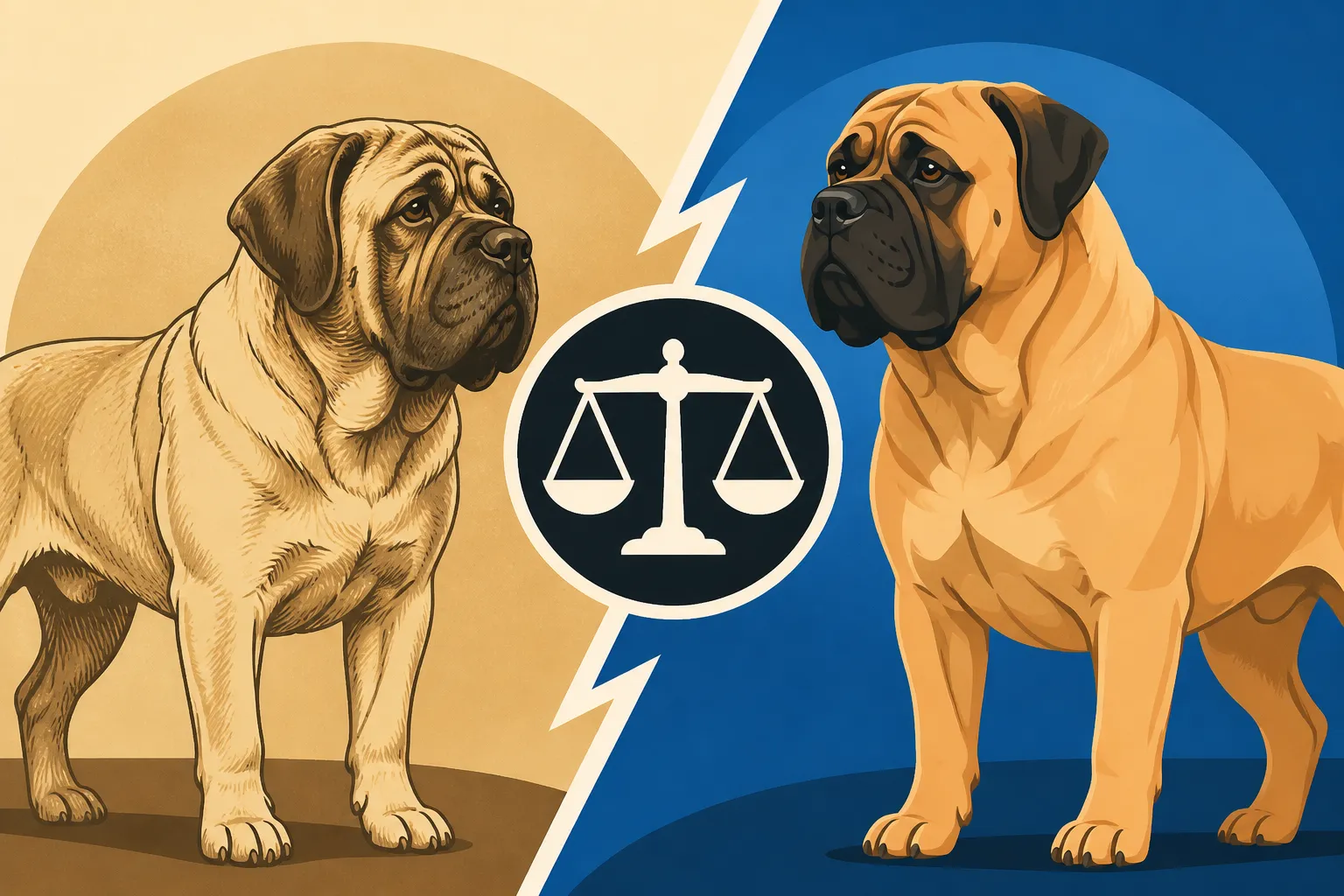
Whether the Mastiff Standard Has Changed Since 1900
A Mastiff shown today may look familiar to one photographed a century ago, yet the words used to judge the breed have been clarified and interpreted over time. That can make it hard to tell whether the official standard really changed or whether breeders simply favored a different look. This guide explains the difference, what the standard describes, and how to read historical comparisons.
What a breed standard is meant to describe
A written ideal, not a record of every Mastiff
A breed standard is a written description of the ideal Mastiff for conformation judging. It sets out the desired overall appearance and details such as structure, proportions, head, coat, color, and movement. Judges use it as a reference when comparing dogs; it is not a promise that every registered Mastiff will look exactly the same.
That distinction matters when looking at old photographs. A dog might have been a well-known Mastiff, or even a successful show dog, without representing every detail of the standard. Photographs can also distort size and proportion: camera angle, posture, lens, and the dog’s condition all affect what you see. A single image is interesting evidence, but it is not a complete record of the breed or its written ideal.
The standard also does not tell an owner how much to feed a dog, what equipment to buy, or how to manage health conditions. Those are practical care questions, not conformation requirements. For the breed name and official recognition context, see What the AKC Officially Calls the Mastiff.
Different standards can describe the same breed
The Mastiff is recognized by kennel organizations in different countries, and each organization has its own standard. The descriptions share a broad picture of the breed, but the wording, organization, and details may not match line for line. So “the Mastiff standard” can refer to a particular registry’s document rather than one universal text.
That is why a comparison needs a clear starting point. If someone says the standard changed “since 1900,” it helps to ask which country’s standard they mean, which edition they are comparing, and whether they are talking about official wording or the dogs seen in show rings. Without those distinctions, a change in one organization’s language can be mistaken for a change in every registry’s rules.
A useful way to orient yourself is to treat a standard as a document with a history, rather than as a timeless checklist. The breed’s written ideal, the population of dogs available to breeders, and the preferences of judges can influence one another, but they are not the same thing.
What may have changed since 1900
Revisions and clarifications to the written description
Standards can be edited over time. A revision may clarify a phrase, reorganize a section, or make a description more precise for judges and breeders. That does not automatically mean the ideal Mastiff has been dramatically reinvented. A careful comparison looks for what the wording actually directs a judge to assess, rather than assuming that any new edition signals a different breed.
It is also possible for an old document and a modern one to use different language while describing broadly similar qualities. Terminology may become more consistent, and descriptions may be arranged differently, without changing the overall picture of a powerful, substantial dog with recognizable breed characteristics. To decide whether a change is meaningful, compare the relevant passages side by side and ask whether the revision changes a feature, adds a requirement, removes one, or merely makes the instruction clearer.
When evaluating a claim about a specific formal revision, check the exact editions from the same registry. A comparison between an early British description and a later American one can be useful for understanding the breed, but it is not an apples-to-apples test of how one organization changed its own standard.
Interpretation can shift even when the wording does not
The most noticeable difference between dogs from different periods may come from selection and interpretation, not a dramatic rewrite of the standard. Breeders choose which dogs to breed, judges decide which dogs best fit the written ideal, and the dogs available in a given generation shape what people come to regard as typical. Over time, those choices can influence the look of show lines.
That shift is not necessarily uniform. One breeder may emphasize a feature that another considers less important, and dogs bred for different purposes may vary while still being registered as Mastiffs. Changes in grooming, presentation, photography, and show culture can also make dogs from different eras appear more distinct than they are.
The key distinction is simple: the standard describes the ideal; the dogs in a particular decade show how that ideal was interpreted in practice. For background on differences between historical and modern dogs, see How the Modern Mastiff Differs From the Prewar Type. That comparison helps explain why a change in appearance is not, by itself, proof of a formal change in the wording.
How to compare old and modern Mastiffs fairly
Compare features, not just overall size
A side-by-side comparison should consider several features, not just which dog looks larger. Look at the head, muzzle, expression, proportions, topline, limbs, coat, and movement. Then ask whether a perceived difference is supported by reliable measurements or a consistent set of photographs, rather than a single image chosen to make a point.
| What you are comparing | What to examine | Why it matters |
|---|---|---|
| Standard wording | The same registry’s editions from different periods | Separates official revisions from differences between organizations |
| Head and expression | Shape, proportions, and the features described in the standard | Photographs and grooming can make details appear different |
| Height and weight | Reliable records, not visual estimates alone | Perspective can make a dog look larger or smaller |
| Body proportions | Balance, depth, length, and stance | A large frame is not the same as sound structure |
| Color and markings | The registry’s written description | Popular colors do not necessarily indicate a change in the ideal |
| Show trends | Dogs from multiple breeders and years | One champion is not a complete picture of the population |
Size is an especially tempting shortcut. A bigger dog may appear more impressive in a photograph, but size alone does not show whether the dog better matches the standard. A sound comparison includes proportion, balance, and movement, as well as the overall impression. For more context on size, see How Much a Male Mastiff Weighs and How Much a Female Mastiff Weighs.
It is also worth remembering that show photographs are often staged. The dog may be posed to emphasize its outline, and a handler may position the head, legs, or tail to show the animal clearly. Those images are useful, but they should not be treated like neutral snapshots or used as the only basis for a historical claim.
Separate appearance from health and population trends
A standard is not a health report. A written description may specify what a judge should see, but it cannot tell you whether a particular dog has been screened for inherited conditions or how long dogs in a population tend to live. Those questions call for health information and careful breeding records, not just a comparison of show-ring photographs.
The population itself can also change. The number of breeding dogs, the relationships among bloodlines, and the choices made by breeders can affect how much variation is present. That broader context may help explain why certain features become common, but it does not prove that a standard required those features. For related background, see How Narrow the Mastiff Gene Pool Is and The Push to Breed Healthier Mastiffs.
The same caution applies to claims that modern Mastiffs are simply “heavier” or “more extreme.” Such claims need a defined comparison: which dogs, which records, which period, and which traits? A few striking examples may reflect individual dogs or a particular line, not a change across the entire breed. See The Push to Breed Heavier Mastiffs for more on the difference between pursuing size and assessing the breed as a whole.
What the standard means for owners and puppy buyers
It is a reference, not a shopping checklist
For a prospective owner, the standard can help explain what distinguishes a Mastiff from other large breeds. It is useful for learning about the breed’s outline and characteristic features, but it should not replace conversations about temperament, health testing, and the realities of living with a very large dog.
If you are looking at puppies, ask about the parents’ health records and the breeder’s priorities. Ask how the breeder describes the puppies’ likely adult structure and temperament, and whether the breeder is willing to discuss limitations and variation. A responsible conversation should be about more than whether a puppy has a fashionable color or looks likely to become exceptionally large.
The standard can also prevent misunderstandings about color and appearance. A color that seems rare or especially dramatic is not automatically more desirable, and a puppy’s appearance may change as it matures. To learn how the written description treats coat color, see Which Colors the Mastiff Standard Allows and Why a Mastiff Must Have a Black Mask.
Use it alongside practical breed knowledge
An owner’s daily life is shaped by much more than conformation. A Mastiff may need carefully planned exercise while growing, good traction on slippery floors, and a household prepared for the dog’s size, strength, and drool. Those concerns are not reasons to judge a dog’s conformation; they are practical realities to consider before bringing one home.
It is also easy to mistake a striking feature for a measure of quality. Deep wrinkles, a massive head, or extra bulk may attract attention, but a single feature does not tell the whole story. The breed standard should be read as a description of a balanced dog, not as encouragement to exaggerate one trait. For a closer look at facial structure, see How Deep a Mastiff's Wrinkles Should Be.
When you encounter a claim that the Mastiff standard has changed since 1900, ask three questions: Which registry’s document is being discussed? What exact wording changed? And is the claim about the written standard or about the dogs people bred and showed? Those questions turn a vague debate into a useful comparison—and help keep historical evidence, show trends, and modern owner expectations in their proper places.
Disclaimer
This article is for general informational purposes only and does not constitute professional advice. Laws, prices and regulations vary by location and change over time. Consult a qualified professional for guidance on your specific situation.