Leash Reactivity in a Two Hundred Pound Mastiff
Walking a two-hundred-pound Mastiff should be a joy, a calm stroll with your gentle giant, but for many, it quickly turns into a white-knuckle experience when another dog or person appears. That sudden, explosive lunge, the deep-chested roar, the sheer force of a dog that outweighs you by a hundred pounds or more – it's not just embarrassing, it's genuinely terrifying and physically draining. This guide is here to walk you through understanding, managing, and ultimately, working to reduce leash reactivity in your majestic Mastiff, turning those dreaded encounters into more manageable moments.
Understanding Leash Reactivity in a Giant Breed
When your gentle giant suddenly transforms into a pulling, barking, lunging behemoth on the leash, it's often labeled "leash reactivity." But it's more than just bad manners; it's a complex set of behaviors, and in a Mastiff, the sheer scale of the dog amplifies every single reaction. Understanding what triggers these outbursts and why they happen is the crucial first step toward helping your big friend.
What Leash Reactivity Looks Like in a Mastiff
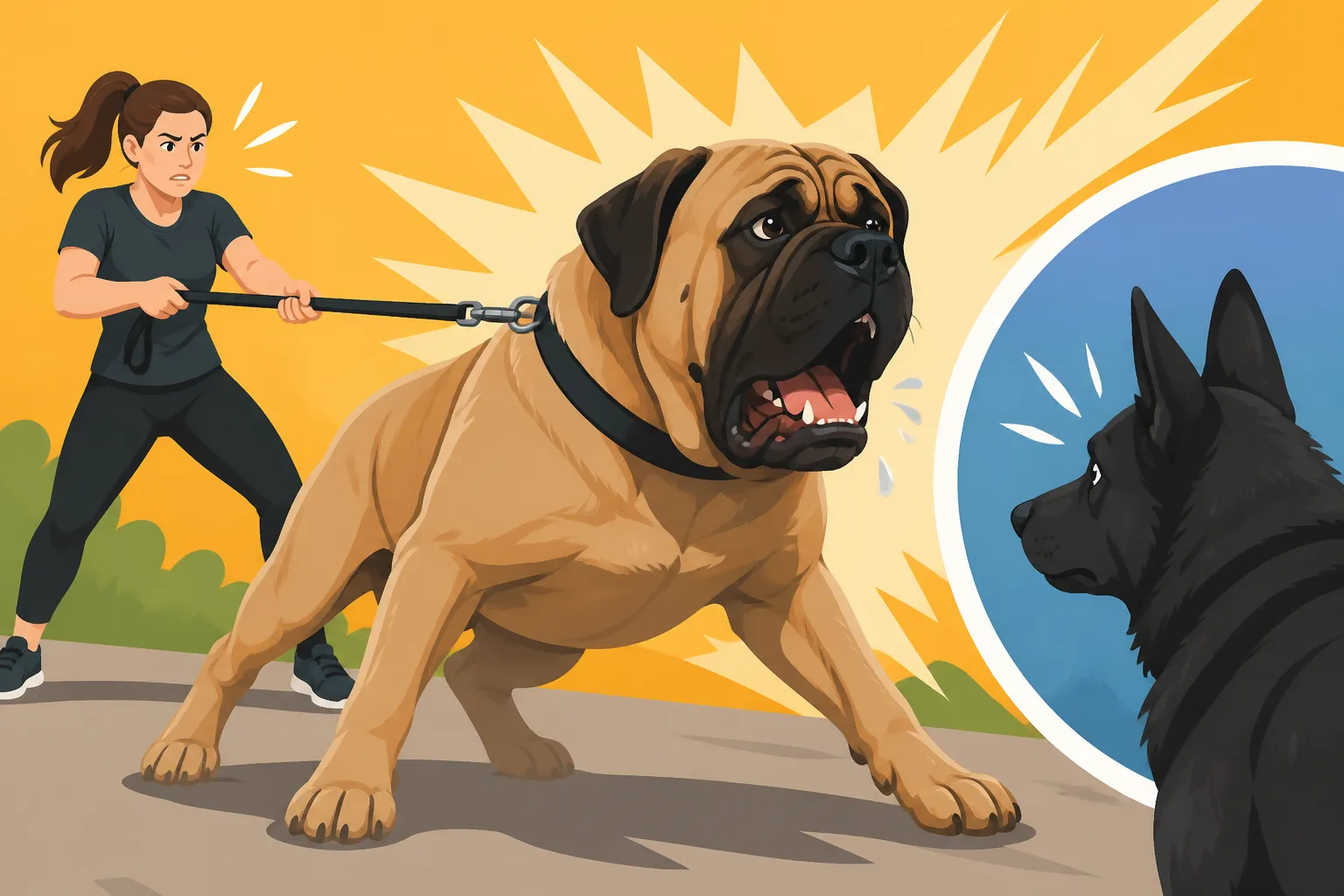
Imagine walking down the street with your Mastiff, and then, seemingly out of nowhere, they see another dog across the park. The first signs might be subtle – a stiffening of the body, ears perked, a slight head turn. Then, it escalates. For a Mastiff, "leash reactivity" isn't a dainty little bark; it's often a full-body experience. You might see a sudden, powerful lunge forward, a deep, resonant growl that vibrates through their chest, or frantic barking that sounds far more aggressive than it usually is.
Sometimes, a reactive Mastiff might even try to plant their feet and refuse to move, creating a monumental immovable object at the end of your leash, or they might spin and twist, wrapping you up in the leash if you’re not careful. The sheer mass and power behind these actions can easily yank an unprepared owner off their feet, or cause injury to the dog's neck if they're straining against a collar. It's not just a loud display; it's a physical challenge that can feel overwhelming, making you dread every walk.
Why Mastiffs Become Leash Reactive
There isn't one single cause for leash reactivity, especially in a breed as nuanced as a Mastiff. One common factor is often fear or insecurity. Despite their imposing size, many Mastiffs are incredibly sensitive dogs, and they can be easily overwhelmed by new situations, strange dogs, or unfamiliar people. A reactive display might be their way of saying, "Stay away! I'm scared!" rather than an actual attempt to be aggressive. When they feel trapped on a leash and unable to retreat, their instinct might be to "go big" to make the scary thing go away. The Sensitivity Nobody Expects in a Two Hundred Pound Mastiff
Frustration is another huge component. Your Mastiff might genuinely want to greet that other dog, but the leash prevents them from doing so. This builds up into an explosion of frustrated energy. Imagine wanting something so badly but being held back—it's natural to lash out. Over-excitement can also manifest as reactivity; some Mastiffs just get so thrilled to see another dog that they can't contain themselves, and their "friendly" lunging comes across as aggressive due to their size. Finally, a lack of proper, varied Socializing a Mastiff Puppy Before It Gets Heavy can contribute, as can genetic predispositions to anxiety or boldness. It's rarely about a "mean" dog; it's almost always rooted in an emotional response that they haven't learned to manage.
The Dangers of a Two Hundred Pound Reactive Dog
Let's be blunt: a two-hundred-pound Mastiff, or even a one-hundred-fifty-pound female, exhibiting leash reactivity is not just a nuisance; it's a significant safety concern. The force a Mastiff can generate when lunging is immense. How Much Force a Mastiff Can Apply on a Leash can easily dislocate a shoulder, pull you off your feet, or cause severe rope burns if the leash slips. Imagine being pulled into a busy street or falling and hitting your head – the consequences can be dire.
Beyond the risk to the handler, there's the danger to other dogs and people. Even if your Mastiff's intent is simply to make a scary thing go away or to get to a friend, their size and noise can be incredibly intimidating. A lunge might accidentally knock over a child or a senior citizen, leading to serious injury. If they do manage to get loose, the potential for an actual dog fight with a much smaller dog, or a perceived attack on a person, is a constant worry. Managing a reactive giant isn't just about training; it's about responsible safety and ensuring no one gets hurt. This means having the right equipment and the right strategies in place before problems escalate.
Tools and Equipment for Managing a Reactive Mastiff
Navigating the world with a reactive Mastiff means you need to be prepared, and that starts with having the right tools. Standard leashes and collars often just aren't enough to safely manage the immense power and sudden movements of a two-hundred-pound dog when they're triggered. Investing in appropriate, heavy-duty gear is not a luxury; it's a necessity for both your safety and your Mastiff's.
Choosing the Right Leash and Collar/Harness
When dealing with a reactive Mastiff, the collar and leash combo is your primary line of defense. A flimsy leash or a basic flat collar simply won't cut it. For a Mastiff, you need robust, wide, and comfortable equipment that distributes pressure effectively and gives you maximum control.
- Front-Clip Harnesses: These are often a game-changer for reducing pulling and giving you more steering control. Instead of clipping on the back, the leash attaches to a ring on the dog's chest. When your Mastiff pulls, they are gently redirected to the side, making it much harder for them to gain traction for a full-force lunge. Look for harnesses specifically designed for giant breeds, with broad straps that won't dig into their skin. Many owners find brands like the Blue-9 Balance Harness or the Freedom No-Pull Harness work well, which you can often find readily on Amazon. Whether a Front Clip Harness Stops a Mastiff Pulling
- Head Halters: Also known as head collars (like a Halti or Gentle Leader), these tools offer excellent control by guiding the dog's head, much like a horse's halter. Where the head goes, the body follows. For a Mastiff, this can be incredibly effective in preventing lunging and redirecting their focus away from triggers. It takes some time and positive conditioning to get a Mastiff comfortable with a head halter, as many initially resist it, but the control it offers can be invaluable. Always introduce it gradually with positive associations like treats. Whether a Head Halter Suits a Mastiff
- Flat Buckle Collars: While essential for ID tags, a flat collar alone is generally insufficient for a reactive Mastiff due to the risk of tracheal damage from excessive pulling. If used, it should be a wide, sturdy collar to distribute pressure, but primarily as a backup or for identification.
- Avoid certain tools: Retractable leashes are a definite no-go as they offer zero control over a sudden lunge. Prong collars and e-collars are highly controversial and can be counterproductive for a sensitive, fear-reactive Mastiff, potentially increasing anxiety and aggression. Whether a Prong Collar Belongs on a Mastiff
Essential Gear for Safety and Control
Beyond the primary leash and harness, a few other items can make a world of difference when managing a reactive Mastiff.
- Double Leashing: For extra security, especially in high-traffic areas or when you're still working through reactivity, consider using two leashes simultaneously – one attached to a harness and one to a flat collar. This provides a backup in case one piece of equipment fails or slips.
- Sturdy, Fixed-Length Leash: Opt for a strong, comfortable leash that is 6 feet in length, made of durable nylon or leather. Avoid anything too thin that could cut into your hands. A good, solid leash gives you consistent feedback and control.
- Long Lines: For practicing recall and controlled exposure in a safe, open area, a 15-30 foot long line can be useful. This allows your Mastiff some freedom to move while still maintaining a connection, helping you practice disengagement from triggers at a greater distance.
- Treat Pouch and High-Value Treats: You'll be doing a lot of positive reinforcement, so a comfortable treat pouch that clips to your waist is invaluable. Fill it with truly high-value treats – not just dry kibble, but something irresistible like small pieces of cooked chicken, cheese, or hot dogs. These powerful motivators are key to changing your Mastiff's emotional response.
High-Value Treats and Treat Pouches
High-value treats are the currency of good behavior for a Mastiff, especially when battling distractions and strong emotions like reactivity. Think of it this way: if your Mastiff sees another dog (a "level 10" distraction), they won't even register a boring piece of dry kibble. You need something that can compete, something so delicious it pulls their focus away from the trigger.
Small, soft, and pungent treats work best because they are easy to swallow quickly, allowing for rapid-fire rewards. Cooked chicken, lean beef, cheese, hot dogs cut into pea-sized pieces, or even specialized soft training treats from brands like Zuke's or Wellness, available on Amazon, can be highly effective. The goal is to make every positive interaction with a trigger incredibly rewarding. Always carry plenty!
A treat pouch is an absolute must-have. Fumbling in pockets for treats slows down your timing, and timing is everything in reactivity training. A good treat pouch has a wide opening for easy access, closes securely (zipper or magnetic clasp) to prevent spillage, and clips comfortably to your belt or waistband, leaving your hands free to manage your Mastiff. This small accessory is a game-changer for efficient and effective training sessions.
Training Strategies for Desensitization and Counter-Conditioning
Addressing leash reactivity in a Mastiff isn't about punishment; it's about changing their emotional response to triggers. This is where desensitization and counter-conditioning come in, gently shifting their fear, frustration, or over-excitement into a more neutral or even positive feeling. It requires consistency, patience, and a deep understanding of your Mastiff's sensitive nature.
The Foundation: Positive Reinforcement and Relationship Building
For a Mastiff, especially one that is reactive, a strong, trusting relationship with their owner is the bedrock of all successful training. These are deeply sensitive dogs, and harsh corrections or punitive methods can easily backfire, eroding trust and potentially exacerbating their anxiety or fear. Why Harsh Correction Ruins a Mastiff Instead of making them fear the trigger or fear your reaction, we want them to feel safe and confident when you are around, even in the presence of triggers.
Positive reinforcement means rewarding the behaviors you want to see. When your Mastiff calmly looks at another dog instead of lunging, that's a jackpot moment that deserves a high-value treat and praise. It teaches them that good things happen when they remain calm. This approach not only makes training more enjoyable for both of you but also strengthens the bond you share, making your Mastiff more likely to look to you for guidance when they feel unsure. This gentle approach is absolutely vital for a Mastiff, who will often "sulk" or shut down if treated harshly. What Actually Motivates a Mastiff
The "Look At That" Game
The "Look At That" (LAT) game is a cornerstone technique for counter-conditioning leash reactivity. The basic idea is to teach your Mastiff that the appearance of a trigger (another dog, person, etc.) predicts something wonderful happening to them.
Here’s how to play it:
- Find Your Distance: Start at a distance where your Mastiff notices the trigger but does not react. This is crucial – you must stay under their threshold of reactivity. For a Mastiff, this might mean spotting another dog across several football fields initially.
- Mark and Reward: The moment your Mastiff notices the trigger (their head might turn, ears perk), say "Yes!" or use a clicker, then immediately feed them a high-value treat. They don't have to do anything, just look at the trigger. The goal is to create the association: "Other dog = yummy treat!"
- Repeat, Repeat, Repeat: Continue this process. Trigger appears, you mark it, treat. Trigger disappears, no treat. You want them to start looking at the trigger and then immediately looking back at you expectantly for the treat. This is the magic moment!
- Gradual Reduction of Distance: As your Mastiff consistently looks back at you for the treat, you can gradually decrease the distance to the trigger. This might take weeks or even months. Always be prepared to increase the distance if they start to show signs of stress or reactivity. It’s a slow dance, and rushing it will set you back.
This game works by changing the emotional valence. The trigger, which once evoked fear or frustration, starts to predict something positive. Your Mastiff begins to associate the other dog with good things coming from you, rather than feeling threatened or overwhelmed.
Controlled Exposure and Thresholds
Understanding your Mastiff's "threshold" is paramount in reactivity training. Their threshold is the point at which they can observe a trigger without reacting negatively. Going over this threshold means your Mastiff is too overwhelmed to learn, and their emotional brain takes over. Staying under the threshold, however, allows them to think, process, and form new associations.
- Identify the Threshold: This might mean starting your training far, far away from other dogs – perhaps across a park, or even just watching dogs from inside your car or house. Observe your Mastiff's body language closely. Are they relaxed? Are their ears soft? Is their tail loose? If you see stiffening, hard stares, lip licking, or pulling, you’re too close.
- Manage the Environment: Initially, you'll need to be proactive about avoiding triggers. Choose quiet walking routes, walk at off-peak hours, or use a long line in a securely fenced area where you control the environment. The goal is to set your Mastiff up for success, not to constantly expose them to situations where they fail.
- Structured Set-Ups: Once your Mastiff is doing well with the LAT game at a distance, you might consider very controlled set-ups. This involves asking a friend with a calm, neutral dog to walk past at a predetermined distance, allowing you to practice staying under the threshold in a controlled environment. This allows for focused practice without the unpredictability of random street encounters.
Remember, every "successful" walk under the threshold builds confidence, while every reactive explosion can reinforce the unwanted behavior and increase stress for both of you.
The Role of a Professional Trainer
While many owners can make significant progress with the right tools and techniques, there are times when a professional trainer is absolutely invaluable, especially with a dog of a Mastiff's size. An experienced professional can provide an objective assessment of your dog's behavior, identify underlying causes, and tailor a training plan specifically for your Mastiff.
Look for a certified professional dog trainer (CPDT-KA) or a certified behavior consultant (CBCC-KA) who specializes in positive reinforcement and force-free methods. They should have experience with large, strong breeds and reactivity. They can help you:
- Accurately read your Mastiff's body language: This is crucial for identifying early signs of stress and staying under threshold.
- Fine-tune your technique: Timing of rewards, leash handling skills, and proper treat delivery are all critical.
- Develop customized strategies: What works for one Mastiff might not work for another. A trainer can provide personalized advice.
- Provide controlled set-ups: A trainer often has access to neutral "helper dogs" for controlled practice sessions.
- Offer ongoing support and guidance: Reactivity training is a journey, and a professional can provide encouragement and adjustments along the way.
Platforms like the Karen Pryor Academy or the Certification Council for Professional Dog Trainers (CCPDT) can help you find qualified professionals in your area. For those seeking structured online guidance, BAXTER & Bella offers comprehensive online puppy and dog training programs that emphasize positive reinforcement, which can be a fantastic resource for learning the foundational skills needed to tackle reactivity, even if you still bring in a local trainer for hands-on sessions. Whether a Mastiff Needs a Professional Trainer
Practical Tips for Daily Walks and Management
Living with a reactive Mastiff means every walk is a strategic operation. It's not just about training; it's about smart management, anticipating challenges, and being ready to respond calmly and effectively. These practical tips can help make your daily outings less stressful and more productive.
Strategic Walking Routes and Times
The easiest way to manage reactivity is to avoid triggers whenever possible, especially in the early stages of training. This doesn't mean your Mastiff never gets to see the outside world; it means you're being smart about when and where you encounter it.
- Off-Peak Hours: Try walking early in the morning, late in the evening, or during midday when fewer people and dogs are typically out. This significantly reduces the likelihood of an unexpected encounter.
- Quiet Routes: Seek out less populated areas – quiet residential streets, industrial parks on weekends, large open fields, or walking trails where you can see potential triggers from a distance. Avoid busy sidewalks, dog parks (a definite no-go for reactive dogs), or popular neighborhood routes where you know you'll consistently run into problems. Why a Dog Park Is Wrong for a Mastiff
- Car Rides for Exposure: Sometimes, a car ride can be a good way to expose your Mastiff to the world without the pressure of a direct encounter. Drive to a park and simply let them watch from the safety of the car, rewarding them for calm observations.
The goal is to provide your Mastiff with walks where they can relax and enjoy sniffing, exploring, and engaging with you, rather than constantly scanning for threats.
Recognizing and Responding to Early Warning Signs
Many Mastiff owners miss the subtle cues their dog gives before a full-blown reaction. Learning to read your Mastiff's body language is critical for intervening early and redirecting their attention.
| Early Warning Sign | What It Might Look Like in a Mastiff | Action to Take |
|---|---|---|
| Stiffening/Freezing | Body becomes rigid, tail might stop wagging, muscles tense. | Increase distance immediately. Ask for a "Watch Me" cue. |
| Hard Stare/Fixation | Eyes fixed on the trigger, often with dilated pupils. | Immediately interrupt eye contact, redirect with a treat to your face. |
| Lip Licking/Yawning | Can indicate stress, not just digestion or tiredness. | Create space, offer a low-stress activity (sniffing), or a gentle check-in. |
| Ears Forward/Upright | Hyper-alertness. | Start the "Look At That" game; mark and treat before reaction. |
| Whale Eye | Showing the whites of their eyes, often a sign of fear. | Move away. Consider ending the walk if stress is high. |
| Head Turn/Aversion | Turning head away from you, trying to escape. | This can also be a subtle calming signal, indicating discomfort. Reassess distance. |
| Low Growl/Rumble | This is a clear warning. | This is past the subtle stage. You've missed earlier cues. Create maximum distance. |
By learning these cues, you can intercept the escalation much sooner. The moment you see your Mastiff tense or fixate, you have a window to use your positive reinforcement techniques or simply create more space before they reach their breaking point.
Managing Unexpected Encounters
Despite your best efforts, unexpected encounters will happen. Knowing how to manage them can prevent a full-blown meltdown.
- Be a "Tree": If a trigger appears suddenly and you can't create distance, stop moving and stand still like a tree. This prevents you from pulling against your Mastiff and causing more tension.
- U-Turn: If you see a trigger coming, execute a swift, calm U-turn and walk in the opposite direction, creating distance. Reward your Mastiff for following your lead.
- Barrier Blocking: Sometimes, a physical barrier like a parked car, a bush, or even your own body can provide a visual block, reducing the intensity of the trigger for your Mastiff.
- High-Value Treat Bomb: If your Mastiff is fixating, try scattering a handful of high-value treats on the ground. This encourages them to sniff and engage their nose, which can be a calming activity that breaks their focus on the trigger.
- "Watch Me" or "Touch": Practice cues like "Watch Me" (look at me) or "Touch" (nose-target your hand) extensively in calm environments. These can be powerful tools to redirect your Mastiff's attention away from a trigger when needed.
The key is to remain calm yourself. Your Mastiff is incredibly perceptive and will pick up on your anxiety, which can make their own reactivity worse. Take a deep breath, and confidently implement your strategy.
Importance of Consistency and Patience
Training a reactive Mastiff is not a quick fix; it's a marathon, not a sprint. Their emotional responses are deeply ingrained, and changing them takes time, repetition, and immense patience. You will have good days and bad days. There will be days when you feel like you've made no progress, or even taken steps backward.
Consistency is vital. Everyone who walks your Mastiff needs to be on the same page, using the same equipment, the same techniques, and the same rewards. Even small deviations can confuse your Mastiff and slow down progress. Celebrate the small victories – a shorter bark, a quicker recovery, a walk where you successfully avoided all triggers. These small steps accumulate over time. Remember, you're helping your Mastiff learn to navigate a world that can feel overwhelming to them. With dedication, the bond you build and the peace you create on walks will be incredibly rewarding.
Leash and Harness Options for Reactive Mastiffs
Choosing the right equipment is fundamental for safety and control when managing a reactive Mastiff. Here's a brief comparison of common options:
| Equipment Type | Pros | Cons | Best Use Case |
|---|---|---|---|
| Flat Collar | Basic ID holder, comfortable. | Minimal control for lunging; risk of neck injury. | Primarily for ID tags and as a backup attachment for a double leash. |
| Front-Clip Harness | Redirects pulling, less stress on neck/throat. | Can sometimes chafe if not fitted well; dog can still pull. | Everyday walks, good for general pulling and initial reactivity management. |
| Head Halter | Excellent steering control, prevents head-on lunging. | Requires desensitization; some dogs dislike it; requires specific fitting. | High-control situations, severe reactivity, or for owners needing maximum leverage. |
| Back-Clip Harness | Comfortable for dog, less neck strain. | Can encourage pulling; offers less directional control. | Generally not recommended for reactive Mastiffs due to lack of control. |
| Sturdy 6ft Leash | Standard, offers good communication with dog. | Requires strong handler for a reactive Mastiff. | Essential for all walks, pair with a good harness/head halter. |
| Long Line (15-30ft) | Allows safe distance training in open areas. | Can be cumbersome; tangles easily. | Controlled training sessions in secure, low-distraction environments. |
Ultimately, the best choice often involves a combination, such as a sturdy 6-foot leash paired with a well-fitted front-clip harness or a head halter. Always prioritize safety, comfort, and the ability to maintain control over your powerful companion.
Managing a reactive two-hundred-pound Mastiff is a journey that demands patience, consistency, and the right approach. It’s natural to feel overwhelmed or frustrated when your gentle giant transforms into a lunging, barking force of nature. But by understanding the root causes, utilizing appropriate tools like a reliable harness and high-value treats, and implementing positive reinforcement training strategies like the "Look At That" game, you can gradually change your Mastiff's emotional response. Remember, every calm moment and successful redirection builds confidence, slowly but surely paving the way for more peaceful walks and a stronger bond with your magnificent Mastiff.
Disclaimer
This article is for general informational purposes only and does not constitute professional advice. Laws, prices and regulations vary by location and change over time. Consult a qualified professional for guidance on your specific situation.