Why a Dog Park Is Wrong for a Mastiff
Many Mastiff owners find themselves in a tricky spot when it comes to dog parks. You want your gentle giant to be well-socialized and happy, romping around with other dogs, but the reality of a busy dog park can quickly turn into a stressful, even dangerous, situation for a breed as unique as the Mastiff. This guide will delve deep into why dog parks are generally unsuitable for Mastiffs, highlighting the specific physical and behavioral challenges they present, and offer safer, more enriching alternatives for their well-being.
The Physical Risks a Dog Park Poses to a Mastiff
Let's be honest, a Mastiff is not just another dog. They are massive, powerful, and have a physiology that demands careful consideration, especially when it comes to high-impact activities or uncontrolled environments like a dog park. The sheer physics of a Mastiff interacting with a varied population of dogs can lead to serious consequences.
Immense Size and Vulnerable Joints
One of the most obvious reasons a dog park is problematic for a Mastiff is their sheer size and weight. Picture a graceful Greyhound or a zippy Jack Russell Terrier trying to play with a two-hundred-pound Mastiff. Even if the Mastiff is trying to be gentle, a simple stumble or an enthusiastic bump from its massive frame can easily injure a smaller dog. Conversely, a smaller, faster dog darting underfoot can trip a Mastiff, leading to a fall that could cause significant injury to its own joints. A Mastiff puppy, still growing rapidly, is even more vulnerable. Their growth plates are open, and their bones and joints are still developing. High-impact running, sudden stops, and rough play are precisely the kind of activities that can exacerbate or contribute to serious orthopedic issues like hip and elbow dysplasia later in life. Why a Mastiff's Hips Fail Under Its Own Weight and Why One Mastiff in Seven Fails Its Elbow Grade truly underscore how critical it is to protect their developing skeletal system. The concern only grows when you consider How Fast a Mastiff Puppy Puts On Weight and the strain that places on immature joints during boisterous play.
Moreover, the ground itself in many dog parks is not ideal. Uneven terrain, hidden holes, or slippery surfaces can pose a serious risk for a dog carrying so much weight. A sudden twist or misstep during play can lead to sprains, strains, or even more severe ligament tears, especially in their knees. A Mastiff’s weight is a double-edged sword: it offers a comforting bulk, but it also makes them incredibly susceptible to joint trauma from uncontrolled physical exertion. Owners often don't fully grasp What a Mastiff's Weight Does to Every Line on the Vet Invoice until an emergency trip to the vet, which can be devastating both emotionally and financially.
Overheating and Exhaustion
Mastiffs, with their deep chests, heavy bones, and often thick coats, are particularly susceptible to overheating. Their massive body mass makes it difficult for them to efficiently regulate their internal temperature, especially during strenuous activity or in warm weather. Dog parks, by their very nature, encourage vigorous, often prolonged, exercise. There's no mechanism to ensure your Mastiff takes adequate breaks or cools down properly. They might keep playing to keep up with other dogs, even if their body is screaming for rest. This can quickly lead to heatstroke, a life-threatening condition.
Symptoms of overheating can escalate rapidly in a Mastiff, going from heavy panting and drooling to stumbling, disorientation, and collapse. Whether a Mastiff Overheats on a Walk explores this in more detail, and the risks are magnified tenfold in a dog park setting where constant movement is encouraged. Unlike smaller, more agile breeds that can sprint and then easily find shade and settle, a Mastiff's recovery from intense exertion is slower, and the metabolic stress is much higher. Simply put, their physiology is not designed for sustained, high-energy frolicking in an environment where they have little control over the pace or intensity of interaction.
Accidental Injury from Other Dogs
It's not just the Mastiff's own size that's a risk; it's the size disparity and differing play styles of other dogs. A tiny terrier, full of beans, might continually nip at a Mastiff's heels or body slam into its legs, completely unaware of the force it's applying or the vulnerability of a giant breed. While most small dogs are harmlessly playful, an accidental collision can lead to a Mastiff’s leg being twisted, or even its head being knocked if a dog jumps up unexpectedly.
On the flip side, even the gentlest Mastiff can accidentally injure a smaller dog. A playful paw swat meant to initiate a game might send a smaller dog tumbling. A Mastiff rolling over or leaning into another dog, a common Mastiff behavior, can unintentionally pin or crush a smaller playmate. These aren't malicious acts, but pure accidents stemming from a vast difference in mass and structural integrity. A dog park is a melting pot of breeds with varied temperaments and play etiquette, and it's simply too unpredictable for a Mastiff, whose immense power makes any accident potentially severe. Why a Mastiff Body Slams Other Dogs delves into this natural behavior and how it can be misunderstood or problematic in mixed company.
Behavioral Challenges and Misunderstandings in a Dog Park
Beyond the physical, a Mastiff's unique temperament and communication style are often misunderstood in the chaotic environment of a dog park. What might be perfectly normal Mastiff behavior can be misinterpreted by other dogs or owners, leading to unnecessary stress, conflict, or even aggression.
The Mastiff's Unique Play Style
If you've spent any time with Mastiffs, you know they aren't typically the high-energy, chase-and-tumble type of dog found joyfully wrestling in dog parks. Their play is often more sedate, deliberate, and sometimes appears almost lazy. They might prefer a slow sniff-walk, a bit of mutual leaning, or a brief, wrestling match that looks like two slow-motion giants moving around. When a Mastiff is trying to engage, it might do a lumbering play bow or a heavy-footed chase that quickly turns into a walk. This can be confusing to other breeds, particularly high-energy herding dogs or terriers, who might perceive the Mastiff's slow approach as an invitation for more intense play or, conversely, as disinterest or even a challenge.
The Mastiff's default mode is often quiet observation, preferring to take in their surroundings rather than constantly engage. This calm demeanor can be a blessing in many situations, but in a dog park, it can lead to problems. Other dogs, especially those lacking good social skills, might persistently "invite" the Mastiff to play, nipping, barking, or jumping on it. A Mastiff, being naturally sensitive, might tolerate this for a while but could eventually become overwhelmed or irritated. The Sensitivity Nobody Expects in a Two Hundred Pound Mastiff highlights this core aspect of their personality, which makes them ill-suited for the relentless, often rude, social overtures common in dog parks.
Interpreting Mastiff Communication
Dog parks are a cacophony of canine communication – barks, growls, tail wags, postures, and body language are constantly being exchanged. However, a Mastiff's communication can be subtle or, when not subtle, misinterpreted by dogs and humans unfamiliar with the breed. A low rumble from a Mastiff might be a polite "back off," but to a smaller dog, it could be perceived as a direct threat. Their deep bark is imposing, even when meant as a simple greeting or warning. Their direct stare, often used to assess a situation, can be seen as aggressive by another dog.
Consider a situation where a smaller, boisterous dog keeps invading a Mastiff's personal space. The Mastiff might give subtle signals: a slight stiffening, a low growl, turning its head away. These are clear "leave me alone" signals to another well-socialized large dog. But to a dog used to more overt, fast-paced communication, or to an owner glued to their phone, these signals can be missed. The Mastiff might then escalate to a firmer warning, which, given its size, can appear terrifying and lead to panic from other owners. The sheer presence of a Mastiff can also intimidate, even if they are perfectly friendly, simply because of What the AKC Officially Calls the Mastiff: a massive, powerful dog. This makes the potential for misunderstanding very high, fostering an environment of anxiety for both the Mastiff and its owner.
The Guardian Instinct and Unpredictable Encounters
Mastiffs were originally bred as guardians, a trait that remains deeply ingrained in their psyche. They are naturally discerning and protective of their families and perceived territory. While this is a wonderful trait at home, it can become a liability in a dog park. An uncontrolled environment with unfamiliar dogs and people can easily trigger this guardian instinct, especially if the Mastiff perceives a threat to its owner or even to another dog it considers part of its temporary "pack."
Imagine a scenario: your Mastiff is calmly observing, when suddenly another dog charges up to you or to a dog your Mastiff has been politely interacting with. A Mastiff's natural response might be to place itself between the perceived threat and its charge, or to offer a deep, booming bark to deter the intruder. While this is its way of protecting, in a dog park, it will almost certainly be viewed as aggression by other owners, leading to conflict and potential accusations. How a Mastiff Judges a Stranger at the Door shows just how carefully they assess new encounters.
Furthermore, dog parks are often poorly managed, with owners who aren't paying attention or dogs with poor social skills. A rude dog might try to take a toy, or jump on a Mastiff that is not in the mood for play. Because of its protective nature, a Mastiff might react defensively, and any reaction from a dog of its size will be significant and potentially dangerous. It's difficult to fully mitigate these risks in such an unpredictable setting, making dog parks a high-stakes gamble for a Mastiff owner. Whether a Mastiff Guards Without Being Taught further clarifies the innate nature of this protective instinct.
Safer Alternatives for Exercise and Socialization
Understanding why dog parks are not the best fit doesn't mean your Mastiff has to live a life devoid of exercise or social interaction. On the contrary, there are many excellent ways to ensure your Mastiff is well-adjusted, physically healthy, and mentally stimulated, all within a safe and controlled environment.
Controlled Playdates and Group Walks
The best way to provide social interaction for your Mastiff is through carefully arranged, controlled playdates with known, stable, and appropriately-sized dogs. Seek out other large breed owners whose dogs are calm, well-socialized, and whose vaccination records you trust. These interactions can take place in a securely fenced yard, or on leash in a quiet park or trail. This allows you to supervise closely, intervene if needed, and ensure that both dogs are enjoying the interaction without stress.
Group walks are another fantastic option. Walking alongside other dogs on leash, even without direct nose-to-nose contact, provides a sense of pack camaraderie and allows for socialization without the chaos of off-leash play. This promotes calm, polite greetings and co-existence. For those seeking a quieter companionship, remember that Whether a Mastiff Tolerates a Small Dog can vary, so always introduce dogs carefully and prioritize safety. Consider joining a local Mastiff club or a large breed walking group. These communities often understand the unique needs of giant breeds and can connect you with suitable playmates.
Structured Training and Enrichment
For Mastiffs, mental stimulation and structured physical activity often outweigh the need for chaotic free-for-alls. Focusing on obedience training, advanced commands, or even fun dog sports like scent work (which is low-impact and mentally engaging) can build confidence and strengthen your bond. Consistent training from a young age is crucial for such a powerful dog, ensuring they respect your commands long before they outweigh you. Many excellent resources are available online. For instance, platforms like BAXTER & Bella offer comprehensive online puppy and dog training programs that emphasize positive reinforcement and structured learning, which are ideal for the sensitive Mastiff. These programs allow you to work at your Mastiff's pace, in your own environment, free from the distractions and potential stressors of a public dog park.
Enrichment toys and puzzle feeders are also invaluable for providing mental exercise without excessive physical strain. Durable, large-breed appropriate toys can keep a Mastiff entertained for hours. Products from Amazon, designed for large, powerful chewers, can stand up to a Mastiff's jaws and provide a good outlet for their natural instincts. These types of activities allow your Mastiff to "work" for their food or treats, engaging their problem-solving skills and reducing boredom, which can lead to destructive behaviors.
Solo Exercise and Quiet Exploration
Never underestimate the power of a good, calm walk for a Mastiff. They don't need to run miles; a steady, hour-long stroll through a quiet neighborhood or a nature trail is often perfect. This allows them to sniff, explore, and simply exist calmly in the world alongside you. It provides gentle exercise for their joints and mental stimulation from the changing scents and sights. Why a Mastiff Only Needs One Hour a Day highlights this perfectly – it's about quality, not necessarily quantity or intensity. Always ensure you have a sturdy leash and a comfortable, well-fitting harness for control. Many heavy-duty leashes and harnesses suitable for giant breeds can be found on Amazon, ensuring you have the right gear to manage their strength safely.
A securely fenced yard is also a wonderful asset, providing a safe space for your Mastiff to explore at their own pace, bask in the sun, or engage in a gentle game of fetch with family members. This controlled environment allows them to move freely without the threat of encountering unknown dogs or people. Remember that a Mastiff often prefers a quiet, predictable household, as explored in Whether a Mastiff Suits a Quiet Household, making calm, solo activities or one-on-one interactions much more beneficial than the unpredictable nature of a dog park.
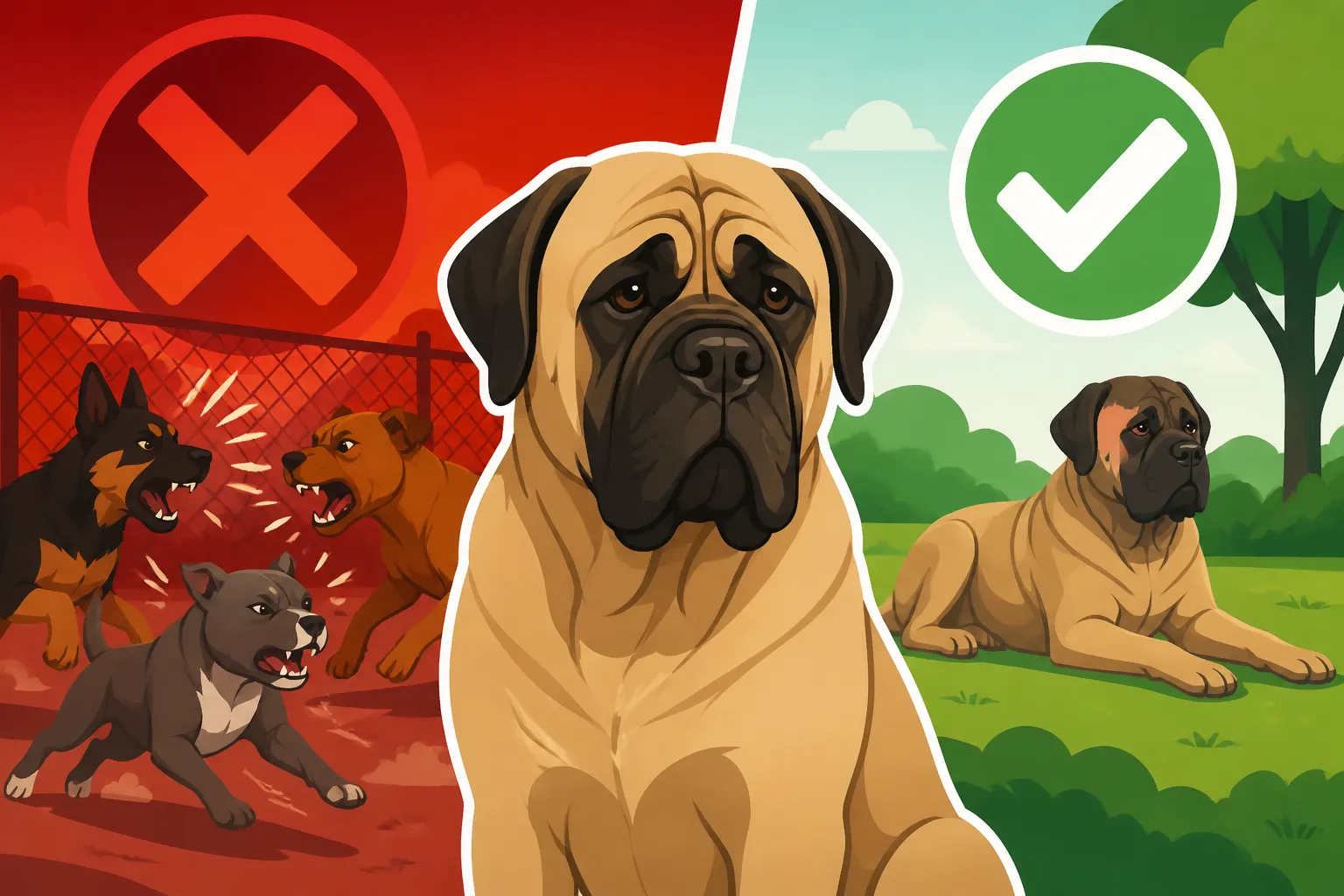
Here’s a quick comparison of dog park risks versus controlled socialization:
| Feature / Risk | Dog Park for Mastiff | Controlled Environment (e.g., playdate, structured walk) |
|---|---|---|
| Physical Safety | High risk of collisions, overheating, accidental injury from disparate sizes/play styles. | Low risk, controlled play partners, monitored exertion, safer surfaces. |
| Behavioral Stress | High due to unpredictable interactions, misinterpretations of communication, potential guardian instinct triggers. | Low, with familiar dogs and owners, predictable dynamics, clear communication. |
| Socialization Quality | Often overwhelming, can lead to negative associations, reinforcing guarding or shyness. | Positive, tailored interactions, builds confidence and appropriate social skills. |
| Disease Exposure | Higher due to many unknown dogs with varying health and vaccine status. | Lower with known, vaccinated playmates, reduced exposure to shared surfaces. |
| Owner Control | Minimal, reliant on other owners' diligence and dog handling skills, which can be inconsistent. | High, direct supervision and intervention possible, ensuring a positive experience. |
| Suitability for Breed Temperament | Poor fit; Mastiffs prefer calm, deliberate interactions over chaotic group play. | Excellent fit; caters to their sensitive, discerning, and protective nature. |
Ultimately, a Mastiff thrives in environments where they feel secure, understood, and where interactions are predictable and positive. While the idea of a dog park sounds appealing for socialization, the practical realities often make it a stressful, and even dangerous, proposition for these magnificent dogs. Prioritizing their unique needs through controlled interactions, structured training, and peaceful exercise will ensure your Mastiff lives a long, happy, and well-adjusted life, free from unnecessary risks. The Mastiff's Short Life Buys the Biggest Bills, so avoiding preventable injuries and stresses is paramount to their well-being.
Disclaimer
This article is for general informational purposes only and does not constitute professional advice. Laws, prices and regulations vary by location and change over time. Consult a qualified professional for guidance on your specific situation.