Why a Mastiff Puppy Must Not Be Exercised Hard
Your twelve-week Mastiff puppy already weighs more than some adult dogs, has endless energy in short bursts, and gives you that look at the door. It feels cruel to say no to a long hike or a game of fetch. But hard exercise during growth can damage joints for life. This guide explains why, and what safe activity looks like month by month.
Why Growth Makes a Mastiff Puppy Fragile
A Mastiff does something no small breed can match: it goes from a puppy you can carry in one arm to an adult that may outweigh you, all in under two years. That speed of growth is the whole story behind the exercise rule.
Soft Growth Plates and Heavy Bodies
The long bones in a puppy’s legs grow from soft zones of cartilage near each end, called growth plates. These areas are busy turning cartilage into bone, and until they close they are the weakest part of the skeleton. In a Mastiff, the plates stay open much longer than in a terrier or a spaniel, often well into the second year, because there is simply so much bone to build.
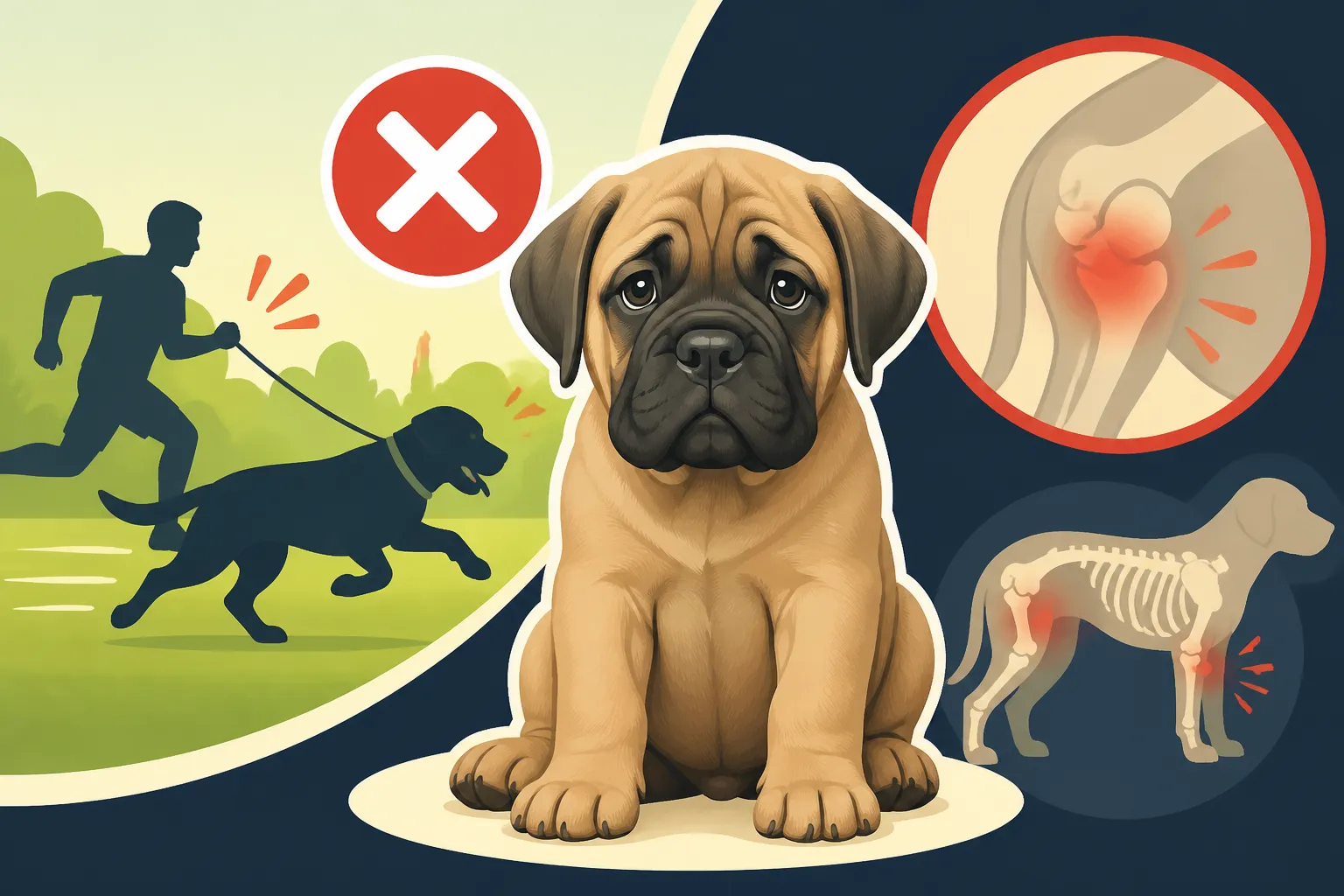
Now add weight. A small-breed puppy puts a few pounds on soft plates. A Mastiff puppy can put well over a hundred pounds on them before they finish closing. Every jump off a deck, every sharp turn while chasing a ball, and every long stretch on pavement loads those zones again and again. Our guide on How Fast a Mastiff Puppy Grows shows just how steep that curve is.
The Joint Problems Hard Exercise Can Make Worse
Mastiffs already carry a genetic risk for hip and elbow dysplasia, where the joint forms loosely or unevenly. Genes load the dice, but environment, including diet, body condition, and the type of exercise during growth, affects how badly the joint ends up formed. Repetitive impact and forced running do not cause dysplasia by themselves, yet they can push a borderline joint toward a worse outcome. Read Why a Mastiff’s Hips Fail Under Its Own Weight for the mechanics.
Other growth disorders show up in giant breeds too. Osteochondrosis, where a flap of cartilage fails to turn into bone properly, often appears in the shoulder or elbow. Panosteitis causes shifting lameness and bone pain in young, fast-growing dogs. None of these is caused only by exercise, but a puppy that is pushed hard while the skeleton is still remodeling is more likely to limp, and more likely to need imaging.
What Counts as Too Hard for a Mastiff Puppy
Owners often hear “don’t over-exercise” without any clear idea of where the line is. Here is how to tell the difference between healthy play and the activity that does damage.
Forced Exercise Versus Free Play
The key word is forced. Free play means the puppy chooses how far to go and when to stop. It trots across the yard, sniffs, flops down, and gets up again on its own schedule. Forced exercise means a human decides the pace and distance: jogging beside a bike, a long leash walk the puppy cannot quit, endless ball throws that keep the dog sprinting and skidding, or a hike that has to be finished because you are a mile from the car.
A Mastiff puppy almost always wants to please you and will keep going long after its body should stop. That is exactly why the decision needs to stay with you, and why short, puppy-led sessions beat long, owner-led ones. For more on the specific danger of running, see Why a Mastiff Puppy Must Not Run.
High-Impact Moves to Avoid
Some activities are risky no matter how short they are, because they put sudden, concentrated force on young joints:
- Jumping in and out of cars, onto beds, or off porches.
- Climbing long flights of stairs, especially going down.
- Rough wrestling with much bigger adult dogs.
- Repeated fetch with sudden stops and sharp turns.
- Running on hard pavement or slippery floors.
- Jogging, biking, or long hikes on a leash.
Stairs deserve special attention because they are part of daily life. Our article Why Stairs Are Worse for a Mastiff Than Any Breed explains the load involved, and Why a Mastiff Puppy Must Be Lifted Into a Car covers the safest way to handle car trips while your pup is still light enough to lift.
A Practical Activity Guide by Age
Many breeders and vets use a rough rule of thumb of about five minutes of structured walking per month of age, once or twice a day, with free play in a safe yard on top of that. It is a guideline, not a scientific limit, and your own vet may adjust it for your puppy. The table below shows how that idea plays out for a typical Mastiff.
| Age | Structured leash walking | Free play | What to avoid |
|---|---|---|---|
| 8 to 12 weeks | A few minutes around the yard | Short bursts on grass, many naps | Stairs, jumping, slippery floors |
| 3 to 6 months | Around 15 to 30 minutes split across the day | Gentle yard play, puppy-safe toys | Long walks, fetch marathons, rough play |
| 6 to 12 months | Gradually longer, still split into short walks | Supervised play with calm dogs | Jogging, hiking, jumping off things |
| 12 to 18 months | Longer walks at the puppy’s pace | Normal play, still on soft ground | Forced running and repeated impact |
| 18 to 24 months and beyond | Build toward adult walks after a vet check | Full play | Sudden jumps in distance or intensity |
For guidance on when to move past these limits, see The Age a Mastiff Can Start Real Walks.
Building a Strong Mastiff Without Hurting It
Restricting hard exercise does not mean a puppy should sit on the couch. A well-muscled, lean, confident Mastiff comes from the right kind of activity, not from no activity.
Low-Impact Activities That Help
Gentle sniffing walks on grass or forest trails are wonderful for a growing giant. They work the mind as hard as the body, and a mentally tired puppy is calmer at home. Short training sessions for sit, down, stay, and loose-leash walking build muscle control and focus. Puzzle feeders and scatter feeding slow down mealtimes and give the puppy a job.
Socialization outings count as exercise too. Sitting on a bench outside a quiet shop and letting your puppy watch the world is more valuable at this age than a long hike. Gentle swimming can be good later on, with a vet’s blessing, and our guide Whether a Mastiff Should Swim for Its Joints weighs the pros and cons.
Keeping Growth Slow and Steady
Exercise is only half the joint equation. Feeding plays a huge role, because a puppy that is too heavy or grows too quickly puts more strain on every joint. Large-breed or giant-breed puppy foods are formulated with controlled calcium and calories for exactly this reason, and adding extra calcium supplements can backfire. You should be able to feel the ribs easily under a thin layer of fat. Our guide Why a Mastiff Puppy Must Grow Slowly explains how diet and exercise work together.
Signs Your Puppy Has Done Too Much
Watch for these warning signs after activity:
- Limping that comes and goes or shifts between legs.
- Stiffness when getting up after a nap.
- Reluctance to climb stairs or get in the car.
- A bunny-hopping gait with both back legs moving together.
- Swelling or heat around a joint.
- Unusual tiredness or yelping when touched.
If you see any of these, cut back on activity and call your vet. Early imaging can catch problems while there are still more treatment options.
Planning for Vet Costs and Insurance
Even with perfect care, some Mastiff puppies will still develop joint disease, because genetics play a major part. Planning ahead protects both your dog and your budget.
Why Joint Problems Are Expensive in a Giant Breed
Everything costs more for a Mastiff: sedation, imaging, medication dosed by weight, and surgery on large joints. Hip and elbow procedures in giant breeds are among the most expensive orthopedic work a general owner is likely to face. Before you buy, ask breeders for parental hip and elbow results, and read Whether a Mastiff Contract Covers Elbows to see what a contract might cover.
When to Look at Pet Insurance
Pet insurance usually excludes conditions that show signs before coverage starts, so timing matters. Many owners enroll as soon as the puppy comes home, before any limping or vet notes appear. Healthy Paws is one of the insurers many large-breed owners compare, partly because its plans are built around accidents and illnesses rather than wellness. Some insurers, including Healthy Paws, have special rules about hip dysplasia depending on the age at which a pet enrolls, so read the policy terms carefully and check the provider’s own page for current details. For more, see The Month a Mastiff Owner Should Buy Insurance.
When you compare plans, look at waiting periods for orthopedic conditions, whether bilateral conditions are treated as one, and how premiums rise with age. A quote from Healthy Paws alongside two or three other providers gives you a good sense of the market. Insurance does not replace careful exercise; it simply gives you more options if a problem appears anyway.
A Mastiff puppy only grows once. By keeping exercise gentle and puppy-led for the first year and a half, feeding for slow growth, and planning ahead for vet costs, you give your dog the best chance of carrying all that weight on sound joints for many years.
Disclaimer
This article is for general informational purposes only and does not constitute professional advice. Laws, prices and regulations vary by location and change over time. Consult a qualified professional for guidance on your specific situation.