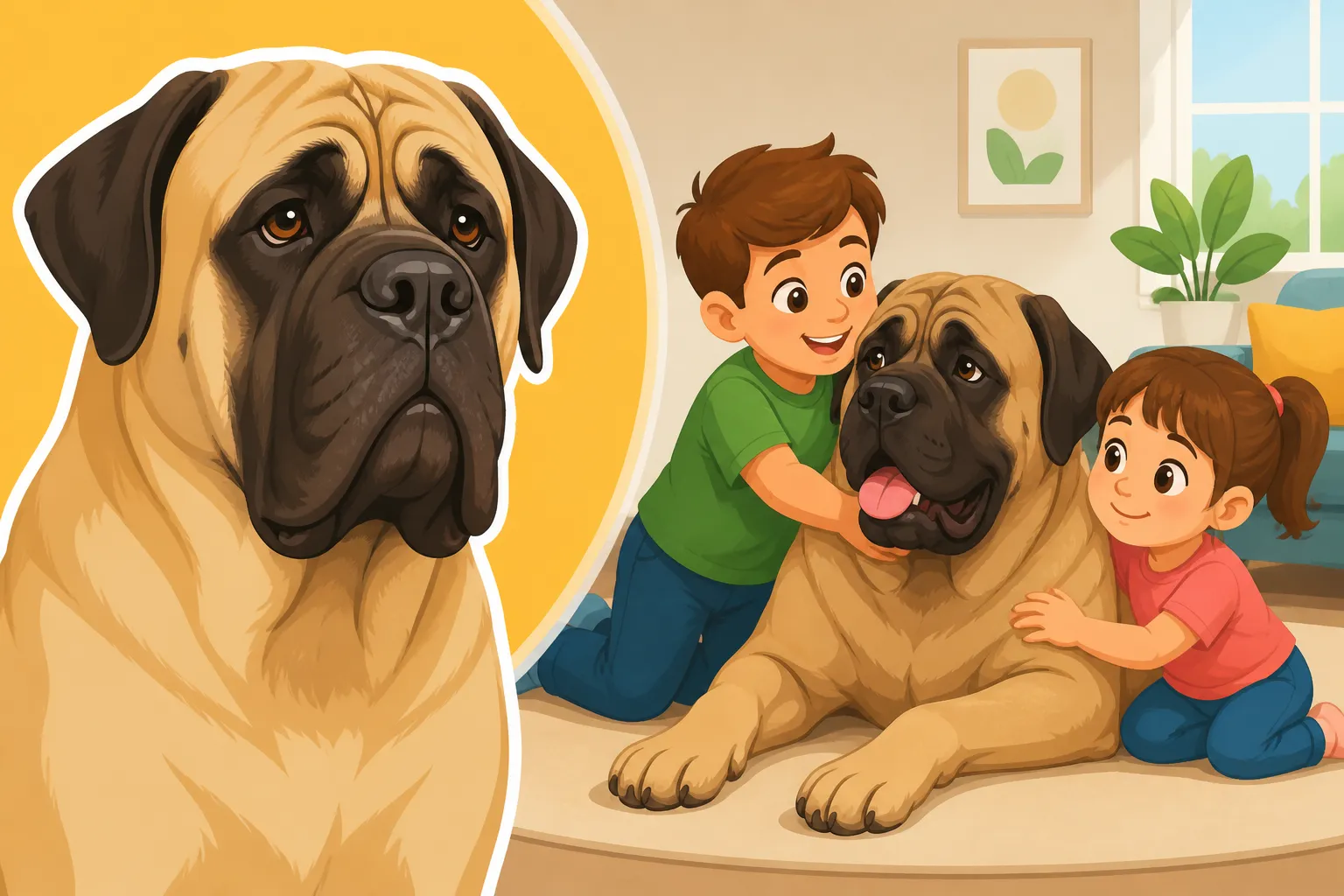
Whether a Mastiff Suits a Family With Young Children
A Mastiff can be a loving family companion, but its size changes the safety equation when young children are around. Even a gentle dog can knock over a toddler, step on small feet, or react badly to grabbing and crowding. This guide explains what family life with a Mastiff can involve, how to reduce everyday risks, and when another breed may be a better fit.
What living with a Mastiff and young children is really like
A gentle temperament does not make a dog automatically safe
Many Mastiffs are calm, affectionate, and happy to stay near their people. That can make them seem like natural family dogs. But “gentle” describes a tendency, not a guarantee. Individual dogs differ, and even a patient dog has limits—especially if it is tired, in pain, startled, or unable to move away.
The practical challenge is the Mastiff’s size. A dog may turn around, rise from a bed, or walk past a child without meaning to hurt anyone and still cause a fall. A happy tail can sweep a toddler off balance. A dog leaning in for affection can tip a small child backward. These are ordinary household moments, not necessarily signs of aggression, but they deserve serious planning.
That is why the question is not simply whether a Mastiff is friendly with children. It is whether the adults can reliably manage interactions, give the dog room to rest, and teach the child how to behave around a large animal. Families weighing those details may also find A Mastiff in a House With Small Children useful for thinking through the day-to-day setup.
Toddlers and preschoolers need especially close management
Young children are still learning impulse control. They may squeal, run, hug tightly, grab a jowl, or approach a sleeping dog before an adult can intervene. A toddler may also be too young to understand that a dog’s retreat, stiff posture, or growl is a request for space.
A Mastiff may respond by moving away, but its body can fill a hallway or doorway, leaving a child nowhere obvious to go. Some dogs tolerate clumsy handling; others do not. No family should rely on a dog’s tolerance as a safety plan. Read Whether a Mastiff Is Safe With Toddlers and Whether a Mastiff Tolerates Rough Handling From Children with the understanding that no breed can be assumed to accept rough treatment.
Supervision means an attentive adult is close enough to step in immediately—not watching from another room or distracted by a phone. If the adult needs to cook, answer the door, or help another child, use a secure gate, pen, or separate room so the dog and child are not together unsupervised. The same rule applies even when the dog has lived with the child for years.
The risks families should plan for
Accidental bumps can matter as much as bites
A large dog can injure a child without showing aggression. The dog may brush past a child on the stairs, crowd them while greeting a visitor, or rise suddenly from a nap. A child who falls against the dog may also frighten it. These situations are easy to underestimate because the dog may be behaving normally.
Consider a common scene: a preschooler is carrying a toy down a narrow hallway while the Mastiff gets up to follow a parent. Neither is doing anything “wrong,” but the dog’s shoulder can bump the child into a wall. Open floor space, predictable routes, and adult supervision help prevent this kind of collision. For a closer look at unintended knocks and other household mishaps, see The Damage a Mastiff Does by Accident.
Food, toys, and resting places need thought as well. Children should not approach the dog while it is eating, chewing, or sleeping, and adults should not ask a child to take a toy or bowl away. Give the Mastiff a quiet area that children are taught not to enter. A baby gate can make that boundary much easier to maintain than repeated verbal reminders.
Watch the dog’s signals and protect its chance to opt out
A dog may show discomfort subtly before it growls or snaps. Turning its head away, licking its lips, yawning when not tired, becoming still, moving away, or showing the whites of its eyes can be reasons to pause and create space. These signs do not diagnose a specific emotional state on their own, but they are a prompt to stop the interaction rather than press for a hug or photo.
Teach children simple rules: let the dog come to them, pet briefly on the shoulder or side if an adult approves, and stop when the dog moves away. No climbing, hugging around the neck, sitting on the dog, chasing, or disturbing it in its bed. Young children will need constant reminders, and the adult remains responsible for enforcing those rules.
If a dog growls, do not punish the warning or force the interaction to continue. Calmly separate dog and child, then consider what was happening and seek help from a veterinarian or qualified behavior professional if the behavior is new, repeated, or concerning. Growling is information that the dog needs space; suppressing it can make a situation harder to read. For practical supervision principles, see Whether a Mastiff Should Be Supervised With Toddlers.
| Situation | Safer family practice |
|---|---|
| The child wants to pet the dog | An adult checks that the dog is relaxed, invites a brief gentle touch, and ends the interaction if the dog moves away |
| The dog is eating or chewing | Keep the child out of the dog’s space; do not have the child take food or objects away |
| The dog is sleeping or resting | Leave the dog undisturbed and use a gate or separate space if needed |
| An adult is distracted or leaves the room | Separate dog and child securely rather than relying on casual supervision |
| The dog seems uncomfortable | Stop contact, create distance, and reassess instead of asking the dog to tolerate more |
Preparing a Mastiff for family life
Start training and socialization before the dog becomes difficult to manage
A Mastiff puppy may be small enough to redirect easily at first, but it grows into a powerful dog. Teach basic skills early: walking calmly on leash, settling on a mat, waiting at doors, leaving dropped items, and responding to a recall or “come away” cue. These skills help adults guide the dog around children without pulling or shouting.
Training should use calm, consistent rewards rather than intimidation. A dog that understands how to move away, settle, and accept handling is easier to manage, but training does not replace barriers or supervision. Families preparing for a puppy can read Teaching a Mastiff Before It Outweighs You and Socializing a Mastiff Puppy Before It Gets Heavy for more on building useful habits while the dog is still growing.
Socialization is not a matter of making the puppy greet every child or tolerate every touch. It means giving the dog positive, manageable exposure to ordinary sights and sounds while allowing it to observe from a comfortable distance. Children should be calm participants, not a crowd surrounding the puppy. Let the dog disengage; forcing contact can create unease rather than confidence.
Make the home work for both child and dog
Set up boundaries before the dog arrives. Decide where the dog can rest without being disturbed, where meals will happen, and how you will separate dog and child during busy moments. Baby gates, closed doors, and a secure exercise pen can make routines more dependable. Avoid placing the dog’s bed in a narrow passage where a child has to walk close by.
Think about footing and furniture too. A large dog that slips on polished flooring may stumble into a child or become reluctant to move. Runners in high-traffic areas can improve traction. Keep tempting food, small toys, and children’s belongings out of reach; a Mastiff’s height can make counters and low tables surprisingly accessible. Dog beds and durable enrichment toys can help create a comfortable resting routine. If you are comparing pet supplies, Chewy may be one place to browse options such as beds, gates, or toys, while checking that any item is suitable for your dog and home.
Plan for the less glamorous parts of ownership, too. Mastiffs can drool, shed, and take up substantial space. A family already stretched by a new baby or a toddler’s unpredictable schedule may find those tasks harder than expected. Chewy can also be a practical place to look for everyday pet-care supplies, but the important question is whether the household has the time and storage space to keep those supplies organized and use them consistently.
Is a Mastiff the right choice for your family?
Look at the adults’ capacity, not only the child’s affection for dogs
A child may adore a Mastiff, but adults carry the responsibility for training, veterinary care, supervision, exercise, and safe separation. Ask whether the adults can physically handle the dog on leash, arrange help when needed, and maintain household rules even when everyone is tired. A strong dog that pulls or plants itself can be difficult to manage; a young child should never be the person responsible for walking it.
Also consider the household’s layout. A small home is not automatically unsuitable, but narrow hallways, steep stairs, and limited places for separation can make management more complicated. Families expecting a baby should account for the period when routines change and adult attention is divided. Whether a Mastiff Suits a Family With a Baby offers another perspective on that transition.
When choosing an individual dog, ask about its observed behavior around children, noise, handling, and household activity. A breeder or rescue can share what they know, but no history can guarantee how a dog will respond in every future situation. Meet the dog calmly, avoid staging intense child-dog interactions, and seek guidance from a veterinarian or credentialed trainer if you are unsure.
Know when another choice may be safer
A Mastiff may be a poor fit if the adults expect the dog to tolerate rough handling, if children are routinely left alone with pets, or if there is no practical way to create a dog-only resting area. It may also be challenging for a family whose adults cannot safely control a large dog on leash or respond quickly if the dog moves toward a child.
That does not mean every family with young children should rule out a Mastiff. It means a good fit depends on the particular dog and the family’s ability to manage the environment every day—not just on affectionate photos or a reputation for being calm. The safest household makes space for the dog to choose distance, teaches children respectful behavior, and treats adult supervision as non-negotiable.
If you decide a Mastiff suits your family, prepare before bringing one home: agree on rules, set up barriers, choose a resting area, and plan who will handle training and care. If those arrangements feel unrealistic, waiting until the children are older—or choosing a dog whose size and needs better match your household—can be a thoughtful decision rather than a disappointment. Chewy can help with routine supply shopping once you have a dog, but no product replaces careful supervision, training, or a home setup that protects both child and dog.
Disclaimer
This article is for general informational purposes only and does not constitute professional advice. Laws, prices and regulations vary by location and change over time. Consult a qualified professional for guidance on your specific situation.