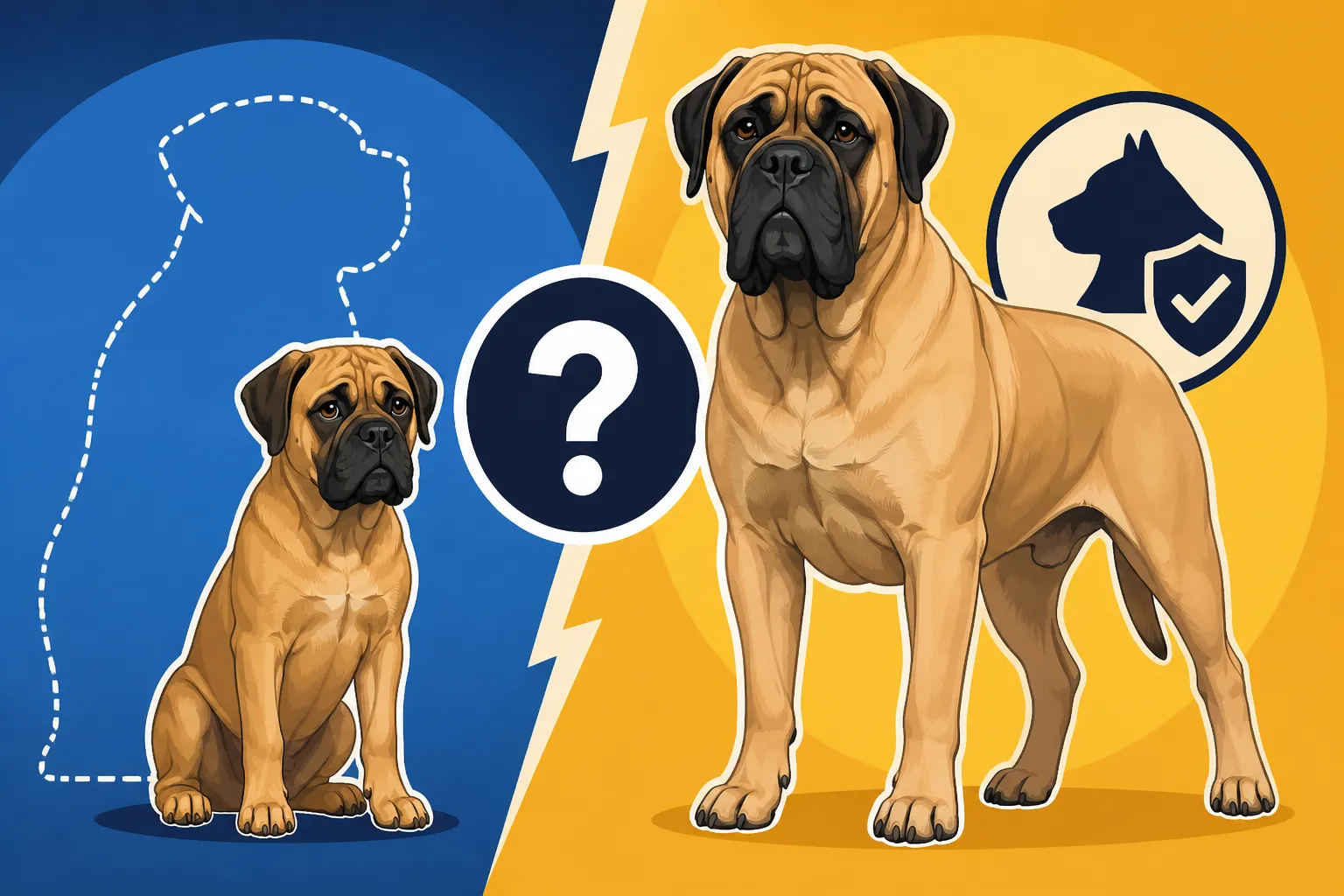
Whether an Undersized Mastiff Is Still Purebred
A Mastiff who stays noticeably smaller than expected can make owners question the pedigree, especially when littermates grow into towering adults. Size alone, however, does not determine whether a dog is purebred. This guide explains how to assess lineage, growth, health, and breed-standard size—and when a veterinarian, breeder, or registry can help answer the question.
Can an undersized Mastiff still be purebred
Size is not proof of ancestry
Yes. A Mastiff can be purebred and smaller than the size people expect from the breed. “Purebred” refers to ancestry and documented lineage, not simply whether a dog reaches a particular height or weight. A small adult may be unusual for the breed, but that alone does not establish that another breed is in the family tree.
Mastiffs vary. Two dogs from the same litter can end up different sizes, and a puppy’s growth may not follow the path suggested by a parent’s appearance. Sex, inherited traits, health, and individual development all contribute. A dog may also look smaller beside a particularly large Mastiff, even if its proportions and weight are otherwise within a healthy range.
It helps to separate three questions: Is the dog purebred by documented ancestry? Does the dog meet the relevant breed standard? Is the dog healthy and growing appropriately? Those questions overlap, but they are not interchangeable. A purebred dog can fall outside a show standard, and a dog that looks exactly like a Mastiff is not necessarily purebred.
What a breed standard can—and cannot—tell you
A breed standard describes the characteristics expected in an ideal representative of the breed. For Mastiffs, that includes overall structure and proportions as well as size. Standards are useful for understanding how a dog compares with the breed type, but they are not a genetic purity test or a diagnosis of health.
Different kennel organizations publish their own standards, so check the organization relevant to your country or the dog’s registration. You can also compare your dog’s measurements with general breed information such as What a Mastiff Actually Weighs, How Much a Male Mastiff Weighs, and How Much a Female Mastiff Weighs. Treat ranges as context rather than a verdict: body condition, frame, age, and veterinary assessment matter alongside the number on the scale.
A dog that is smaller than the standard may be considered outside the ideal for conformation competition, depending on the rules being applied. That does not automatically cancel its pedigree. Conversely, a large dog is not proven purebred just because it resembles the breed standard. Appearance can raise questions, but records are what provide the strongest evidence of ancestry.
How to assess a Mastiff’s pedigree and background
Start with registration and family records
If you bought your dog from a breeder, ask for the registration paperwork, the registered names or numbers of the parents, and any pedigree information that was included in the sale. A reliable breeder should be willing to explain what the documents show and help you understand how the puppy’s family relates to its size.
Registration records are valuable because they connect a dog to recorded ancestors under a particular organization’s rules. They are not the same as an independent genetic verification of every ancestor. The details vary by registry and registration type, so contact the organization directly if you need to confirm what a document establishes or whether a record can be corrected.
For a rescue or rehomed Mastiff, the history may be incomplete. That is common and does not make the dog less worthy of care. You can gather whatever information is available—previous veterinary records, breeder details, old registration documents, or a known parent’s name—but an uncertain pedigree should be described honestly rather than filled in with guesses.
Understand the limits of DNA breed tests
Consumer DNA tests can offer ancestry estimates, but they should not be treated as a definitive certificate of purebred status. Results depend on the company’s reference data and methods, and the report may describe genetic similarity rather than provide a complete, verified family tree. If the question has practical consequences, ask the relevant registry or a qualified genetics professional what evidence it accepts.
If you are comparing home DNA kits, look closely at what the test claims to establish and what its report actually includes. A kit you encounter while browsing Chewy or another retailer is still only as useful as the laboratory’s methods and the question you are trying to answer. Chewy may be a place to find consumer products, but a product listing does not verify a dog’s pedigree. Before ordering through Chewy, check the test maker’s explanation of its breed analysis and whether the results address ancestry estimates or formal parentage.
A DNA result can be a conversation starter, not a reason to dismiss paperwork or accuse a breeder of misrepresentation on its own. If a report appears inconsistent with a documented pedigree, contact the test provider and registry to understand what each result means. Keep copies of the paperwork and reports, and avoid making breeding or medical decisions based on a breed estimate alone.
Why some purebred Mastiffs stay smaller
Growth is influenced by more than one factor
Inherited size is not a simple calculation. A puppy may take after a smaller relative, and even full siblings can develop differently. Parents’ sizes offer clues, but they cannot guarantee an individual adult weight. For more context, see Whether Parent Size Predicts a Mastiff's Adult Weight.
Age matters, too. Mastiffs are a giant breed, and they do not finish maturing as quickly as many smaller dogs. A young adult can still be developing in body and muscle even after its height has largely settled. If you are trying to judge a dog before it has finished growing, The Age a Mastiff Stops Growing is a useful companion topic.
Nutrition affects development, but feeding more is not a safe way to try to make a Mastiff larger. Overfeeding can encourage excess weight rather than healthy skeletal development, and a heavy dog may place more strain on growing joints. A veterinarian can assess body condition and recommend an appropriate diet for the dog’s age and health. Avoid changing portions, supplements, or feeding plans just to chase a target size.
| What you notice | What it may mean | A sensible next step |
|---|---|---|
| A puppy is smaller than its littermates | Normal variation, a difference in development, or a health concern | Track growth and ask the veterinarian to assess it |
| An adult is below a breed-standard size | The dog may be outside the ideal standard but still have purebred ancestry | Review pedigree records and check the applicable standard |
| The dog is losing weight or not gaining as expected | Illness, parasites, feeding issues, or another problem may be involved | Arrange a veterinary examination |
| The dog looks Mastiff-like but has no records | Appearance alone cannot confirm ancestry | Gather available history and consider professional guidance |
Small size is not the same as poor health
Some Mastiffs are simply smaller, proportionate individuals. Others may be lean, underweight, or affected by a condition that has limited growth. These possibilities can look similar to an owner at first, which is why a home judgment based on height or weight alone is not enough.
Pay attention to the whole dog. A healthy weight assessment considers body condition, muscle, appetite, energy, stool, and growth history—not just whether the dog seems small beside another Mastiff. A vet can review the dog’s growth pattern and decide whether examination or testing is appropriate. If the dog’s size is accompanied by poor appetite, persistent digestive problems, weakness, or a sudden change in weight, do not assume it is simply a small build.
Puppy growth deserves particular care. Rapid weight gain is not a goal in itself for a giant-breed puppy, and an owner should not use a generic chart as a substitute for an individual assessment. For additional feeding context, see How Much a Mastiff Puppy Eats—and discuss any concerns about growth or body condition with your veterinarian.
What to do if your Mastiff seems unusually small
Build a clear record before drawing conclusions
Write down your dog’s age, current weight, previous weights, diet, appetite, and any changes in health or behavior. If the dog is still growing, record measurements over time rather than trying to interpret one weigh-in. A single number can be misleading, especially if the dog is young, recently ill, or being compared with an unusually large relative.
Gather the papers you already have: purchase or adoption records, vaccination history, veterinary notes, registration documents, and any available information about the parents. Ask the breeder specific questions rather than making a general accusation. For example, you might ask whether the parents had recorded measurements, whether other puppies from the litter are similar in size, and what documentation supports the dog’s pedigree.
If the dog came from a rescue, ask what the organization knows and what it does not know. A rescue may have no reliable access to the parents’ records. That uncertainty is frustrating, but it is better to distinguish “unknown” from “not purebred” than to treat a missing paper trail as proof either way.
Get help from the right person for the right question
For concerns about weight, growth, or symptoms, start with a veterinarian. Bring your notes and ask whether your dog’s body condition and development appear appropriate. If the vet identifies a possible medical issue, follow the recommended evaluation rather than focusing only on breed identity.
For pedigree questions, speak with the breeder or registry and provide the dog’s identifying details. For questions about whether a dog fits a show standard, consult the standard used by the relevant kennel organization or ask a knowledgeable breed mentor. These are separate routes: a veterinarian can assess health, while a registry can explain its records and rules.
If your dog is healthy but smaller than expected, there may be no problem to solve. You can still describe the dog accurately: a Mastiff with documented lineage, a Mastiff with uncertain ancestry, or a dog that resembles a Mastiff. The distinction is useful when discussing registration, breeding, or competition, but it does not determine how much the dog belongs in your family. For broader context on expected size differences, Whether a Female Mastiff Is Much Smaller can help you compare sex-related variation without treating it as a test of purity.
Disclaimer
This article is for general informational purposes only and does not constitute professional advice. Laws, prices and regulations vary by location and change over time. Consult a qualified professional for guidance on your specific situation.