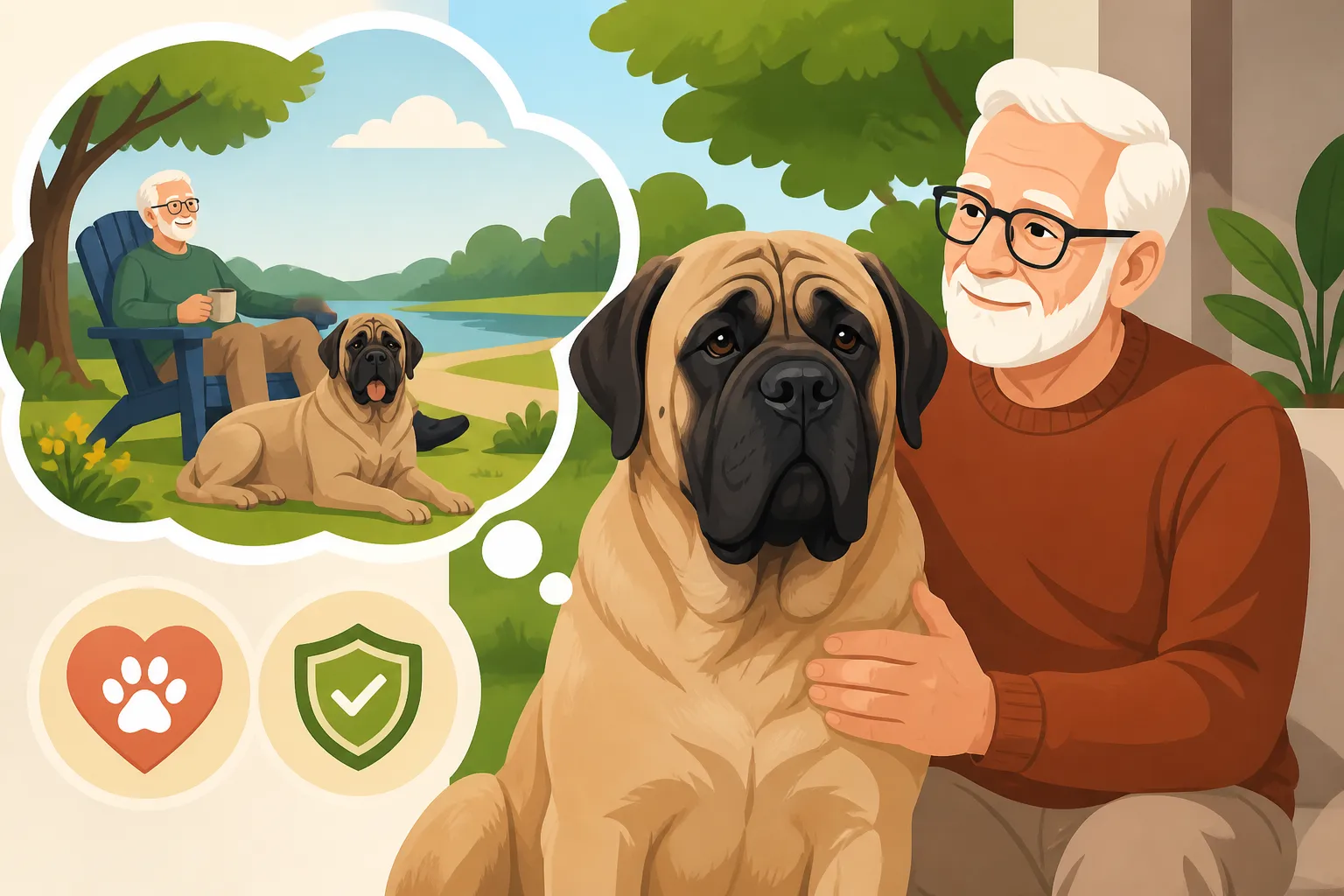
Whether a Mastiff Suits a Retired Owner
A Mastiff can be a gentle, affectionate companion for a retired owner, but its size changes the practicalities of daily life. The key question is not simply whether you have more time at home; it is whether you can safely manage a very large dog’s strength, care needs, expenses, and backup arrangements as both of you age.
Is a Mastiff a good fit for retirement
Time at home helps, but physical capacity matters too
Many Mastiffs are content with a fairly calm routine: companionship, short walks suited to the individual dog, and plenty of time to lounge near their people. Retirement can make that routine easier to provide. You may be available for regular meals, toilet breaks, training, and the kind of quiet company a people-oriented dog often enjoys.
But having time is not the same as being able to manage a giant dog in a difficult moment. An adult Mastiff may be heavy enough that guiding one through a doorway, helping it into a vehicle, or preventing it from rushing toward something can be a serious physical challenge. A dog that normally walks politely can still pull suddenly if startled, excited, or uncomfortable. The practical question is whether you can stay on your feet and manage the leash if that happens.
Consider your everyday surroundings, not only your best days. If you have painful hands, limited balance, a steep front path, or stairs between the dog and the yard, those details can matter. Even routine tasks such as lifting a paw to inspect it or helping a dog that has slipped may be hard when the dog is this large. For a closer look at mobility and handling, see Whether a Mastiff Suits Someone Who Cannot Lift It.
A calm temperament does not make the dog effortless
Mastiffs are often described as laid-back, but temperament varies by dog. A relaxed dog can still take up a lot of room, knock into someone by accident, lean heavily against a person, or block a narrow hallway. Those everyday moments may be manageable in a roomy home with secure footing and carefully arranged furniture; they can be less comfortable for someone who is unsteady or lives in a tight space.
Training is part of safe ownership, not an optional extra. A Mastiff should learn early to walk on a loose leash, wait at thresholds, greet visitors calmly, and cooperate with handling. Because a young dog grows quickly, it is far easier to establish those habits before the dog is full-sized. A small puppy may seem easy to redirect, but the same behavior becomes harder to manage as its body grows.
If you are considering a first giant breed, think honestly about whether you want to train and supervise a large adolescent dog. A calm adult with a known history may be a better fit than a puppy, but adult dogs still need time to settle into a new home. The guide Whether a Mastiff Suits a First Time Owner can help you weigh the learning curve more broadly.
The daily realities of caring for a giant dog
Plan for walks, stairs, floors, and hot weather
Mastiffs generally do not need to be treated like endurance athletes, and strenuous exercise can be a poor match for their build, especially while they are growing. Still, they need appropriate movement, regular toilet opportunities, and mental engagement. The right routine depends on the individual dog’s age, health, fitness, and veterinary advice. A short, manageable walk may be more realistic than a long outing, particularly in warm weather.
Think about the route before bringing a dog home. Are there hills, slippery steps, or stretches where you cannot easily turn around? Can you walk at a time of day when the pavement and air are comfortable? A giant dog may overheat more readily than a smaller, lighter companion, so outdoor plans need to account for conditions and the dog’s response. For more on the breed’s needs in warm conditions, see Whether a Mastiff Suits a Hot Climate.
Inside, traction and access matter. Bare, slick flooring can be hard for a large dog to navigate and may make falls more likely. Runners and rugs can help create a safer path between resting areas, the water bowl, and the door. If there are stairs, consider whether the dog can avoid them or whether you can manage the arrangement safely if its mobility changes. See Whether a Mastiff Needs Runners Through the House for practical flooring considerations.
Care tasks can become harder as you both age
A Mastiff’s short coat is not the same as no maintenance. You will still need to manage shedding, clean ears as appropriate, keep nails at a comfortable length, and check the skin around folds. Drool is another ordinary part of life with many Mastiffs: it may end up on the floor, furniture, or your clothes after drinking or shaking its head. Some owners keep towels in convenient places and wipe the dog’s jowls after water breaks.
The most important issue for a retired owner may be whether you can keep up these routines without straining yourself. Nail care, bathing, and veterinary examinations can be awkward when the dog is reluctant to cooperate or cannot comfortably stand for long. Practice calm handling gradually, and ask your veterinarian about safe ways to make care easier. If outside help may be needed, check in advance whether a groomer or clinic can comfortably handle a dog of the individual’s size.
Supplies also take up space. Food storage, a large bed, bowls, cleaning cloths, and mobility aids all need a place in the home. When planning purchases, compare suitable options and availability rather than assuming a standard-size item will work. A retailer such as Chewy may be one place to check for everyday supplies, while a veterinarian or experienced Mastiff owner can help you assess what is appropriate for your particular dog.
Health, expenses, and backup care
Budget for routine care and unexpected needs
A large dog can bring higher practical costs than a smaller one. Food, medication, preventive care, equipment, and veterinary procedures may all be affected by the dog’s size. Exact expenses depend on location, the dog’s health, and the services or products chosen, so it is sensible to request estimates from nearby veterinary practices before committing.
Do not plan only for an ordinary year. Ask yourself how you would handle an urgent clinic visit, a mobility problem, or a period when the dog needs closer supervision. A Mastiff that cannot get into your car may require a different transport plan. You might need help from a family member, a neighbor, or a professional service, and that help should be identified before an emergency rather than after one begins.
Insurance and savings are separate considerations to discuss and compare. Read policy terms closely, including exclusions, deductibles, and limits, and ask your veterinarian what health concerns are relevant to the dog’s age and history. A general overview of the breed’s health considerations is available in Which Cancers Mastiffs Get, though only a veterinary professional can assess an individual dog’s risks and symptoms.
Make a plan for mobility changes
Mastiffs can develop joint and mobility problems, and a large dog that struggles to rise can be difficult for one person to assist. A ramp, well-fitted harness with handles, non-slip flooring, or help from another adult may make some situations more manageable, but equipment should be chosen to suit the dog and its specific needs. It is also worth asking a veterinarian to show you safe handling techniques rather than trying to lift a heavy dog without guidance.
Think through a realistic worst-case scenario: your dog slips on the way out, cannot manage the steps, or becomes too unwell to walk to the car. Who can come over? Is there a way for that person to enter the home? Can the dog reach an accessible outdoor area? Your answers may point to changes you can make now, such as adding flooring traction or arranging a reliable backup person.
A good plan protects you as well as the dog. If you have a health condition that could limit your ability to walk or care for the dog temporarily, identify someone who can take over before you need them. For older dogs, Lifting an Old Mastiff Without Hurting Yourself covers a challenge that is worth anticipating rather than improvising.
Choosing a Mastiff that fits your retirement
Consider an adult dog with a known temperament
A puppy offers the chance to shape habits from the beginning, but it also brings months of house training, supervision, socialization, and growth. A young Mastiff may be strong before it has mature judgment or reliable leash skills. That combination can be tiring for an owner who wants a predictable, low-impact routine.
An adult dog may already be house-trained and have a clearer personality, but age alone does not guarantee an easy fit. Ask about leash manners, comfort with visitors, handling tolerance, medical history, and behavior around other animals. Meet the dog more than once if possible, and take a normal walk together in a safe setting. Notice whether you can comfortably hold the leash and guide the dog without being pulled off balance.
A rescue organization or responsible breeder should be willing to talk frankly about what is known and what remains uncertain. Avoid choosing based only on a dog’s gentle appearance or a reassuring label. The best match is the individual whose habits, health, and energy level fit your actual home and capabilities.
Use a practical fit check before you commit
The table below can help you turn a general feeling of readiness into specific questions. If several answers depend on “I’ll figure it out later,” pause and solve those issues first.
| Area to consider | Questions to ask yourself | A helpful sign |
|---|---|---|
| Leash control | Can I manage a sudden pull without losing balance? | The dog is well trained, and you can control it comfortably |
| Home access | Are floors, steps, and doorways workable for a giant dog? | There is a safe route to rest, food, and the outdoors |
| Transport | How would I get the dog to a clinic if it could not jump into my vehicle? | A ramp, suitable vehicle, or reliable helper is available |
| Daily care | Can I manage cleaning, feeding, grooming basics, and toilet breaks? | The routine feels sustainable on an ordinary day |
| Budget | Can I cover routine care and prepare for unexpected needs? | You have a clear financial plan and understand likely care needs |
| Backup support | Who can help if I am ill, injured, or away? | At least one dependable person knows the dog and can step in |
A Mastiff can be a wonderful retirement companion for someone who enjoys a quiet, close relationship with a dog and has the physical, financial, and practical support to care for one. It may be a poor fit if you need a dog you can easily lift, transport, or restrain on your own, or if your home has access barriers that cannot be changed.
If you are still deciding, speak with Mastiff owners, a veterinarian, and any rescue or breeder you are considering. Be candid about your mobility and future plans. Chewy can be a convenient place to compare routine supplies, but supplies cannot solve the bigger questions of safe handling, transport, and backup care. A thoughtful match is less about whether retirement provides extra hours and more about whether the dog’s whole life fits the support you can reliably offer.
Disclaimer
This article is for general informational purposes only and does not constitute professional advice. Laws, prices and regulations vary by location and change over time. Consult a qualified professional for guidance on your specific situation.