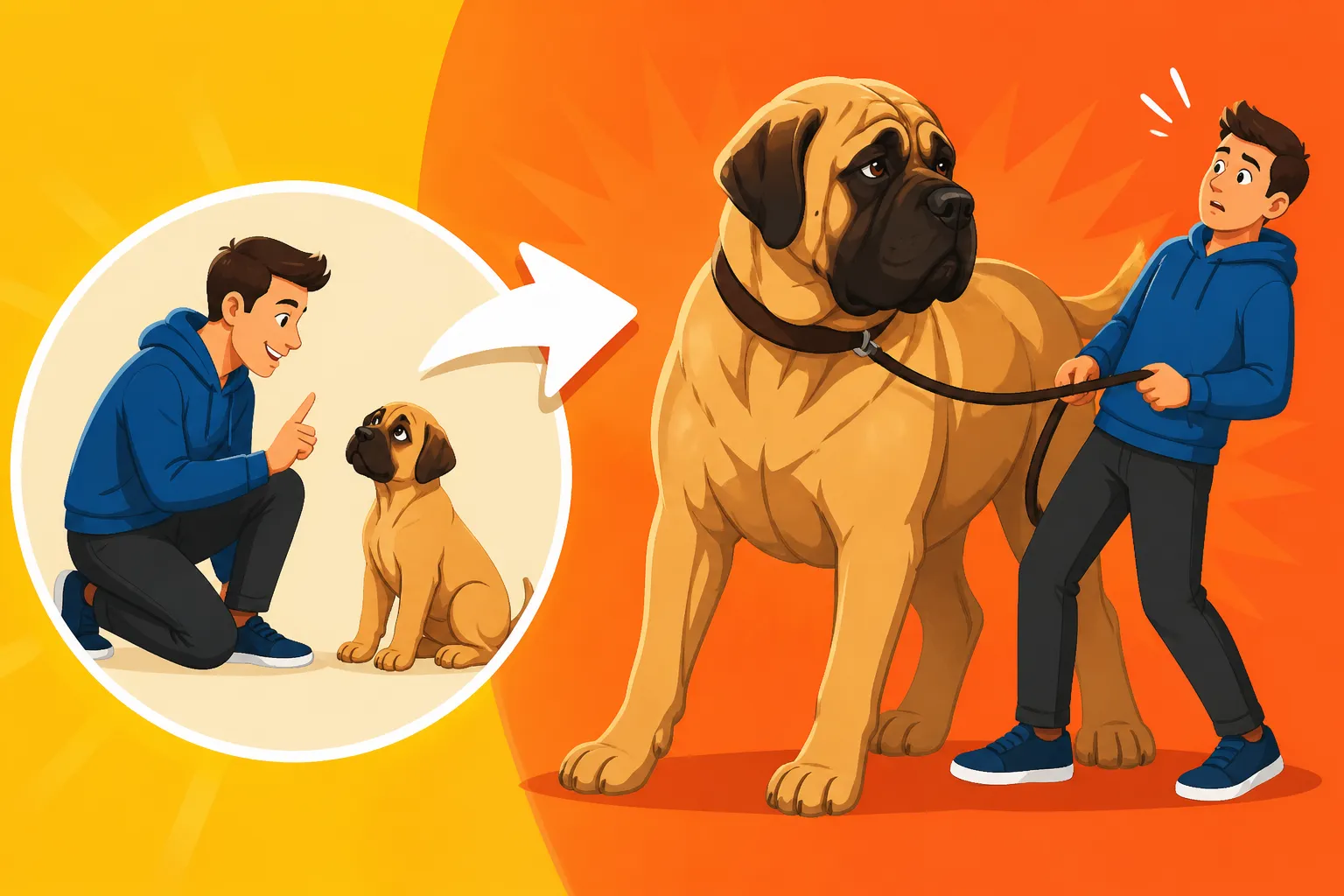
Teaching a Mastiff Before It Outweighs You
One of the biggest lessons you'll learn as a Mastiff owner is that time is not on your side when it comes to training. That adorable, wobbly fluffball you brought home at eight weeks old will soon outweigh a full-grown human, and trying to teach a two hundred-pound dog to not jump on Grandma is a vastly different challenge than teaching a twenty-pound puppy the same thing. This guide is all about giving you the tools and mindset to establish good habits and boundaries with your Mastiff while they're still manageable, ensuring a harmonious life for everyone involved.
The Urgency of Early Training: Why Size Matters Sooner Than You Think
It's easy to get lost in the sheer cuteness of a Mastiff puppy. Those big paws, the wrinkly face, the clumsy play – it's all incredibly endearing. But under all that fluff is a freight train in the making, and understanding the rapid timeline of their growth is crucial to effective training. What seems like a minor annoyance in a small puppy can quickly become a serious safety concern or a monumental struggle when that puppy hits adolescent size.
The Rapid Growth Spurt: Understanding the Timeline
Mastiffs grow at an astonishing rate. They don't just get taller; they pack on immense muscle and bone density at a speed that can be hard to fathom for owners accustomed to smaller breeds. A Mastiff puppy can gain several pounds a week during its peak growth phases. This isn't just about their weight; it's about their sheer physical presence and the force they can exert. By six months, many Mastiff puppies are already seventy, eighty, even a hundred pounds. That's a strong, adolescent dog that can easily pull an adult off their feet, knock over furniture, or send a small child sprawling. This rapid growth means you have a very narrow window to instill fundamental behaviors before sheer size becomes a dominant factor in every interaction. Waiting until your Mastiff is a year old to address issues like leash pulling or jumping is often too late for comfortable, safe resolution without professional intervention. It truly underscores why understanding The First Year With a Mastiff Puppy That Doubles in Size is so vital.
The Physics of a Giant Breed Puppy: Already a Force to Be Reckoned With
Even a seemingly small Mastiff puppy has a significant bone structure and natural strength. When a small breed puppy jumps, it might be a nuisance. When a Mastiff puppy jumps, even at four months old, it can bruise you. When they pull on a leash, they're not just tugging; they're anchoring themselves with impressive stability. Their center of gravity is lower, their paws are larger, and their frame is built for immense power. Understanding this physical reality means you can't approach training with the same casual attitude you might for a smaller dog. Every interaction, every lesson, needs to be approached with the future two hundred-pound dog in mind. You're not just training a puppy; you're molding a giant. This means proactive, consistent, and patient work from day one. You want to avoid the situation where you're asking yourself How Much Force a Mastiff Can Apply on a Leash when they're already adult size.
Establishing Leadership Early: Beyond Alpha Theories
Forget outdated "alpha dog" theories; establishing leadership with a Mastiff isn't about dominance, but about clear communication, consistency, and trust. Your Mastiff needs to see you as a reliable guide, someone who provides structure, safety, and clear boundaries. This means you decide when and where things happen. You initiate play, you dictate meal times, you lead on walks, and you control access to resources. This isn't about being mean or withholding affection; it's about creating a predictable environment where your Mastiff understands their place in the household hierarchy. When a giant breed trusts you to lead, they're far more likely to defer to your judgment, even when their instincts tell them otherwise. This foundation of trust and clear communication is far more effective than trying to physically overpower a dog that will soon be much stronger than you. It's about setting the expectation that you are the decision-maker, without ever resorting to fear or intimidation, because Why Harsh Correction Ruins a Mastiff is a lesson you'd rather not learn the hard way.
Foundation Skills: Non-Negotiables for a Future Giant
Some training commands are simply more important for a Mastiff than for, say, a Chihuahua. When your dog is the size of a small pony, certain behaviors become absolutely critical for public safety, your own physical well-being, and the dog's ability to navigate the world comfortably. These are the "must-haves" that you need to prioritize from the moment your puppy steps through your door.
Leash Manners: Preventing the "Sled Dog" Scenario
A pulling Mastiff is an unstoppable force. Even a well-meaning lunge towards a squirrel can send an unsuspecting owner flying. Teaching your Mastiff to walk politely on a leash, without pulling, is perhaps the single most important skill you can instill early. Start with short, frequent sessions in a quiet area, rewarding every step your puppy takes with a loose leash. Use high-value treats and enthusiastic praise. A front-clip harness can be an invaluable tool during this learning phase, giving you more leverage and redirecting their forward momentum without causing discomfort around their throat. Remember, you're building habits, and it's far easier to prevent pulling from becoming ingrained than to break it later. Consider investing in a good quality, strong front-clip harness. Many options are available on Amazon that are designed for large breeds and can help give you more control during these crucial learning stages.
It's not just about not pulling; it's about teaching them to walk with you, paying attention to your pace and direction. Stop every time they pull, wait for the leash to slacken, then continue. This teaches them that pulling gets them nowhere, and a loose leash allows them to move forward. This patience in early puppyhood will save your shoulders and back in the years to come. Don't underestimate how quickly a small pull becomes an uncontrollable drag. When you are asking yourself Whether a Mastiff Can Be Walked by One Person in the future, the answer will depend heavily on the work you put in now.
Recall: Safety Net for a Gentle Giant
A reliable recall – coming when called – is essential for any dog, but especially for a Mastiff. Imagine a two hundred-pound dog casually ambling away from you towards a busy street or an unfamiliar dog. The thought alone is terrifying. Start practicing recall in a confined, safe area like your backyard. Use a happy, excited tone of voice and reward your puppy lavishly with treats and praise every single time they come to you. Don't just call them when it's time to go inside; call them for no reason, reward them, and then let them go back to playing. This builds a positive association with coming when called, rather than seeing it as the end of fun.
As they get older and more reliable, gradually introduce distractions. A long line (a very long leash) can be a fantastic tool for practicing recall in slightly more open, but still safe, environments. This allows you to give them a sense of freedom while still having a physical way to bring them back if they get distracted. Never punish your Mastiff for a slow or failed recall; this will only teach them to avoid coming to you. A strong recall is a cornerstone of responsible giant breed ownership and gives you peace of mind in various situations.
Polite Greetings: Keeping All Four Paws on the Floor
A Mastiff jumping up to greet someone, even out of pure joy, can be dangerous. They can easily knock over an elderly person, a child, or even a robust adult. Teaching polite greetings from day one is paramount. As soon as your puppy starts to jump, turn your back and ignore them. Only engage when all four paws are on the floor. When they sit or stand calmly, reward them with attention and a treat. Enlist friends and family to help reinforce this rule. Consistency is key here.
It's also important to manage the excitement. Teach your Mastiff a "place" command or to lie down calmly when guests arrive. This helps them learn to control their impulses. Remember, the goal isn't to squash their enthusiasm, but to channel it into acceptable behaviors. A gentle giant is one who understands how to interact respectfully with people of all sizes, and teaching them to keep their paws to themselves is a critical part of that. This early training can prevent serious accidents and ensure your Mastiff is a welcome presence wherever they go, helping to avoid issues such as Whether a Mastiff Jumps Up on Visitors later on.
Managing the Mastiff's Environment: Safety for Them and You
A Mastiff puppy quickly grows into a significant presence in your home. Their size necessitates specific considerations for their living environment, not just for their comfort, but for the safety and smooth operation of your household. Proactive management of their space and how they interact with it can prevent many common giant breed challenges.
Crate Training: A Sanctuary and a Management Tool
Crate training is invaluable for a Mastiff. It provides them with a safe, den-like space where they can relax and feel secure. For you, it's an essential management tool for house training, preventing destructive chewing, and ensuring they have a quiet place when you can't actively supervise them. Given their eventual size, a truly giant-sized crate is a significant investment, but it's one of the best investments you can make. The crate should be large enough for your adult Mastiff to stand up, turn around, and lie down comfortably.
Introduce the crate positively, making it a comfortable, inviting space with soft bedding and toys. Feed meals in the crate and give special treats only when they are inside. Never use the crate as punishment. Early, positive crate training makes a huge difference in managing a large puppy and later, an adult Mastiff. Many robust, extra-large crates can be found on Amazon, but be sure to check dimensions carefully to ensure it will truly fit your fully grown Mastiff. An online training program like BAXTER & Bella often has modules on successful crate training, which can be immensely helpful for giant breed puppies.
Doorway and Threshold Manners: Preventing Accidental Blocks
A two hundred-pound Mastiff lounging in a doorway or barging through can be a real problem. From early puppyhood, teach your Mastiff to wait patiently at thresholds. This means they should not bolt out the front door, through a gate, or even through an interior doorway without your explicit permission. Use a "wait" or "stay" command and consistently make them pause before allowing them to pass. This isn't about being mean; it's about safety. An uncontrolled Mastiff charging through a doorway can knock you over, escape, or create a dangerous situation.
This also applies to getting in and out of cars. A young Mastiff should be taught to wait before jumping in or out, and as they grow, you might need to teach them to use a ramp to protect their developing joints. Why Stairs Are Worse for a Mastiff Than Any Breed highlights the importance of managing physical strain on their body, and doorways are no different. Consistent training around these physical boundaries establishes good manners and keeps everyone safe.
Car Travel: Getting a Growing Puppy In and Out Safely
Transporting a Mastiff, even a growing puppy, requires forethought. Their size quickly makes casual lifting impossible. From a young age, expose your Mastiff puppy to car travel positively. Reward them for calmly getting into and out of the vehicle. For larger puppies and adults, a sturdy ramp is almost always necessary to prevent injuries to their joints, which are already under immense strain from rapid growth. Imagine trying to lift a hundred-pound dog into an SUV multiple times a week; it's not sustainable or safe for your back or their joints.
Teach them to use the ramp with treats and praise, making it a fun and positive experience. Always secure your Mastiff in the car using a crash-tested harness or a secure crate. This protects them in case of an accident and prevents them from becoming a dangerous projectile. Prioritizing safe car travel early on means you won't be scrambling for solutions when your Mastiff is too big to lift. This also touches on Why a Mastiff Puppy Must Be Lifted Into a Car until they can manage a ramp.
Positive Reinforcement and the Sensitive Mastiff Brain
Mastiffs are often described as sensitive giants. Their imposing size can sometimes belie a surprisingly soft and thoughtful nature. Understanding this inherent sensitivity is key to successful training. Positive reinforcement methods, focused on reward and clear communication, are almost universally effective and far preferable to harsh or punitive approaches.
Motivation: What Really Clicks for a Mastiff
Mastiffs are intelligent but can be deliberate thinkers. They're not always eager to please in the same frantic way a working breed might be. For a Mastiff, motivation often boils down to "what's in it for me?" High-value treats, like small pieces of cooked chicken, cheese, or hot dogs, are excellent motivators. Praise, gentle petting, and short bursts of play with a favorite toy can also be effective, but typically come second to food for initial learning.
The key is to find what your individual Mastiff values most and use it strategically. Keep training sessions short and engaging to maintain their interest. If a Mastiff gets bored or feels pressured, they're likely to disengage or simply plant themselves, which, at their size, means the session is over. Understanding What Actually Motivates a Mastiff is the first step to unlocking their potential.
Avoiding Harsh Corrections: The Mastiff's Emotional Response
Mastiffs do not respond well to harsh corrections, yelling, or physical punishment. Due to their sensitive nature, such methods can quickly lead to fear, shutdown, or resentment. A Mastiff that becomes fearful of its owner can develop behavioral problems, including aggression, which is a dangerous scenario with a dog of this magnitude. Instead of compliance, you'll get avoidance or a complete refusal to engage.
Focus on redirecting unwanted behaviors and rewarding desired ones. If your Mastiff does something wrong, avoid making a big fuss. Calmly interrupt the behavior, redirect them to something appropriate, and then reward that positive choice. For example, if they mouth you, calmly say "no" or "off," give them a chew toy, and then praise them for chewing the toy. This approach builds trust and confidence, essential components for training such a physically powerful yet emotionally sensitive breed. Remember that How a Mastiff Sulks After Being Told Off indicates their sensitive nature.
Short, Sweet, and Consistent: Tailoring Training Sessions
Given their deliberate nature and potential for boredom, Mastiffs thrive on short, frequent training sessions rather than long, drawn-out ones. Aim for 5-10 minute sessions, several times a day. This keeps them engaged, prevents them from getting tired or frustrated, and helps reinforce lessons repeatedly throughout the day. Consistency across all family members is also paramount. Everyone in the household needs to use the same commands, hand signals, and expectations. A Mastiff who gets conflicting signals will become confused and inconsistent.
Think of training not as a separate activity, but as an ongoing conversation throughout your day. Incorporate commands into everyday interactions: "sit" before receiving dinner, "wait" at the door, "come" for a cuddle. This makes training a natural part of their routine and strengthens their understanding of what you expect. A structured online puppy school like BAXTER & Bella can provide excellent guidance and consistency in your training approach, offering bite-sized lessons that work well with a Mastiff's learning style.
Socialization: Building a Confident, Well-Adjusted Giant
Socialization for a Mastiff puppy isn't just about exposing them to new things; it's about doing so safely, positively, and in a controlled manner that builds confidence without overwhelming them. A poorly socialized Mastiff can become fearful or reactive, and a fearful or reactive giant is a significant concern.
Controlled Exposure: Quality Over Quantity
When socializing a Mastiff puppy, prioritize quality interactions over sheer quantity. It's not about meeting every single person and dog on the street. It's about having positive, brief, and calm experiences. Introduce your puppy to a variety of sights, sounds, smells, people of different ages and appearances, and other friendly, vaccinated dogs. Always keep these experiences positive with treats and praise. If your puppy seems overwhelmed or scared, gently remove them from the situation and try again later, at a lower intensity.
A great way to do this is to take your puppy to a quiet park and simply sit and observe. Let them take everything in from a distance, rewarding their calm behavior. Allow friendly strangers to offer treats if they approach gently. This teaches your Mastiff that new experiences are good and safe, without forcing them into uncomfortable situations. This thoughtful approach can prevent What Becomes of an Undersocialized Mastiff.
Interacting with Children and Other Animals: Gentle Giants in Training
If you have children or other pets, deliberate training for gentle interactions is crucial. Mastiffs can be wonderful with children, but their size means accidental bumps or knocks can be serious. Teach your puppy to be calm around children, rewarding gentle play and discouraging jumping or nipping. Always supervise interactions between your Mastiff and young children. Teach children how to respectfully interact with the dog, understanding when to give them space.
For other pets, introduce them slowly and under supervision. Ensure positive experiences, rewarding calm behavior from all animals involved. Never leave a Mastiff puppy unsupervised with smaller pets until you are absolutely certain of their gentle interactions. Early, positive exposure will foster a sense of tolerance and companionship that is vital in a multi-pet household. It will lay the groundwork for a harmonious relationship, preventing issues such as Whether a Mastiff Tolerates a Small Dog.
Public Outings: Preparing for the World Outside
Getting your Mastiff comfortable in various public settings is part of building a well-adjusted companion. Start with low-stimulation environments like quiet neighborhoods or pet-friendly stores during off-peak hours. Focus on loose-leash walking and polite greetings. Gradually increase the level of distraction as your Mastiff gains confidence and skill. Always bring high-value treats to reinforce positive behavior.
Remember that a Mastiff will attract a lot of attention. Be prepared for people to want to pet them. Use these opportunities to reinforce polite greetings: "Four paws on the floor, please," or "He's learning to 'sit' for pets." Carrying treats to hand to friendly strangers to give your dog can also create positive associations. Exposure to different environments builds a confident dog who isn't easily startled, making life easier and safer for everyone. This can include experiences like going to a local hardware store or walking through a bustling outdoor market, provided it’s not too overwhelming.
Addressing Specific Giant Breed Challenges Early
Certain behaviors, while problematic in any dog, take on a whole new level of concern when you're dealing with a Mastiff. Addressing these challenges early, before your puppy's size makes them truly unmanageable, is essential.
Jumping: A Danger at Any Size
We've touched on polite greetings, but jumping isn't just a greeting behavior; it can be an expression of excitement, attention-seeking, or frustration. A Mastiff who jumps on people, counters, or even walls can cause significant damage or injury. The key to stopping jumping is consistent enforcement from everyone. If your Mastiff jumps on you, turn your back, cross your arms, and completely ignore them until all four paws are on the floor. Only then can you offer attention, praise, or a treat.
For jumping on counters, ensure no tempting food items are left within reach. If you catch them in the act, a firm "off!" and redirection to a permitted activity (like a chew toy) is appropriate. Consistency is vital. Every time the behavior is inadvertently rewarded, it sets back your progress. This isn't just about manners; it's about preventing potential injury to both people and your dog. Knowing How High a Mastiff Can Reach on a Counter can help you proactively remove temptations.
Counter Surfing: Keeping Paws Off the Kitchen
Related to jumping, counter surfing is a common problem for resourceful large breeds. What starts as a curious sniff as a puppy can quickly become a full-fledged food heist when they can easily reach the countertop. Proactive management is the first line of defense: never leave food unattended on counters. Even crumbs can be an enticing reward. Teach a "leave it" command early and practice it regularly.
If your Mastiff starts to put paws on the counter, a quick, clear "off" or "leave it" command, followed by a redirection to a mat or a "place" command, can be effective. Reward them for staying off the counter. Consistency is crucial, as even a single successful counter-surfing attempt can be a huge reward for your dog, making them more likely to try again.
Resource Guarding: Proactive Prevention
Resource guarding – where a dog protects its food, toys, space, or even people from others – can be dangerous in any dog, but particularly in a Mastiff. Proactive prevention is key. Start by making approaching their food bowl a positive experience. While your puppy is eating, gently drop extra high-value treats into their bowl. This teaches them that your approach means good things, not that you're going to take their food.
Practice "trade" with toys: offer a high-value treat in exchange for a toy, then immediately give the toy back. This teaches them that giving up an item results in something even better and that you're not trying to steal their possessions. Ensure everyone in the family, especially children, understands not to bother the Mastiff while it's eating or resting. Early intervention and positive associations can prevent resource guarding from developing into a serious problem. It’s also wise to consider Whether a Mastiff Guards Without Being Taught, and how to channel this instinct appropriately.
Maintaining Consistency: The Long Game of Mastiff Training
Training a Mastiff isn't a one-time event; it's an ongoing commitment that evolves as they grow from puppyhood into a magnificent adult. The foundations you lay in those early months will serve you for years to come, but continued reinforcement and a consistent approach are what truly cement those good habits.
Involving the Whole Family: Unified Front
One of the biggest pitfalls in giant breed training is inconsistency among household members. If one person allows a behavior (like jumping up) and another corrects it, the Mastiff becomes confused and the training breaks down. It's absolutely crucial that everyone in the family understands and adheres to the same rules, commands, and expectations. Hold family meetings to discuss training goals and methods. Create a cheat sheet of commands and acceptable behaviors to post on the fridge.
When everyone is on the same page, your Mastiff learns much faster and retains lessons more effectively. This unified front reinforces your leadership and creates a predictable, stable environment for your dog, which is especially important for a sensitive breed like the Mastiff. This consistency helps prevent The Age an Adolescent Mastiff Stops Listening.
Continued Learning: Puppy Class and Beyond
Even if you're an experienced dog owner, enrolling in puppy classes and then advanced obedience classes with your Mastiff is highly recommended. These classes offer invaluable opportunities for supervised socialization with other dogs and people, and they provide structured learning environments with professional guidance. A good instructor can help you troubleshoot challenges specific to large breeds and offer techniques tailored to your Mastiff's temperament.
Beyond formal classes, keep learning! Read books, watch reputable training videos, and consider an online program like BAXTER & Bella that offers ongoing support and lessons. The dog training world is constantly evolving, and staying informed can only benefit you and your Mastiff. Learning is a lifelong journey for both of you.
Troubleshooting Common Puppy Issues: Patience is Key
Puppyhood, especially with a Mastiff, comes with its own unique set of challenges. Nipping and biting is common as puppies explore the world with their mouths. Redirect nipping to appropriate chew toys and ensure they have plenty of them. Potty training can take time with large breed puppies who have bigger bladders but also produce more waste; consistency with outdoor breaks and lavish rewards for appropriate elimination are key. Understanding How Long a Mastiff Puppy Takes to House Train can help set realistic expectations.
Barking, digging, and chewing are also normal puppy behaviors that need to be managed through redirection, appropriate outlets, and consistent training. The most important thing is patience. Your Mastiff puppy isn't trying to be "bad"; they're simply acting on instinct and learning about their world. With calm, consistent guidance, they will learn the house rules and grow into the well-mannered giant you envision.
| Training Priority | Why It's Crucial for a Mastiff | Early Intervention Strategy | Recommended Tool/Approach |
|---|---|---|---|
| Loose Leash Walking | Prevents injury to owner, other people, and the dog; ensures public safety. | Reward every step with a slack leash; stop when pulling occurs. | Front-clip harness (e.g., from Amazon), high-value treats, short frequent sessions. |
| Reliable Recall | Critical for safety in off-leash situations; prevents escapes. | Practice in secure areas; make coming to you highly rewarding. | Long line, enthusiastic praise, highest-value treats. |
| Polite Greetings | Prevents accidental knocking over of people (especially children/elderly). | Ignore jumping; reward all four paws on the floor. | Turn your back, "place" command for guests, consistent family rules. |
| Crate Training | Provides a safe den; aids house training & destructive chewing prevention. | Make crate positive (meals, treats, toys); never use as punishment. | Giant-sized crate (e.g., from Amazon), comfortable bedding, puzzle toys. |
| Threshold Manners | Prevents bolting, accidental collisions in doorways/cars. | Teach "wait" at all doors; reward calm compliance. | Consistent commands, patience, reward for waiting. |
| Resource Guarding | Prevents aggressive behavior over possessions; builds trust. | Add treats to food bowl; practice "trade" with toys. | Positive association with your presence during meals/play. |
| Controlled Socialization | Builds confidence; prevents fear or reactivity in a large dog. | Positive, brief exposure to diverse sights, sounds, people, and calm dogs. | High-value treats, quiet environments, gradual increase in distractions. |
Disclaimer
This article is for general informational purposes only and does not constitute professional advice. Laws, prices and regulations vary by location and change over time. Consult a qualified professional for guidance on your specific situation.