The Dogue de Bordeaux’s Link to the Mastiff
The Dogue de Bordeaux and the English Mastiff share a massive build, a broad head, and a history tied to the old mastiff type—but that does not make them the same breed or prove that one descended directly from the other. This guide explains their likely shared ancestry, how they differ today, and what those differences mean for a potential owner.
How the Dogue de Bordeaux is connected to the Mastiff
A shared mastiff type, not necessarily a direct family line
The Dogue de Bordeaux is often called the French Mastiff, while the English Mastiff is commonly referred to simply as the Mastiff. Those names point to a genuine resemblance: both are large, heavy-boned dogs with broad heads and a history associated with guarding and working. They belong to the wider group people often describe as mastiff-type or molosser dogs.
That shared type is not the same as a documented, straight-line family tree. The histories of old working dogs are difficult to reconstruct with confidence. Dogs moved between regions, names were used inconsistently, and many modern breeds took shape long after the earliest mastiff-like dogs appeared. It is more accurate to say the Dogue de Bordeaux and the English Mastiff share a broad historical background than to claim the Dogue is simply an English Mastiff in French dress.
The word “mastiff” itself can add to the confusion. It is used in breed names and informal descriptions for several dogs that look or behave somewhat alike, even when their modern histories are distinct. For a useful overview of that naming tangle, see Why So Many Breeds Are Called Mastiff.
The Dogue de Bordeaux developed as a French breed
The Dogue de Bordeaux is associated with France, particularly the Bordeaux region. Its history is commonly linked with work such as guarding, but accounts of the breed’s older roles and exact origins vary. As with many old European dogs, today’s breed identity reflects centuries of local development, changes in working life, and later efforts to establish a consistent appearance and temperament.
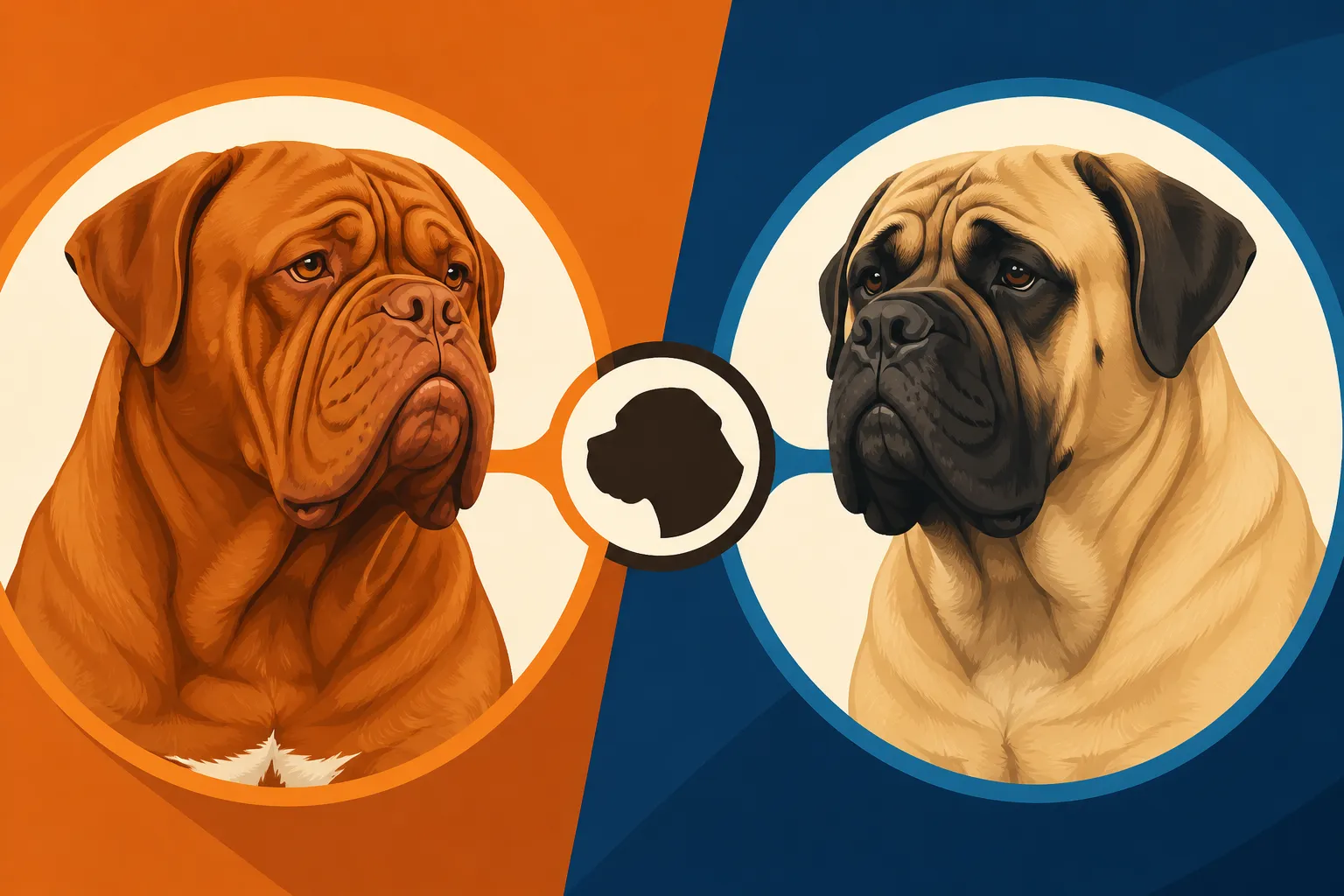
The modern Dogue de Bordeaux has a notably distinctive look. Its head is very large and heavily wrinkled, its muzzle is short, and its coat is usually a shade of fawn with a darker mask or facial coloring. The English Mastiff is also broad and powerful, but is generally longer in the muzzle and has a different overall head shape and coat presentation. Breed standards describe these distinctions; they do not establish that the two breeds are interchangeable.
The English Mastiff also has its own breed history and identity. Its size, proportions, colors, and characteristic black mask are part of what defines it. If you are comparing appearances, The Mastiff Against a Neapolitan Mastiff offers another helpful example of how dogs can share a mastiff label yet remain visibly different breeds.
How the two breeds compare today
Size, head shape, and coat
Both dogs are large, but an individual dog’s size depends on its sex, family line, condition, and overall health. A healthy dog should not be judged by an extreme weight or by a record-setting example. With either breed, sound structure and a comfortable, functional body matter more than simply being as heavy as possible. For a closer look at the English Mastiff’s size, see What a Mastiff Actually Weighs.
The Dogue de Bordeaux is particularly recognizable for its deeply wrinkled face and short muzzle. The English Mastiff has a broad head too, but usually appears less compact through the face. Their coats are also easy to distinguish in many cases: Dogues are typically fawn-colored, while the English Mastiff is seen in colors such as fawn, apricot, or brindle, with the characteristic dark mask. The English Mastiff’s accepted colors are discussed in The Colors a Mastiff Comes In.
| Feature | Dogue de Bordeaux | English Mastiff |
|---|---|---|
| Common name | French Mastiff | Mastiff |
| Breed identity | Distinct French breed | Distinct English breed |
| Typical appearance | Very broad, wrinkled head and short muzzle | Large, broad head with a generally longer muzzle |
| Common coat appearance | Fawn shades, often with facial mask coloring | Fawn, apricot, or brindle, typically with a dark mask |
| Shared traits | Large, powerful build and mastiff-type appearance | Large, powerful build and mastiff-type appearance |
| Important distinction | Not simply a French variety of the English Mastiff | Not interchangeable with the Dogue de Bordeaux |
These are broad breed-level comparisons, not guarantees about every dog. Some individuals have more pronounced wrinkles, heavier frames, or shorter-looking muzzles than others. A responsible breeder or rescue can explain the particular dog in front of you, including its parents’ size, health history, and temperament.
Temperament and daily life
Neither breed should be chosen on appearance alone. A Dogue de Bordeaux or an English Mastiff may be calm at home, deeply attached to its family, and watchful around unfamiliar people, but temperament varies from dog to dog. Early socialization, kind and consistent training, health, and the environment all matter. A dog’s huge body also makes good manners especially important: even friendly leaning, turning quickly, or stepping on a foot can be a lot for a child or visitor.
Their needs overlap in practical ways. Both require secure handling, enough space to rest comfortably, and a household prepared for a large dog’s everyday realities. That includes drool, shedding, a large appetite, transport challenges, and veterinary care that may require equipment suited to a giant breed. The details of the English Mastiff’s ideal home are explored in The Household a Mastiff Was Built For.
If you are considering one of these breeds as your first dog, look beyond whether the dog seems gentle during a brief visit. Ask yourself whether you can safely manage an adult who pulls, refuses to move, or needs help getting into a vehicle. Whether a Mastiff Suits a First Time Owner can help frame those questions for an English Mastiff; many of the practical considerations also apply to a Dogue de Bordeaux.
Health and care differences that deserve attention
Build and breathing
The Dogue de Bordeaux’s short muzzle and facial structure deserve particular attention. Dogs with shortened muzzles can be more vulnerable to breathing difficulties, especially during exertion, excitement, or hot weather. Pronounced facial wrinkles also need monitoring because moisture and debris can collect in skin folds. A prospective owner should ask a veterinarian or breed-knowledgeable professional what signs of breathing strain look like and how to keep the dog comfortable.
The English Mastiff’s face is generally less shortened, but its enormous size brings other practical considerations. Heavy dogs can place substantial demands on their joints, and puppies need sensible growth and activity rather than forced exercise. Both breeds need regular veterinary care, a suitable body condition, and exercise matched to the individual dog’s age and health—not a one-size-fits-all routine.
Before choosing a puppy, ask about health screening and the history of the parents and close relatives. A responsible breeder should be willing to discuss health concerns openly and provide records relevant to the breed. A rescue may have incomplete background information, so a veterinary examination and a realistic plan for ongoing care are especially useful.
Daily care and supplies
The care routines are similar in broad strokes, but the Dogue de Bordeaux’s facial folds may call for closer attention than those of a less wrinkled individual Mastiff. Keep folds clean and dry, and ask a veterinarian before applying medicated products or powders. Redness, odor, discharge, or persistent irritation should not be treated as a normal wrinkle issue; those signs can point to infection or another problem.
For either dog, the home setup matters. A sturdy, roomy bed, non-slip paths on slick floors, a properly fitted collar or harness, and a vehicle plan can make ordinary routines safer. Owners often discover that a bed that looked large in a shop is surprisingly cramped once a giant dog stretches out. Chewy, for example, can be one place to compare bed dimensions and washable covers, but measure the dog and the available floor space before ordering. A washable cover is especially practical when drool, muddy paws, or shedding are part of daily life.
Food and water arrangements also deserve thought. Keep meals measured and follow veterinary guidance rather than feeding to the dog’s apparent appetite or size. If a dog gulps food, ask the veterinarian whether a feeding adjustment is appropriate. When choosing supplies through a retailer such as Chewy, check the actual product dimensions and the dog’s eating habits rather than assuming a product labeled for large breeds will suit a very large individual.
Choosing between a Dogue de Bordeaux and an English Mastiff
Questions to ask before bringing one home
Start by deciding which breed’s physical traits and care needs fit your household. If the Dogue de Bordeaux’s short muzzle and heavy facial folds appeal to you, make sure you are also prepared to watch for breathing discomfort and keep the folds healthy. If you are drawn to the English Mastiff’s size and expression, think carefully about space, safe movement around the home, and the cost and logistics of caring for a giant dog.
Ask breeders or rescues specific, practical questions:
- What health concerns have appeared in this dog’s parents or close relatives?
- What health screening or veterinary records are available?
- How does the dog behave around visitors, children, other dogs, and unfamiliar environments?
- What food, exercise, and care routine is the dog currently used to?
- Can the dog enter your vehicle, settle on the flooring, and rest comfortably in the home?
- What support is available if a health or behavior concern develops after adoption or purchase?
A thoughtful answer should be detailed, not just reassuring. “They’re all gentle” does not tell you how a particular dog handles a crowded room, a veterinary visit, or a slippery kitchen floor. Whenever possible, meet adult dogs from the same line or rescue environment and observe how they move and recover from excitement.
Which breed is right for you
There is no universal winner. The Dogue de Bordeaux may suit someone who understands the care needs associated with its facial structure and wants a French breed with a very distinctive appearance. The English Mastiff may suit someone prepared for an exceptionally large companion and the space, management, and physical planning that size requires. In both cases, the best match is an individual dog whose health and temperament fit the household.
Do not choose based on the assumption that one breed is automatically healthier, calmer, or easier to manage. Differences between individual dogs can be substantial, and responsible breeding, early experiences, preventive care, and body condition all influence the life you will share. A careful match is more important than a confident claim that one breed is “better.”
The Dogue de Bordeaux and English Mastiff are related in the broad sense that both belong to the mastiff-type world of large, powerful dogs. Their shared appearance does not erase their separate breed identities, and it does not prove a simple direct ancestry. Knowing that distinction helps you compare them realistically—and choose based on the dog’s actual needs, not just a familiar name.
Disclaimer
This article is for general informational purposes only and does not constitute professional advice. Laws, prices and regulations vary by location and change over time. Consult a qualified professional for guidance on your specific situation.