Why So Many Breeds Are Called Mastiff
When someone says “mastiff,” they may mean the English Mastiff—or a Bullmastiff, Cane Corso, Tibetan Mastiff, or another large, powerful dog with mastiff in its name. That overlap is confusing, especially when breed descriptions make the dogs sound interchangeable. This guide explains why the label appears across different breeds, what it does and doesn’t tell you, and how to compare the dogs you’re considering.
“Mastiff” can mean a breed or a type of dog
The English Mastiff is one specific breed
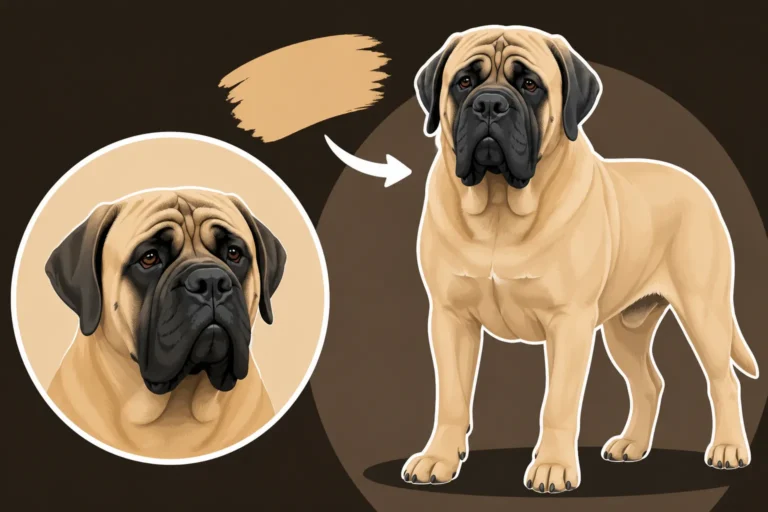
In everyday conversation, “a Mastiff” often means the English Mastiff, whose official breed name in the American Kennel Club is simply “Mastiff.” It is a distinct, recognized breed with its own standard and history. A person who says they own a Mastiff may be talking about this particular dog—not using “mastiff” as a catch-all for every large, heavy-bodied breed.
The word also appears in the names of many other breeds. That can make it seem as if “mastiff” is a single, precise family name, like a surname shared by close relatives. It isn’t that simple. In some contexts, the word points to an individual breed; in others, it describes a broad, mastiff-like kind of dog.
If you’re trying to understand the name of the English breed itself, it helps to separate it from informal labels such as “Old English Mastiff.” The naming history is covered in What the AKC Officially Calls the Mastiff and Why Some Call It the Old English Mastiff.
“Mastiff type” describes a look or general build
People may use “mastiff type” for dogs with some combination of a large frame, substantial bone, a broad head, and a protective or guarding history. That description can be useful as shorthand, but it is not a guarantee that the dogs share the same temperament, ancestry, or care needs.
Think of it like calling several vehicles “trucks.” The word gives you a rough idea of shape or function, but it doesn’t tell you whether you’re looking at a pickup, a delivery van, or a heavy work vehicle. In the same way, two dogs called mastiffs may look imposing yet have different origins, movement, coat, energy, and training needs.
“Mastiff type” is also not a substitute for an official breed name. If a rescue listing or online advertisement describes a dog as a “mastiff,” ask what that means in that specific case. The dog could be a purebred English Mastiff, a different named breed, or a mixed-breed dog with a broad head and a large frame.
The word does not establish close relatedness
A shared word in a breed name is not proof that two breeds are closely related or interchangeable. Names develop over time, shaped by local traditions, historical descriptions, translations, and the way people classified dogs before modern breed registries existed.
That’s why the term can be both helpful and misleading. It may suggest a general appearance or working role, but it does not settle questions such as “Which breed is this?” or “Will this dog suit my household?” For those, you need to look at the individual breed, the dog’s background, and the dog in front of you.
Why the mastiff label appears in so many breed names
Different regions developed dogs for demanding jobs
Large dogs were developed in many places for work that called for strength, confidence, and a substantial physical presence. Depending on the region and period, that work could involve guarding property, livestock, or people. Local communities shaped dogs around their needs and conditions, rather than following one shared plan to create a single worldwide “mastiff family.”
Later writers and dog fanciers used broad terms to describe powerful, heavy-built dogs. The label “mastiff” could travel between languages and descriptions even when the dogs being discussed came from different places. Over generations, those descriptions became attached to some breed names.
This history is not always neat. Old accounts may use a familiar word without applying today’s careful breed definitions. For background on the broad historical category, see The Molossus in the Mastiff's Ancestry. It’s useful context, but historical labels should not be mistaken for a modern genetic family tree.
Breed names preserve local history and tradition
Some breed names reflect a region, a type of work, or a descriptive label that stuck. “Mastiff” may have been included because people recognized a dog as large and imposing, because the name was already familiar, or because it helped distinguish a local type from other dogs.
The result is a group of names that sound related without all meaning the same thing. The Bullmastiff, Neapolitan Mastiff, Spanish Mastiff, and Tibetan Mastiff each have their own identity and development. Their names offer a clue to how people described them, but not a complete explanation of how they are related.
This is why breed histories can contain both meaningful connections and loose terminology. A breed may share historical influences with other large working dogs while still developing into a distinct modern breed. For a closer look at one comparison, The Mastiff Against the Bullmastiff explains why a Bullmastiff is not simply a smaller English Mastiff.
“Molosser” is another broad label, not a breed name
You may also see the word “Molosser” used for large, powerful dogs, including some breeds commonly described as mastiff-type. It is generally used as a broad grouping or type label, not as the name of one recognized breed. Writers and breed enthusiasts may use it differently, so it is wise to check how a particular source defines the term.
That flexibility can create more confusion. One person may use “Molosser” to discuss a wide range of large dogs; another may be talking about a narrower group or a particular historical theory. Neither term—“Molosser” nor “mastiff type”—should be treated as a precise answer to a question about an individual dog’s breed or ancestry.
If you’re reading a breed description and encounter several labels at once, focus on the actual breed name first. Then look at the breed’s standard, history, and practical needs rather than assuming a broad category tells the whole story.
How mastiff-named breeds can differ
A shared label doesn’t mean a shared day-to-day experience. Even when two dogs are both large and powerful, they can differ in structure, coat, movement, guarding tendencies, and how much management they need. The table below is a starting point, not a substitute for learning about each breed individually.
| Name | What the shared label may suggest | What to remember |
|---|---|---|
| Mastiff, often called the English Mastiff | A very large, heavy-built dog | “Mastiff” is the official breed name used by the AKC |
| Bullmastiff | A mastiff-like dog with a distinct breed identity | It is not simply a smaller English Mastiff |
| Cane Corso | A large, muscular dog often grouped with mastiff-type breeds | Its history, build, and needs differ from those of the English Mastiff |
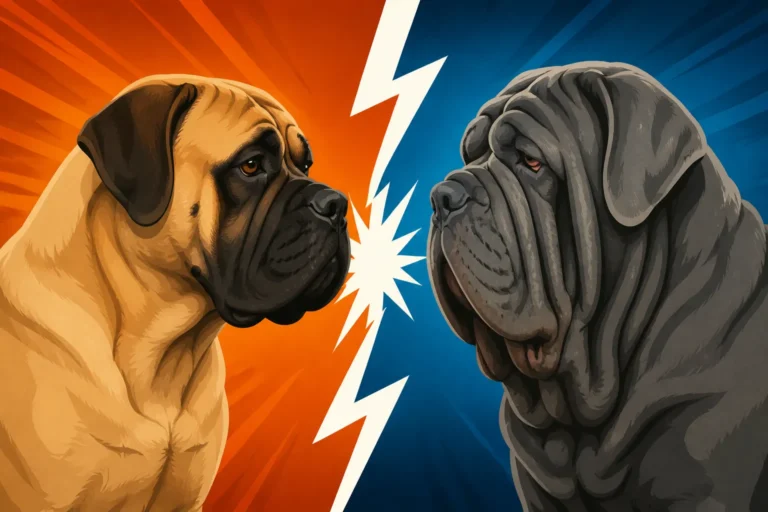
| Neapolitan Mastiff | A large dog with a distinctive, loose-skinned appearance | The name identifies a separate breed, not a coat or body variation of the English Mastiff |
| Tibetan Mastiff | A large guardian breed with “Mastiff” in its common English name | The name alone does not establish close relationship to the English Mastiff |
The Bullmastiff is not just a smaller Mastiff
The English Mastiff and Bullmastiff are separate breeds, even though their names and some physical traits invite comparison. A quick glance at size or head shape cannot tell you everything about a dog’s history or expected behavior. Breed standards, development, and individual temperament matter.
That distinction is practical, not just technical. Someone choosing a dog should not assume that experience with one breed will translate perfectly to another. Training, socialization, exercise expectations, and how a dog responds to unfamiliar people can vary by breed and by individual.
For a more detailed breed-to-breed comparison, see The Mastiff Against the Bullmastiff. If you are looking at a specific dog, ask about its parents, health history, behavior, and prior living situation instead of relying on the name alone.
Cane Corso and Neapolitan Mastiff are distinct breeds too
The Cane Corso and Neapolitan Mastiff are often included in conversations about mastiff-type dogs, but that broad grouping should not blur their separate identities. They have their own breed histories and physical characteristics, and they should be researched on their own terms. A large head or powerful frame does not make one breed a variation of another.
For example, a prospective owner comparing an English Mastiff with a Cane Corso should look beyond the shared “mastiff-type” shorthand. Consider the dog’s size and strength, how it behaves in daily household situations, and whether the owner can provide consistent training and management. The Mastiff Against a Cane Corso explores some of those differences, while The Mastiff Against a Neapolitan Mastiff addresses another commonly confused comparison.
When you see a breed name used casually in a social media post or rescue listing, ask what the writer means. “Mastiff mix” is not a detailed breed assessment, and appearance alone cannot reliably identify a dog’s ancestry.
The Tibetan Mastiff name needs extra care
The Tibetan Mastiff is a particularly clear example of why names can mislead. It is a distinct breed, and the word “Mastiff” in its English name should not be read as proof that it is simply a regional version of the English Mastiff. The name reflects a history of description and naming, not a guarantee of close modern relationship.
If you are comparing these dogs, investigate their breed-specific backgrounds and characteristics rather than assuming that “mastiff” means the same thing in each name. Whether a Tibetan Mastiff Is a Mastiff at All and Why a Tibetan Mastiff Is Not Related to the Mastiff explore the naming question from different angles.
This matters when choosing a dog, too. A name can create expectations about size, temperament, and care that don’t fit the individual breed. Look at breed-specific information, then meet the dog and ask informed questions.
How to make sense of the label when choosing a dog
Ask what someone means by “mastiff”
If a breeder, shelter, rescue, or friend describes a dog as a mastiff, ask a simple follow-up: “Do you mean an English Mastiff, another named breed, or a mastiff-type mix?” That one question can prevent a surprising amount of confusion.
For a purebred dog, ask for the registered breed name and documentation. For a rescue dog or mixed-breed dog, ask what is known about its history and behavior. Be wary of certainty based only on a photo: many large dogs share features, and appearance is not a dependable way to establish a complete pedigree.
Then move from the label to the details that affect daily life. Ask how the dog behaves around visitors, other animals, and routine handling. Find out what kind of training it has had and whether it has lived comfortably in a home similar to yours. The word “mastiff” cannot answer those questions for you.
Match the breed to your household, not just your preference
It’s easy to get drawn in by a breed’s dramatic appearance or reputation. But a large dog needs a realistic plan for space, handling, exercise, veterinary care, and training. A dog that is manageable as a young puppy can become difficult to physically control if basic skills are postponed until it is fully grown.
Consider your home’s flooring, stairs, vehicle access, and the people who will handle the dog. Think honestly about whether you can guide a powerful dog calmly on leash, arrange suitable care when you travel, and keep up with routine health needs. These questions matter whether the dog is an English Mastiff, a Cane Corso, or a mixed-breed dog described as mastiff-type.
For household planning, it can help to read about Whether a Mastiff Is Too Much Dog for Most People and The Household a Mastiff Was Built For. The goal is not to discourage anyone; it is to make sure the match works for both the dog and the people who will care for it.
Shop and plan around the exact dog
Once you know the dog’s breed or approximate size, use that information when choosing everyday supplies. A generic “mastiff” label may not tell you whether a particular collar, bed, or crate will fit. Measure the individual dog, check the item’s sizing guidance, and consider how much room it needs to lie down and turn comfortably.
For example, someone preparing for a large-breed puppy may browse Chewy for beds or feeding supplies, but should still compare measurements with the puppy’s expected growth and the product’s specifications. Searching Chewy by the exact breed can help narrow the options, though the dog’s actual dimensions are more useful than its breed label alone. If you are arranging supplies through Chewy, check sizing and return details directly before ordering, especially for bulky items.
Most importantly, don’t let the word in a breed name make decisions for you. A Mastiff, Bullmastiff, Cane Corso, and Tibetan Mastiff are not interchangeable simply because their names overlap. Learn the individual breed, assess the individual dog, and make choices based on the home you can realistically provide.
Disclaimer
This article is for general informational purposes only and does not constitute professional advice. Laws, prices and regulations vary by location and change over time. Consult a qualified professional for guidance on your specific situation.