How a Mastiff’s Weight Compares With a Great Dane’s
A Mastiff can weigh more than a Great Dane, even though the Dane usually stands taller. That difference can be confusing when you are comparing breed charts, planning for a puppy, or trying to picture the space a dog will take up at home. This guide explains typical adult weights, why the numbers overlap, and what weight means for health and everyday care.
Typical adult weights for Mastiffs and Great Danes
How the adult weight ranges compare
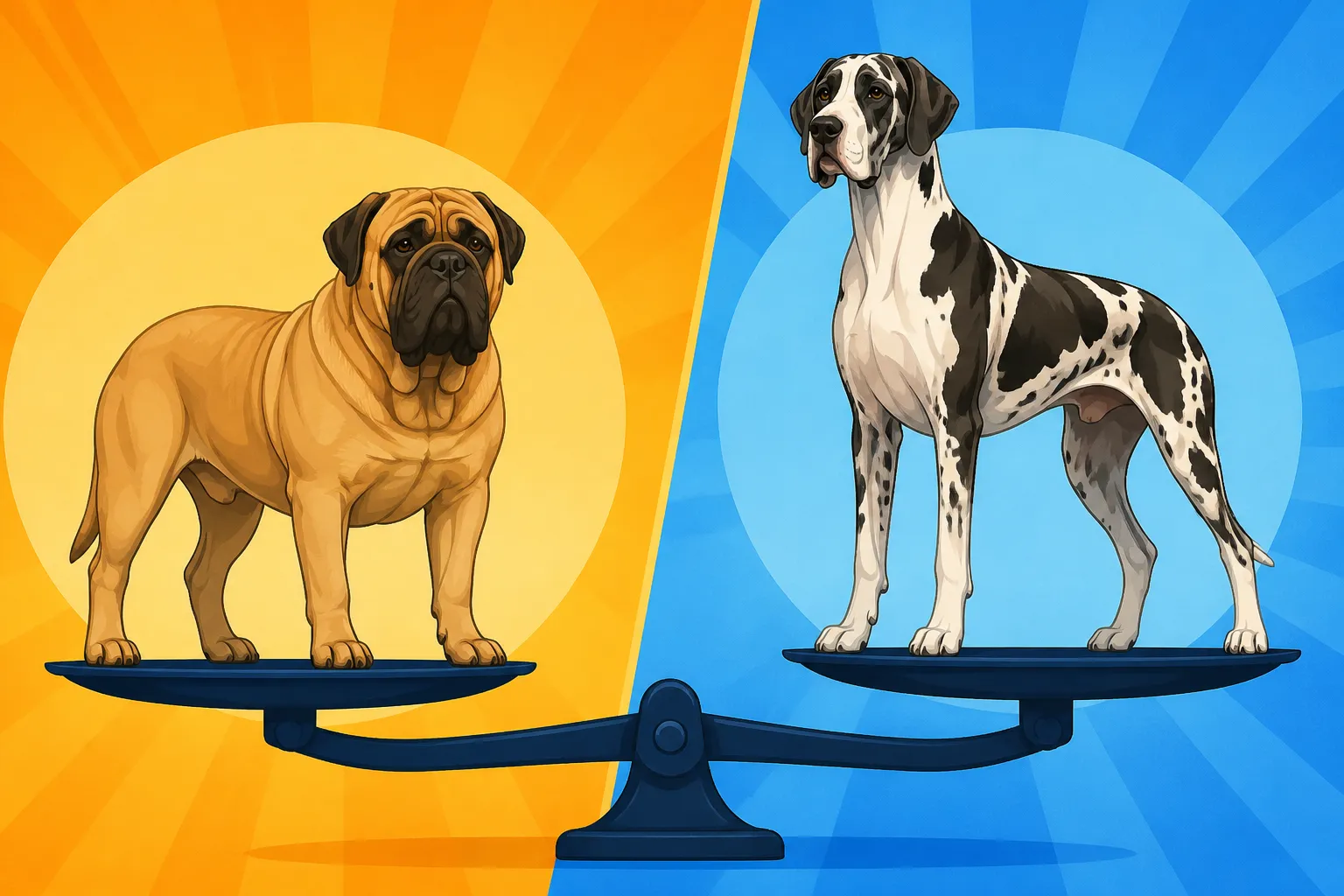
Adult weights vary with sex, frame, family lines, and individual condition, so breed figures are best treated as broad reference points rather than a promise about any one dog. As a general guide, male Mastiffs are often around 160 to 230 pounds, while females are commonly around 120 to 170 pounds. Great Danes are usually lighter: males often fall around 140 to 175 pounds, and females around 110 to 140 pounds.
Those ranges overlap. A large female Mastiff may weigh about the same as a male Great Dane, and a smaller male Mastiff may weigh less than a particularly substantial male Dane. That is why “which breed is heavier?” has a straightforward general answer—usually the Mastiff—but not a guaranteed answer when comparing two specific dogs.
| Adult dog | Common weight range | Typical impression |
|---|---|---|
| Male Mastiff | About 160–230 pounds | Very heavy, broad, and substantial |
| Female Mastiff | About 120–170 pounds | Large-bodied, with considerable variation |
| Male Great Dane | About 140–175 pounds | Tall and long-legged, often lighter than a Mastiff |
| Female Great Dane | About 110–140 pounds | Tall and athletic, generally lighter than a Mastiff |
These are broad ranges, not veterinary targets. Individual breed standards and published references may present figures differently, and a healthy dog can fall outside a typical range. A dog’s body condition, movement, and veterinary assessment matter more than whether the scale matches a chart exactly. For a broader look at adult size, see What a Mastiff Actually Weighs and How Much a Male Mastiff Weighs.
Why the taller dog may weigh less
Great Danes are famous for their height. Their long legs and upright build can make them look enormous beside a Mastiff, especially when both dogs are standing. Mastiffs tend to be lower-set and wider, with a deep chest, heavy bone, broad head, and a more compact impression. Height and weight describe different aspects of size: the Dane may tower over the Mastiff, while the Mastiff carries more mass through its body.
Think of two dogs standing together in a hallway. The Dane’s head may be higher, and its long legs may make it look like it occupies more vertical space. The Mastiff may appear shorter but wider, and its shoulders and chest can give it a heavier presence. A glance across the room cannot tell you which dog weighs more; the scale and the dog’s build can tell a different story from the silhouette.
This distinction also explains why a Great Dane can feel exceptionally tall without being the heavier animal. If you are comparing breeds for a household, consider both dimensions: how much vertical reach the dog has and how much room its body needs to turn, lie down, and pass through doorways. How Tall a Mastiff Stands explores the height side of the comparison.
What makes individual dogs different
Sex, family lines, and body frame
Sex can influence expected adult size, but it does not determine an individual dog’s final weight. A female Mastiff may be heavier than a male Great Dane, for example, while another female Mastiff may weigh less than a male Dane. Within each breed, dogs inherit different combinations of height, bone, chest depth, and overall build from their parents.
Family lines matter, too. Some Mastiffs are especially broad and heavy-framed; others are more moderate. Great Danes also vary, and a dog’s height does not tell you exactly how much muscle or body mass it will carry. When choosing a puppy, ask about the parents’ adult size and condition, but treat that information as a clue rather than a precise forecast. Whether Parent Size Predicts a Mastiff's Adult Weight explains why even well-informed estimates have limits.
Age changes the comparison as well. A young dog may still be growing, and giant breeds mature gradually. A puppy’s current weight is not a reliable way to decide whether it will become larger than an adult dog of another breed. Growth rate, developmental stage, and body condition all affect what the scale says at a particular moment.
Healthy weight is not the same as maximum weight
It is tempting to treat the biggest number as the ideal, particularly with giant breeds. But a dog is not healthier simply because it weighs more. Excess weight can place added strain on joints and make activity more difficult, while an underweight dog may have an underlying health or nutritional issue. A broad chest or heavy frame can also make visual guesses misleading.
Veterinary teams commonly assess body condition by looking at the dog’s shape and feeling for landmarks such as the ribs. On a healthy dog, the ribs should generally be possible to feel without pressing through a thick layer of fat, though they may not be sharply visible. The waist and abdominal tuck can also offer clues. A dense coat, loose skin, or a Mastiff’s massive frame may make these signs harder for an owner to judge, so ask your veterinarian to demonstrate what is appropriate for your dog.
If your dog’s weight is changing unexpectedly, do not try to correct it by making a dramatic food change based on a breed chart. A veterinarian can consider age, activity, body condition, medical history, and feeding routine together. For Mastiff-specific guidance, read How to Tell a Heavy Mastiff From a Fat One and Keeping a Mastiff Lean on Purpose.
How size affects daily life
Space, handling, and getting around
The difference between a tall dog and a heavy dog becomes practical at home. A Great Dane may need more clearance around counters, tables, and doorways because of its height and reach. A Mastiff may need more floor space to lie down comfortably and more assistance if it cannot get up or move easily. Either breed can be difficult to lift, transport, or reposition without planning.
Measure the spaces your dog will actually use: the crate opening, vehicle hatch, hallway turns, and route to the yard. A crate can be large enough on paper but awkward to fit through a doorway or position in a room. Likewise, a vehicle may have enough interior volume yet still be difficult for a heavy dog to enter. A stable ramp, non-slip flooring, and a roomy resting area can make ordinary routines much less stressful.
Think about the dog’s future needs, not just what works for a puppy. If an adult dog becomes sore or weak, stairs and slippery floors can quickly turn into obstacles. Whether a Mastiff Needs a Ramp Into the House and Why a Mastiff Slips on Hardwood cover two common planning issues. Great Danes can also need thoughtful access arrangements because height does not make climbing into a vehicle or navigating slick floors effortless.
Food, supplies, and the real cost of a giant breed
A heavier dog may need more food than a smaller dog, but weight alone does not set a feeding amount. Age, health, activity, body condition, food formulation, and veterinary advice all matter. Two dogs of similar weight can have different needs, so use the feeding guidance on a food label as a starting point and adjust with professional advice rather than assuming the heavier breed must eat a fixed amount more.
Large, sturdy supplies are another consideration. Beds need to support the dog without flattening quickly; bowls should be stable; collars and harnesses must fit securely without restricting movement. When comparing options at a pet retailer such as Chewy, check product dimensions, weight limits where provided, return conditions, and whether the item can be cleaned easily. A product described as “large” may still be too small for a broad Mastiff or too short for a long-bodied Dane.
The costs of food and equipment are only part of the picture. Veterinary care, transport, boarding, and emergency handling can also be affected by a dog’s size. A clinic’s equipment and staff procedures matter when treating a giant breed, so it is sensible to ask in advance how the practice handles large dogs. For more on the day-to-day implications, see What a Mastiff's Weight Does to Every Line on the Vet Invoice.
Choosing between the breeds by weight and build
Questions to ask before bringing a dog home
If weight is your main concern, compare individual adult dogs rather than assuming every Mastiff will outweigh every Great Dane. Ask the breeder or rescue about the dog’s parents, known adult relatives, current body condition, and expected growth stage. For a puppy, ask how the breeder monitors growth and what veterinary care the dog has received. A responsible answer should acknowledge normal variation rather than guarantee a precise adult weight.
It also helps to picture the physical work involved. Could you manage a dog that is reluctant to move on a walk? Is there a plan for getting the dog into a vehicle if it is injured? Can you keep floors grippy and provide a comfortable resting place? A dog’s temperament and training matter enormously, but with either breed, physical management is part of responsible ownership. Whether a Mastiff Can Be Walked by One Person offers more context on handling a powerful dog outdoors.
If you are choosing a dog because you want a particular look, be honest about whether your home and routine suit the whole animal—not just its height or impressive appearance. A Great Dane’s reach and leggy frame bring different challenges from a Mastiff’s heavier, broader build. Meeting adult dogs in person can help you understand those differences better than comparing numbers alone.
A useful way to interpret the comparison
In most broad comparisons, the Mastiff is the heavier breed and the Great Dane is the taller breed. Yet actual weights overlap, and health cannot be judged by scale readings alone. A well-conditioned dog whose weight suits its frame is a better goal than the largest dog in the litter or the highest figure on a breed chart.
For practical planning, assume either breed will need giant-breed accommodations: a suitable vehicle, secure walking equipment, a spacious bed, traction around the home, and access to veterinary care that can manage a large patient. Then assess the specific dog in front of you. That approach gives you a more realistic picture of the commitment than a single number can.
Disclaimer
This article is for general informational purposes only and does not constitute professional advice. Laws, prices and regulations vary by location and change over time. Consult a qualified professional for guidance on your specific situation.