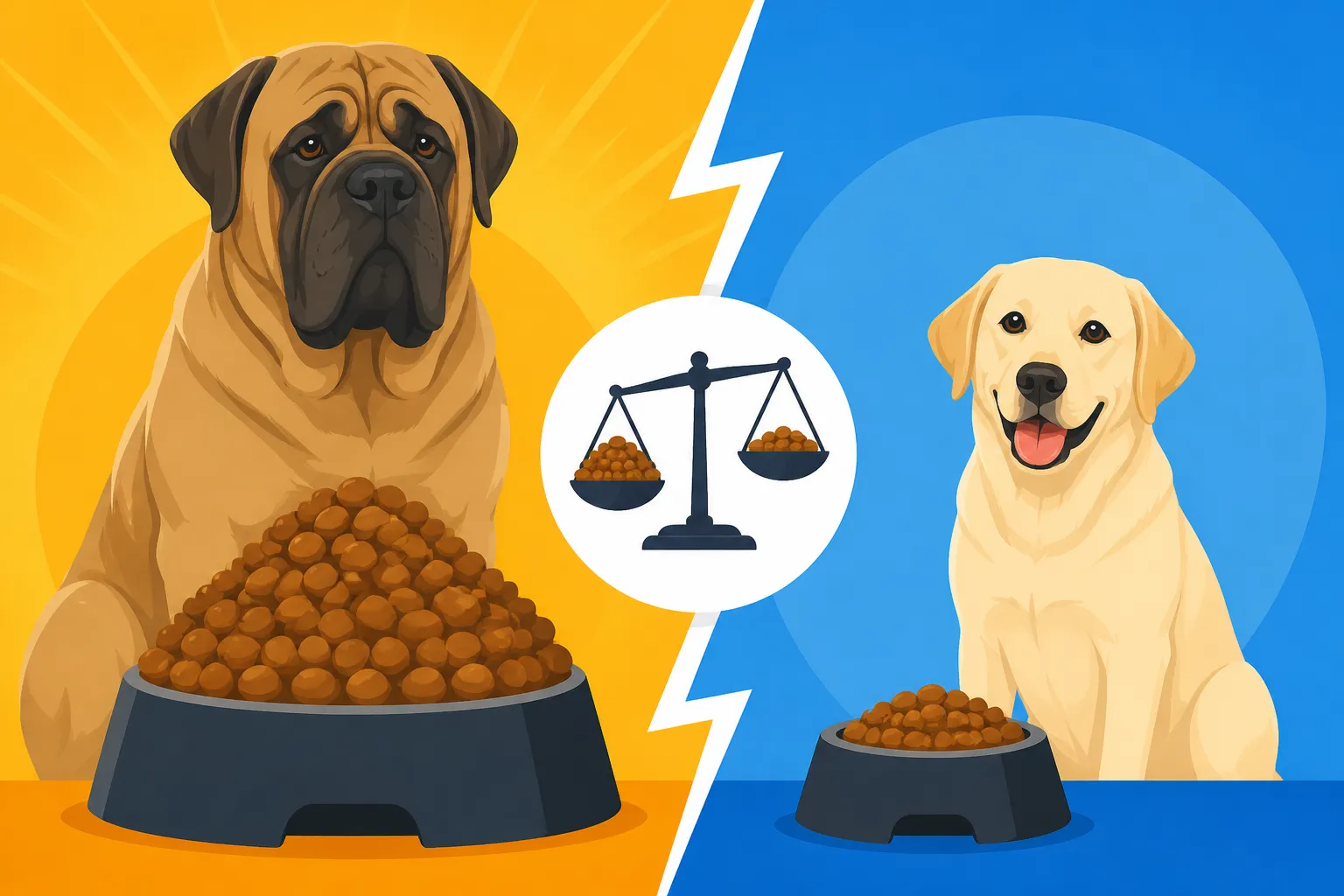
How a Mastiff’s Food Bill Compares With a Labrador’s
One of the biggest eye-openers for new giant breed owners is realizing that the food bill for a dog the size of a small pony isn't just "a bit more" than for a standard-sized dog; it's a completely different league. If you're wondering how the sheer volume and specialized needs of a magnificent Mastiff stack up against a beloved, active Labrador Retriever, you're about to get a very realistic picture of what feeding a true giant actually entails.
The Sheer Volume of Food a Mastiff Consumes
Let's be brutally honest: a Mastiff is a walking, breathing, drooling food hoover. When you stand next to one, you understand why the term "giant breed" exists. Their physical mass alone demands an incredible amount of fuel to simply exist, let alone thrive. This isn't just about feeding a bigger dog; it's about feeding a dog that often weighs two to three times as much as a Labrador.
Why Mastiffs Need More Calories
The fundamental reason a Mastiff requires so much more food lies in its size and metabolic needs. Imagine maintaining a large house versus a small cottage; the larger structure simply consumes more resources. A male Mastiff can easily hit 200 pounds or more, with some individuals pushing even higher, like the legendary Zorba. A Labrador, while a robust medium-to-large breed, typically weighs between 55 and 80 pounds. That's a massive difference right there.
Beyond just the raw weight, Mastiffs tend to have a slower metabolism than many other breeds, but the sheer volume of their lean muscle and bone mass dictates a higher caloric intake overall. They're not burning calories like a Border Collie flying through an agility course, but their bodies are constantly working to maintain their colossal structure. Young, growing Mastiff puppies have particularly critical dietary needs, requiring carefully balanced nutrition to support their rapid development without encouraging too-fast growth, which can lead to serious skeletal problems. This means a specialized large breed puppy food, often higher in quality, which naturally comes at a premium. Why a Mastiff Puppy Must Grow Slowly
Daily Rations and Bag Sizes
For an adult Mastiff, you're looking at anywhere from 6 to 10 cups of high-quality kibble per day, sometimes more depending on their individual metabolism, activity level, and the caloric density of the food itself. Compare that to a Labrador, who might eat 2.5 to 4 cups daily. The math quickly shows the disparity.
What does this mean for your shopping cart? While a 30-pound bag of kibble might last a Labrador a solid three to four weeks, that same bag could be gone in just over a week, or even less, for a hungry Mastiff. You're not just buying bigger bags; you're buying more frequently. Many Mastiff owners find themselves buying the largest available bags – 40 or even 50 pounds if they can find them – every week or two. Retailers like Chewy become invaluable for scheduling regular deliveries of these monumental bags of food, often offering discounts for auto-ship programs that help ease the financial sting a little.
Storage and Logistics
Think for a moment about storing a 30-pound bag of dog food. Maybe it tucks neatly into a pantry or a corner of the kitchen. Now imagine storing two, three, or even four 40-pound bags at a time to ensure you don't run out. That's 120-160 pounds of kibble! This isn't a trivial consideration. Many Mastiff owners dedicate significant pantry space, or even garage space, to food storage. Airtight containers become essential not just for freshness, but to deter pests from a bounty of food that would last a smaller dog months. We’ve even known some folks to Where a Mastiff Owner Stores a Month of Food in dedicated bins in a temperature-controlled area. It’s a logistical challenge most smaller dog owners never have to face.
The Labrador's More Moderate Appetite
While Labradors are known for their love of food – often seeming like bottomless pits – their overall dietary needs are simply on a different scale than a Mastiff's. Their activity levels are generally higher, but their smaller body mass means the fuel requirements are proportionally less.
Activity Levels and Energy Needs
A Labrador is typically a very active dog, bred for retrieving and often excelling in dog sports, hunting, and as enthusiastic family companions. They burn a good number of calories through their daily zoomies, long walks, and tireless games of fetch. However, even a highly active Labrador rarely exceeds 80 pounds. Their metabolic rate is often higher than a Mastiff's, meaning they efficiently process and use the calories they consume for energy. This is a crucial distinction: while a Lab may seem to eat a lot for its size, a Mastiff eats a lot more simply because there's so much more of it to maintain. How Much an Adult Mastiff Eats by Weight Each Day
Standard Bag Lifespan and Cost per Serving
For a Labrador, a 30-pound bag of quality kibble might last anywhere from 3 to 5 weeks, depending on the dog's size, activity, and the food's caloric density. This means fewer trips to the pet store, or less frequent online orders, and a significantly lower monthly expenditure on their primary food source. The cost per serving, when you break it down, is dramatically lower for a Labrador than for a Mastiff.
Consider the cost of a premium brand kibble. Let's say it's X dollars for a 30-pound bag. For the Labrador, that X dollars stretches over nearly a month. For the Mastiff, that same X dollars might only cover a week or ten days. This multiplication factor is where the real financial difference becomes stark. You're not paying incrementally more; you're often paying two or three times as much, if not more, for the core diet.
Variety and Special Diets
Labradors, like any breed, can develop sensitivities or require special veterinary diets. However, the cost impact of these specialized foods is less severe due to the lower volume needed. If a Labrador needs a prescription diet for allergies or digestive issues, the increase in cost per bag might be significant, but you're still only buying one bag every few weeks. If a Mastiff needs that same specialized diet, you're buying multiple bags every month, and the expense quickly escalates into hundreds of dollars. This is where a robust pet insurance plan, such as those offered by Healthy Paws, can become incredibly valuable, covering a percentage of unexpected veterinary diet costs if prescribed for a covered condition.
Beyond Kibble: Supplements and Treats
Food isn't just about the main meal in the bowl. For both breeds, especially as they age, a whole ecosystem of supplements and treats can become part of their daily intake. For a Mastiff, these extras aren't just additions; they're often critical to their long-term health and well-being, and their cost scales with the dog's massive size.
Joint Support is Non-Negotiable for Giants
This is perhaps the biggest hidden cost where Mastiffs truly diverge from smaller breeds. Due to their immense weight and rapid growth, Mastiffs are highly susceptible to joint issues like hip and elbow dysplasia, as well as arthritis later in life. Proactive joint support isn't an option; it's a necessity from a young age. Joint Supplements for a Mastiff are often recommended to start even before a Mastiff reaches full maturity.
These supplements – often containing glucosamine, chondroitin, MSM, and sometimes turmeric or green-lipped mussel – are dosed by weight. This means a Mastiff needs substantially higher dosages than a Labrador. Where a Labrador might need one chew or pill, a Mastiff might need three or four. This multiplies the cost of these often-expensive supplements, turning a monthly expense of maybe $20-$30 for a Lab into $60-$100 or more for a Mastiff. This consistent, long-term expense is something many new owners overlook when calculating the true cost of feeding a giant. Even fish oil, a common addition for coat and joint health, requires much larger quantities for a Mastiff.
Treats Add Up Fast
Both Mastiffs and Labradors love treats. They are excellent motivators for training and wonderful ways to bond. However, the size of a treat suitable for a Mastiff is often much larger than what you'd give a Labrador. A "large dog treat" for a Lab might seem like a small bite for a Mastiff. To truly satisfy a Mastiff or use treats effectively in training, you're often breaking larger treats into pieces or buying bags of specially sized, giant-breed-appropriate treats.
This again comes down to volume and frequency. If you're doing regular training sessions, even tiny pieces of high-value treats will disappear quickly into a Mastiff's maw. Whether Training Treats Count Against a Mastiff's Calories is also a consideration; for a Mastiff on a carefully managed diet, these extra calories need to be factored in. While a 10-pound bag of training treats might last a Labrador a few months, it could be gone in a matter of weeks for a Mastiff. The weekly treat budget alone for a Mastiff can rival the monthly treat budget for a Labrador.
Fresh Food and Raw Diets at Scale
The trend towards fresh food or raw diets has gained popularity, with companies like Ollie offering customized meal plans. While these can be a fantastic option for many dogs, the economic reality for a Mastiff is often prohibitive. For a Labrador, a fresh food subscription might be a manageable expense, albeit higher than kibble. They might require one or two pre-portioned trays per day.
For a Mastiff, imagine that same scenario scaled up. You're no longer talking about a tray or two; you might be talking about several pounds of fresh food per day, or numerous large raw patties. The daily cost skyrockets into a realm that makes it simply unfeasible for many owners. Whether Fresh Food Is Realistic for a Mastiff truly depends on your budget and commitment. Storing these massive quantities of fresh or raw food also demands significant freezer space, a logistical hurdle that few households are equipped to handle. While the nutritional benefits are often touted, the sheer volume makes it a luxury item for most Mastiff owners, whereas it might be a practical choice for a Labrador.
Long-Term Financial Implications and Budgeting
When we talk about the cost of feeding a dog, it's not just about the monthly grocery bill. It’s a commitment that spans years, and for a Mastiff, that commitment is magnified by their size in every financial category, especially food.
The Lifetime Food Bill
While a Mastiff's average lifespan is shorter than a Labrador's—typically 6-10 years compared to a Lab's 10-12 years—the annual food bill for a Mastiff is so much higher that their overall lifetime food expenditure can still easily exceed that of a Labrador. Let's imagine a hypothetical scenario: if a Labrador costs X dollars per year for food, a Mastiff might cost 2X or even 3X dollars per year. Over a span of six to ten years for a Mastiff, the cumulative total can become staggering. What a Mastiff's Food Bill Comes to Over Eight Years isn't a small number. It's often equivalent to a significant down payment on a car or even a modest annual salary for some people.
This isn't to say a Labrador is cheap; no dog is. But the sheer exponential increase in food costs for a Mastiff can be a shock. Many owners, even those who have owned other large breeds, are simply unprepared for the constant need to replenish their Mastiff's pantry.
Unexpected Dietary Needs
Just like humans, dogs can develop health issues that require specialized diets. Food allergies, kidney disease, sensitive stomachs, or other ailments can all necessitate a switch to prescription or limited-ingredient diets. For any dog, these diets are more expensive than standard kibble.
However, when a Mastiff needs one of these specialized foods, the cost multiplies exponentially due to the volume required. A 20-pound bag of prescription kibble for a Labrador might last a month; for a Mastiff, it might last a week. This turns an already expensive food into an astronomical monthly expense. This is another area where a comprehensive pet insurance policy can be a lifeline. While not all policies cover prescription diets, some, like Healthy Paws, may cover them if they are part of a treatment plan for a covered condition, softening the financial blow when unexpected dietary needs arise. The importance of keeping a Mastiff lean to prevent exacerbating existing conditions or creating new ones, especially joint-related, also means careful portion control and high-quality food are crucial. Keeping a Mastiff Lean on Purpose can literally add years to their life and reduce vet bills. Whether an Overweight Mastiff Dies Younger is a serious consideration for such a large breed.
Smart Shopping and Bulk Buying
Mastiff owners quickly become experts in economical feeding strategies. Buying in bulk is almost a necessity. This means purchasing the largest available bags, often 40 or 50 pounds, from stores like Chewy or specialty feed stores that cater to large animals. Many opt for auto-ship programs with online retailers to ensure a steady supply and often benefit from recurring discounts. Whether a Mastiff Owner Should Buy by the Pallet might sound extreme, but for some multi-Mastiff households, it's a genuine consideration!
It also means comparing unit prices meticulously. A slightly cheaper bag upfront might be more expensive per pound. Savvy owners also learn to track sales, use coupons, and sign up for loyalty programs. For those who consider fresh or raw feeding, finding local butchers or co-ops that offer bulk meat at discounted prices is a common strategy, though as discussed, the sheer volume can still be daunting compared to a Labrador's needs.
| Feature | Mastiff | Labrador Retriever |
|---|---|---|
| Typical Adult Weight | 120-230+ lbs | 55-80 lbs |
| Daily Kibble (approx.) | 6-10+ cups | 2.5-4 cups |
| 30lb Bag Lifespan | 7-14 days | 3-5 weeks |
| Monthly Bag Count | 2-4+ bags | 1 bag |
| Joint Supplements | High dosage, often critical, significant cost | Moderate dosage, often beneficial, manageable cost |
| Treat Volume | Large, frequent purchases | Moderate, less frequent purchases |
| Fresh/Raw Diet | Often cost-prohibitive due to volume | More feasible, though still premium |
| Storage Needs | Dedicated, large-scale storage required | Standard pantry/bin storage |
| Lifetime Food Cost | Very high, despite shorter lifespan | High, but significantly less than Mastiff |
Choosing a Mastiff means understanding that their majestic size comes with a majestic appetite and a food bill to match. It's a significant financial commitment that demands careful budgeting and smart shopping strategies from day one.
Disclaimer
This article is for general informational purposes only and does not constitute professional advice. Laws, prices and regulations vary by location and change over time. Consult a qualified professional for guidance on your specific situation.