Why a Bullmastiff Is Not Just a Smaller Mastiff
A Bullmastiff may weigh less than an English Mastiff, but the difference is not just a smaller frame. The breeds have distinct histories, proportions, temperaments, and day-to-day needs. If you are comparing them for your home, this guide explains what their shared ancestry does—and does not—mean, so you can choose based on the dog you can care for rather than size alone.
How a Bullmastiff differs from a Mastiff in size and build
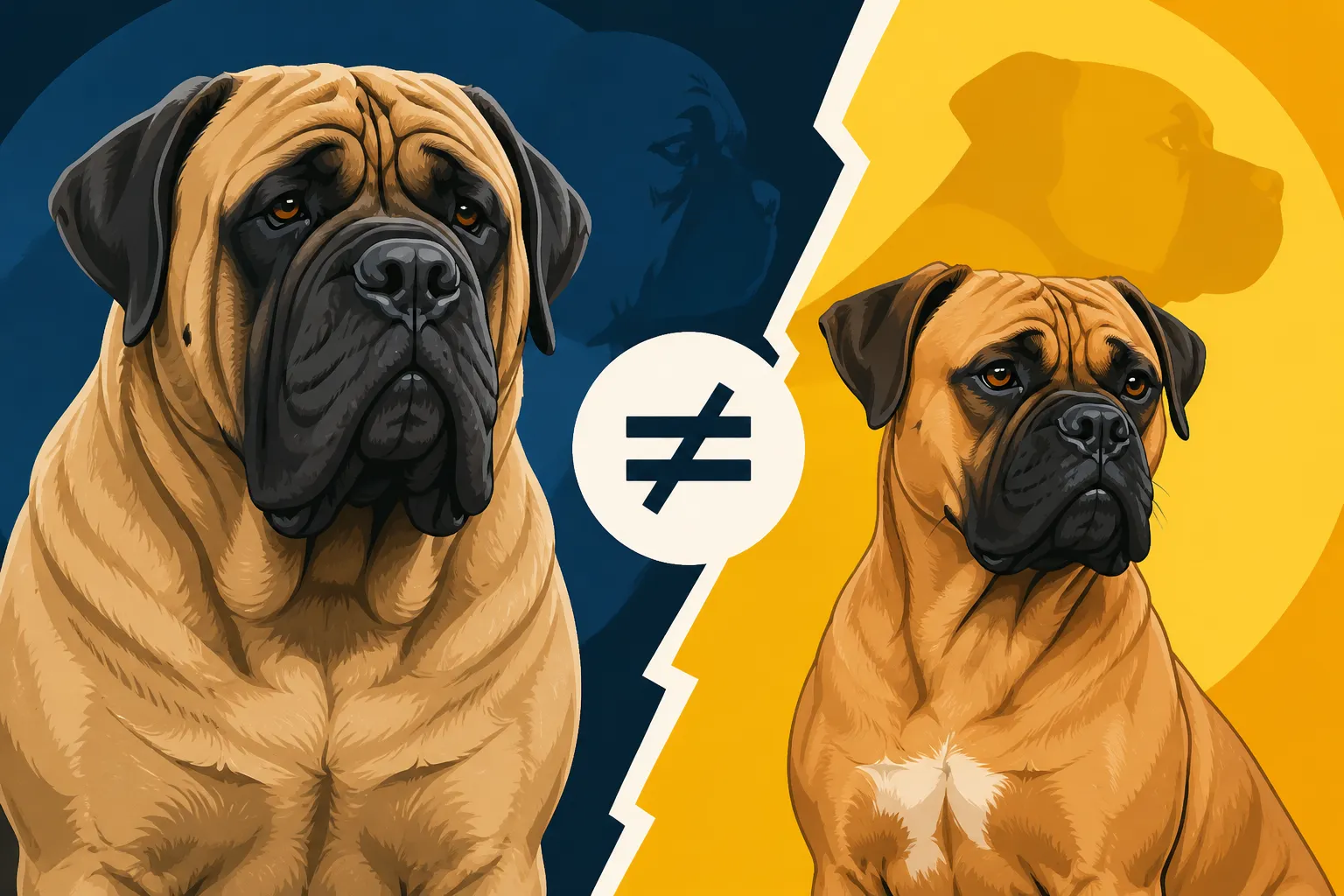
The Bullmastiff is smaller, but not a miniature Mastiff
An adult Bullmastiff is a large, powerful dog, not a compact version of the heaviest Mastiff. Breed standards describe different size ranges: Bullmastiffs are generally shorter and lighter, while Mastiffs are taller and substantially heavier on average. Individual dogs vary, of course, and a large Bullmastiff can still feel enormous in a hallway or on a leash.
The build matters as much as the scale. A Mastiff is known for a great deal of bone and body mass, with a broad, imposing outline. A Bullmastiff tends to look more compact and athletic, with a sturdy, muscular body. That does not make one breed delicate or the other automatically more agile; it does mean they can move and occupy space differently.
Picture a narrow entryway, a back seat, or a dog trying to turn around in a small kitchen. Either breed may need thoughtful planning, but a Mastiff’s greater bulk can make ordinary household logistics more challenging. Before bringing either dog home, measure doorways, vehicle openings, and the spot where the dog will sleep. A bed listing on Chewy, for example, may provide product dimensions, but measuring your own floor space and the dog’s resting posture is what tells you whether it will fit your home.
For more on the size differences, see The Mastiff Against the Bullmastiff and How Much a Male Mastiff Weighs. If you are also considering other giant breeds, The Mastiff Against the Cane Corso offers another useful comparison.
Their coats and color patterns overlap, but the breeds remain distinct
Both breeds have short coats and can come in fawn or brindle shades, and both are associated with a dark mask. Those similarities can make the dogs look related at a glance, especially when they are young. Color alone is not a reliable way to identify a breed or judge how large a puppy will become.
Look at the whole dog instead: proportions, head shape, height, body length, and the way the dog carries itself. Even then, appearance is only part of the picture. A responsible breeder should be able to explain the puppy’s lineage and provide relevant health information, rather than asking buyers to rely on coat color or a dramatic claim about future size.
If you are comparing photos online, remember that camera angles can make a dog look taller or broader than it is. Ask for images of adult relatives and, where possible, meet dogs from the line. The general overview of The Mastiff Against the Bullmastiff and the Cane Corso can help put these visual differences in context.
Why the breeds developed different temperaments
A shared background does not mean identical behavior
The Bullmastiff was developed as a working estate dog, commonly described as a cross involving Mastiffs and Bulldogs. Its history is associated with guarding and helping gamekeepers deter poachers. The Mastiff has a separate, much older breed history and is also strongly associated with guarding, but its modern role is usually that of a companion.
That background does not dictate exactly how an individual dog will behave. It can, however, help explain why both breeds may be watchful, physically imposing, and inclined to take their surroundings seriously. A Bullmastiff is not automatically a more aggressive or more obedient dog because of its history, and a Mastiff is not guaranteed to be placid simply because many owners describe the breed as laid-back.
In daily life, the distinction may show up in how each dog responds to activity and unfamiliar situations. One Bullmastiff may be quick to notice movement at the front window; a particular Mastiff may be slower to react but still highly attentive. Temperament is influenced by genetics, early experiences, training, health, and the home environment. For a broader look at the English breed’s typical household fit, see The Household a Mastiff Was Built For.
Both need thoughtful socialization and calm, consistent training
A large dog that is unsure of visitors can be difficult to manage—not because the dog is destined to be dangerous, but because its size gives ordinary behaviors more force. A friendly lean, a sudden lunge toward a familiar person, or a dog planting its feet at the doorway can become a real handling problem when the dog is powerful.
Start early with low-pressure exposure to people, surfaces, household sounds, car rides, and veterinary handling. The goal is not to make a puppy greet everyone. It is to help the dog learn that new experiences can be approached calmly and that you will guide what happens next. Rewarding calm behavior and teaching practical cues such as “wait,” “come,” and “leave it” can make ordinary routines safer.
Avoid relying on physical strength to correct a dog that may eventually outweigh the person holding the leash. If a young dog is already pulling, freezing, or reacting strongly, get help from a qualified, reward-based trainer before the behavior becomes harder to manage. The advice in Teaching a Mastiff Before It Outweighs You and Whether a Mastiff Is a Guard Dog or a Deterrent is relevant to either breed, though each dog should be assessed as an individual.
What caring for each breed can mean at home
Space, exercise, and everyday handling
Neither dog needs a mansion simply because it is large. What matters is whether the home allows the dog to move safely, rest comfortably, and be managed without constant obstacles. A spacious yard does not replace walks, companionship, or training, and a smaller home can work if the dog’s routines and physical needs are met.
Exercise should suit the individual dog’s age, health, and structure. A young giant-breed puppy should not be pushed into strenuous running or repetitive high-impact activity just to tire it out. For an adult, steady walks and calm enrichment may be a better fit than intense exercise. Ask a veterinarian how to adapt activity as the dog grows, gains or loses weight, or develops joint discomfort.
Consider how the dog will get in and out of your vehicle, climb stairs, and manage slippery floors. A Mastiff’s mass can make a fall or awkward jump especially consequential, while a Bullmastiff is still strong enough that an uncontrolled leap can knock someone off balance. Runners on slick floors, a well-fitted harness, and a plan for getting veterinary help can make daily life easier. For Mastiff-specific mobility context, see Whether a Mastiff Needs a Yard and Why Stairs Are Worse for a Mastiff Than Any Breed.
Food, equipment, and health planning
A dog’s food needs depend on age, body condition, activity, and veterinary guidance—not simply its breed label or the size of the bag. Growing giant-breed puppies need careful feeding, and it is worth asking a veterinarian to review the food’s suitability rather than switching between products based on marketing. When comparing options on Chewy or elsewhere, check the nutritional information and confirm that the food is appropriate for the dog’s life stage with your veterinary team.
Equipment should be chosen for fit and durability, not just a breed name on the package. Measure the dog’s chest and neck for a harness, and check that a crate or bed is large enough for the dog to stand, turn, and lie down comfortably. A product marketed for a Mastiff may not fit every Mastiff, and a Bullmastiff may need sturdier equipment than its smaller size suggests. Chewy product listings can help you check dimensions, but a tape measure and a realistic look at your space are more useful than a label alone.
Both breeds benefit from routine veterinary care, weight management, and planning for emergencies. Large dogs can be difficult to lift or transport when ill, so identify a clinic that can accommodate a big patient and ask what to do if your dog cannot walk into the building. Talk with your veterinarian about breed-appropriate screening and warning signs that should prompt urgent care. Mastiff owners can explore The Four CHIC Tests a Mastiff Breeder Must Clear and Bloat in the Deepest Chest of Any Breed: the Mastiff for more background; for either breed, a veterinarian can explain what applies to your particular dog.
| Consideration | Bullmastiff | Mastiff |
|---|---|---|
| Overall size | Large and powerful, generally shorter and lighter | Giant, with greater average height and body mass |
| General build | More compact and muscular | Heavier-boned and bulkier |
| Historical role | Estate guarding and gamekeeper work | Long history associated with guarding and companionship |
| Household planning | Needs strong handling, training, and room to rest | Needs the same, with extra attention to its greater bulk |
| Best comparison method | Meet adults and ask about temperament and health | Meet adults and ask about temperament and health |
How to decide which breed fits your household
Choose for the life you can provide, not the size you admire
It is easy to focus on a striking head, impressive weight, or the idea of having a natural protector. A more useful test is to imagine an ordinary Tuesday: taking the dog out in bad weather, wiping muddy paws, getting it into a vehicle, managing a visitor at the door, and arranging care when you are away. The best match is the dog whose needs you can meet consistently, not the one that looks most imposing in a photograph.
Think about the people in your household, too. If a child, older adult, or someone with limited mobility lives with you, assess whether everyone can safely share space with a strong dog. Even a gentle dog can bump into someone, block a doorway, or pull hard when startled. Supervision and training are important for both breeds, and no dog should be expected to manage young children without adult oversight.
Also consider the emotional side of choosing a giant breed. Their size can make routine expenses and care arrangements more complicated, and their lifespan may feel heartbreakingly short to the people who love them. Read What Mastiff Owners Wish They Had Known and Why the Short Lifespan Puts People Off Mastiffs before making a decision. Those topics are particularly relevant to prospective Mastiff owners, but the broader commitment is worth considering for any large dog.
Meet the individual dog and ask specific questions
Whether you are considering a puppy or an adult, ask how the dog behaves in familiar situations: around guests, other dogs, grooming, car travel, and veterinary handling. Ask what the breeder or rescue knows about the parents and relatives, and how the dog has been raised. Clear, specific answers are more useful than promises that every puppy will be “calm,” “protective,” or “easy.”
For a puppy, ask to see health records and discuss the parents’ physical and behavioral traits. Do not assume that a puppy will remain small because one parent is smaller, or that a large puppy will necessarily become the best fit for your household. For an adult rescue, ask about known medical needs, leash manners, separation behavior, and the situations that make the dog uncomfortable. A thoughtful introduction process can help you understand whether the dog and your home are a good match.
Finally, choose the breed for its whole package. The Bullmastiff is not simply a Mastiff reduced in size: it has its own history, proportions, and individual range of temperaments. The Mastiff is not just a larger Bullmastiff, either. Meet dogs where possible, talk with knowledgeable breed people and a veterinarian, and make your choice around daily care, safe handling, and the particular dog in front of you.
Disclaimer
This article is for general informational purposes only and does not constitute professional advice. Laws, prices and regulations vary by location and change over time. Consult a qualified professional for guidance on your specific situation.