How the Bullmastiff Came From the Mastiff
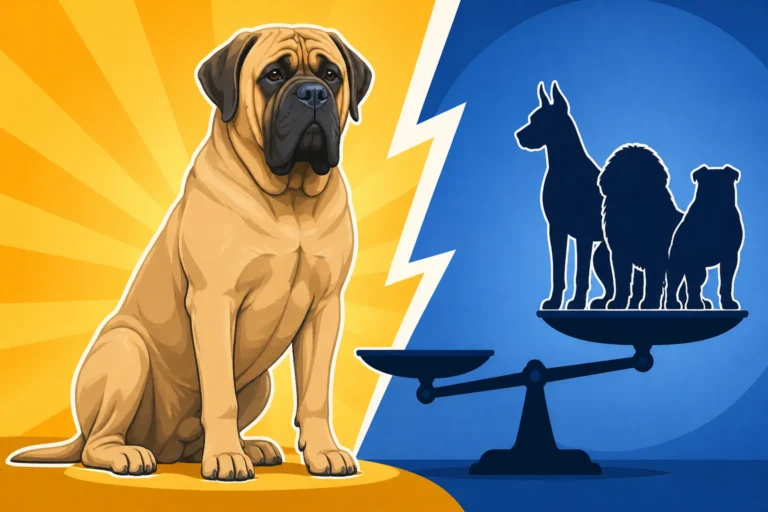
A Bullmastiff can look like a smaller, more athletic Mastiff, but that resemblance only tells part of the story. The breed was developed for a particular job on English estates, with a different mix of ancestry and purpose. This guide explains how the Bullmastiff came from Mastiff stock, what the other parent breed contributed, and why the two dogs are not interchangeable.
The Bullmastiff’s origins on English estates
Why gamekeepers wanted a different kind of dog
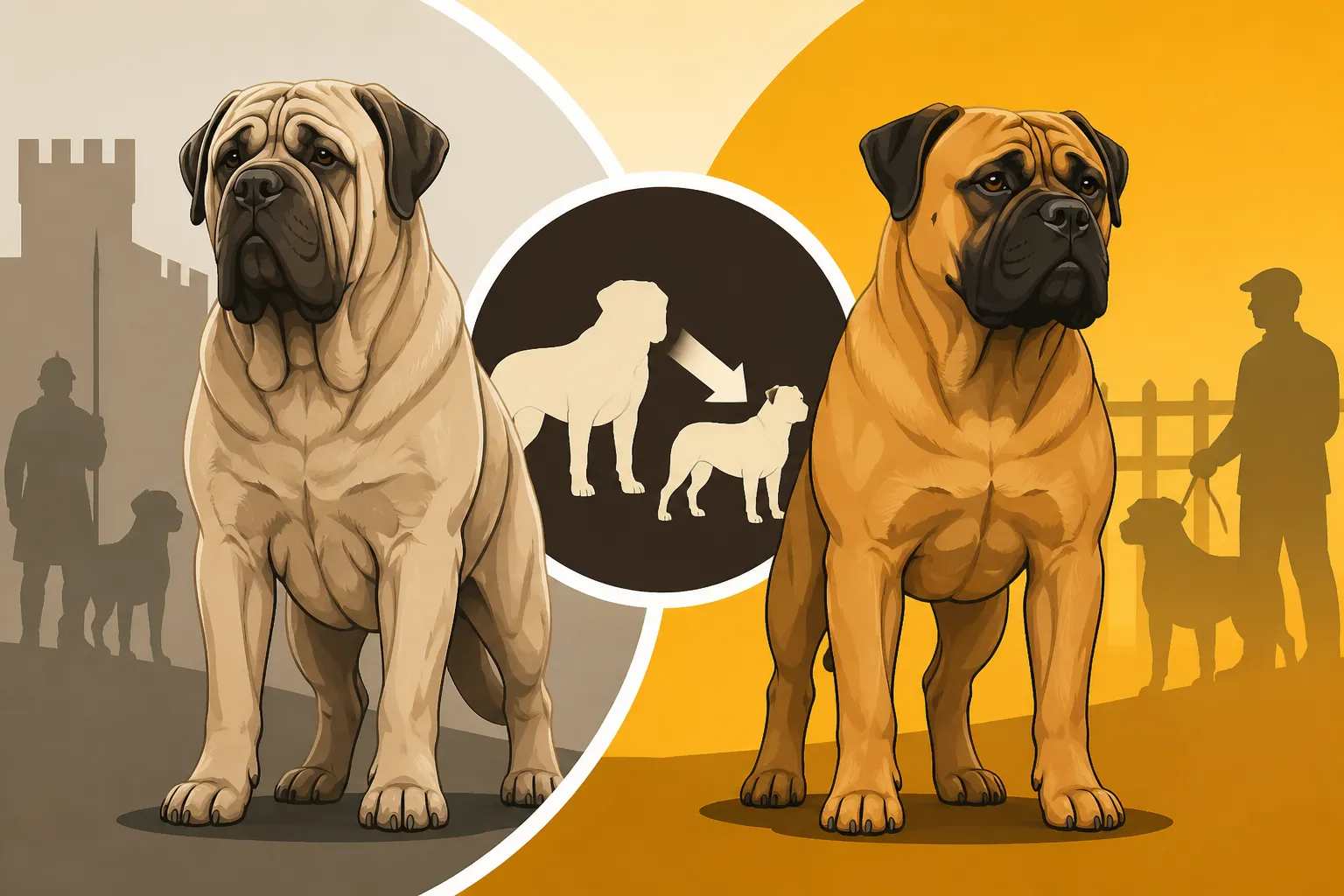
The Bullmastiff took shape in England during the nineteenth century, when estate gamekeepers faced a practical problem: poaching. A large dog could help deter intruders, but size alone was not enough. Gamekeepers needed a dog that could move through rough ground, respond quickly, and hold a person until help arrived.
The dog that emerged became known as the “Gamekeeper’s Night Dog.” The nickname captures its intended role, though it is not a formal description of every Bullmastiff’s temperament or behavior. These dogs were bred to work alongside people guarding estates, not to act independently as attack dogs.
That working purpose helps explain why the Bullmastiff developed differently from the Mastiff. Mastiffs were valued for imposing size and strength, while gamekeepers needed a dog with more speed and agility. The Bullmastiff combined traits suited to confronting and restraining a trespasser rather than simply presenting a formidable silhouette.
The history of the Mastiff itself is much older and broader than the Bullmastiff’s estate-guarding story. For background on the parent breed, see The Household a Mastiff Was Built For and The Mastiff Against the Bullmastiff.
How Mastiff and bulldog ancestry came together
Bullmastiffs were developed by crossing Mastiffs with bulldogs. The bulldog involved was the historical Old English Bulldog, not simply the modern English Bulldog as people know it today. The old working type was more athletic and differed in appearance from the present-day breed.
Mastiff ancestry contributed substantial size, strength, and presence. The bulldog side was valued for tenacity, courage, and a more compact, powerful build. Together, these traits produced a dog intended to move decisively and hold its ground.
You may see the Bullmastiff described as roughly 60 percent Mastiff and 40 percent bulldog. That ratio is a commonly repeated shorthand for the breed’s development, not a precise recipe that can be applied to every early dog. The breed did not arise from one single, documented pairing; it developed over time through selective breeding for a particular working purpose.
It is also worth separating ancestry from modern appearance. A Bullmastiff is not simply a Mastiff crossed with a modern bulldog, nor is every dog with a broad head and heavy build a Bullmastiff. Breed identity comes from a history of selection and a recognizable type, not from one feature.
How the Bullmastiff became a distinct breed
From a working cross to a consistent type
Early Bullmastiffs were valued for what they could do. As breeders continued selecting dogs with useful combinations of strength, agility, and steadiness, the type became more consistent. Over time, the Bullmastiff moved from being described mainly by its working background to being recognized as a distinct breed.
That transition matters because it explains why modern Bullmastiffs are not simply “part Mastiff, part bulldog” in the everyday sense. They belong to a breed with its own established characteristics and history. Their ancestry is mixed, but generations of breeding helped create a recognizable Bullmastiff type.
The Mastiff, by contrast, developed along a separate path. It is generally larger and heavier in build, while the Bullmastiff is typically more compact and athletic. Both can be affectionate family companions, but their shared ancestry does not make their needs or behavior identical. For a more detailed comparison, see Why a Bullmastiff Is Not Just a Smaller Mastiff.
Breed recognition also helped establish the Bullmastiff as more than a regional working dog. Once kennel clubs began recognizing and recording the breed, breeders had a clearer framework for preserving its traits. Recognition did not erase its working origins; it gave the breed a more formal identity.
What the two breeds share and where they differ
Both breeds are powerful, large dogs with a strong physical presence. They can be devoted to their families and may be reserved around unfamiliar people. Neither should be chosen solely because of its appearance or reputation. Early socialization, considerate handling, and consistent training matter for any dog of this size.
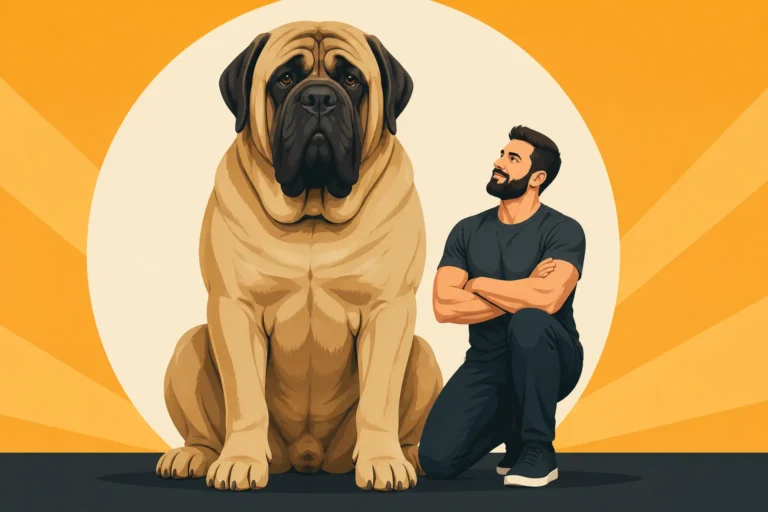
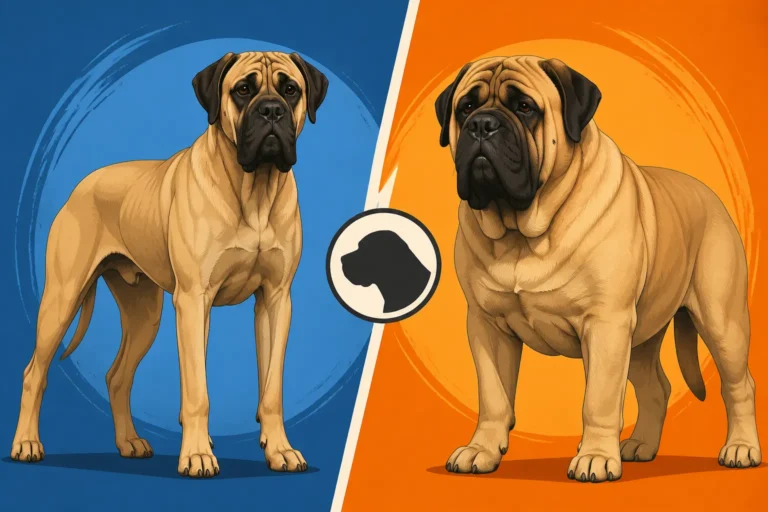
The differences are just as important. A Mastiff is generally the heavier, more massive dog, while a Bullmastiff tends to be more agile and compact. Individual dogs vary, of course, and a dog’s behavior depends on more than breed ancestry. Still, a prospective owner should not assume that a Bullmastiff will be a low-maintenance substitute for a Mastiff—or that the two breeds have identical exercise, training, or space needs.
| Feature | Mastiff | Bullmastiff |
|---|---|---|
| Historical role | A large guardian and companion with a long history | Estate guardian developed to help gamekeepers deter and restrain poachers |
| Ancestry | An established breed with its own long history | Developed from Mastiff and historical Old English Bulldog ancestry |
| General build | Typically heavier and more massive | Typically more compact and athletic |
| What the comparison means for owners | Plan for a very large dog and its practical needs | Plan for a powerful dog that still needs thoughtful training and management |
If you are weighing the breeds for a household, Mastiff or Bullmastiff for a Family offers a useful next step. The right choice depends on the individual dog, your experience, and whether your home and routine can comfortably accommodate a large, strong companion.
What the Bullmastiff’s history means for owners
A guardian background is not a training plan
A breed’s original job can help explain its physical traits and tendencies, but it cannot tell you exactly how an individual dog will behave. Bullmastiffs were developed for estate work, yet a modern dog still needs careful introductions to visitors, predictable routines, and training that rewards calm, manageable behavior.
Because of their size and strength, polite leash skills are especially important. A dog that lunges, rushes through a doorway, or jumps up can create a real safety problem even if it is friendly. Practice basics such as waiting at thresholds, walking without dragging the handler, and settling on a bed before those habits become difficult to manage. Teaching a Mastiff Before It Outweighs You discusses why early training matters with a large breed.
A guardian reputation should not be treated as a reason to encourage suspicion or aggression. Dogs need to learn how to remain composed around ordinary visitors, delivery workers, and neighborhood activity. Socialization is not about forcing a dog to greet everyone; it is about giving it safe, positive experiences and helping it respond calmly to everyday situations.
Owners comparing Bullmastiffs and Mastiffs should also consider the household’s practical setup. Think about vehicle access, stairs, flooring, visitors, and who will handle the dog on walks. A dog can be gentle and still be difficult to manage if its strength and size are not planned for. See The Mastiff Against the Bullmastiff for more breed-level context.
Supplies and daily care for a large dog
A large dog needs equipment that fits securely and can withstand normal use. Before bringing a Bullmastiff home, check collar and harness sizing, leash strength, bed dimensions, and whether the dog can get in and out of your vehicle safely. If your local shops have limited giant-breed sizes, online retailers such as Chewy can be one place to compare available options; measure the dog rather than relying only on a breed label.
Food decisions also deserve care. Choose an appropriate complete diet and discuss the dog’s body condition and feeding routine with a veterinarian. A broad chest and substantial frame do not mean a dog should carry excess weight. For owners also researching Mastiff care, Keeping a Mastiff Lean on Purpose explains why body condition is more useful than judging weight by appearance alone.
When ordering supplies through Chewy or another retailer, double-check dimensions and return policies before opening bulky items. A bed that looks large in a product description may not give a big dog enough room to stretch out, and a harness that fits in one area may rub or restrict movement elsewhere. A proper fit should allow comfortable movement while remaining secure.
Routine matters as much as equipment. Make grooming, nail handling, and calm veterinary visits part of the dog’s life early, when the dog is easier to guide and physically manage. If you are building a supply list, Chewy may let you compare food, bedding, and grooming items in one place, but a veterinarian or qualified trainer can help you decide which choices actually suit your dog.
Choosing between a Bullmastiff and a Mastiff
Questions to ask before deciding
Start with the dog’s individual needs rather than the idea that one breed is simply the “smaller version” of the other. Ask breeders or rescue groups about the specific dog’s temperament, health history, behavior around people and animals, and experience with everyday handling. A responsible source should welcome thoughtful questions and be candid about what is known.
Next, picture ordinary life with the dog. Can you safely manage a strong dog on a leash? Is there enough room for a large bed and a comfortable resting place? Can the dog enter your vehicle without being lifted in a way that risks injury to either of you? Do the people in the household agree on rules for guests, furniture, and training?
Consider the dog’s future care, too. Giant breeds may need specialized handling and equipment, and an emergency clinic or boarding facility may have practical limits on the dogs it can accommodate. Call ahead to ask about size capacity rather than discovering those limits during a stressful situation. The same planning is useful whether you choose a Mastiff or a Bullmastiff.
For owners drawn to the Mastiff’s size and history, What a Mastiff Actually Weighs can help put the breed’s physical scale in context. If you are comparing expected longevity, How a Bullmastiff's Lifespan Compares With a Mastiff's is another relevant topic to explore alongside veterinary advice and individual health information.
How to make a thoughtful choice
A Bullmastiff may appeal to someone looking for a powerful, historically estate-oriented breed with a more athletic outline than a Mastiff. A Mastiff may suit someone prepared for a heavier, more massive dog. Those are broad distinctions, not guarantees about any particular dog’s personality or behavior.
Meet dogs in a calm setting when possible, and notice how they recover from new sights and sounds, respond to handling, and settle after excitement. Ask what the dog has been exposed to and how it behaves in ordinary situations, not just whether it is “protective” or “good with people.” Those labels are vague; concrete examples are more useful.
Finally, choose for the life you can provide, not for the breed’s reputation or appearance. Both dogs need patient training, responsible socialization, appropriate veterinary care, and an owner who can manage their size safely. Understanding the Bullmastiff’s Mastiff ancestry is a helpful starting point—but the most important decision is whether the individual dog’s needs fit your household.
Disclaimer
This article is for general informational purposes only and does not constitute professional advice. Laws, prices and regulations vary by location and change over time. Consult a qualified professional for guidance on your specific situation.