Which British Mastiff Lines Survived Unbroken
The question sounds simple until “survived unbroken” gets pinned down. A kennel can close while its dogs’ descendants continue elsewhere; a breed can persist even when its numbers collapse and outside dogs are added to rebuild it. This guide explains what is known about British Mastiff continuity, why Lyme Hall is often part of the story, and what pedigree records can—and cannot—prove.
What an unbroken Mastiff line would mean
A kennel name is not the same as a bloodline
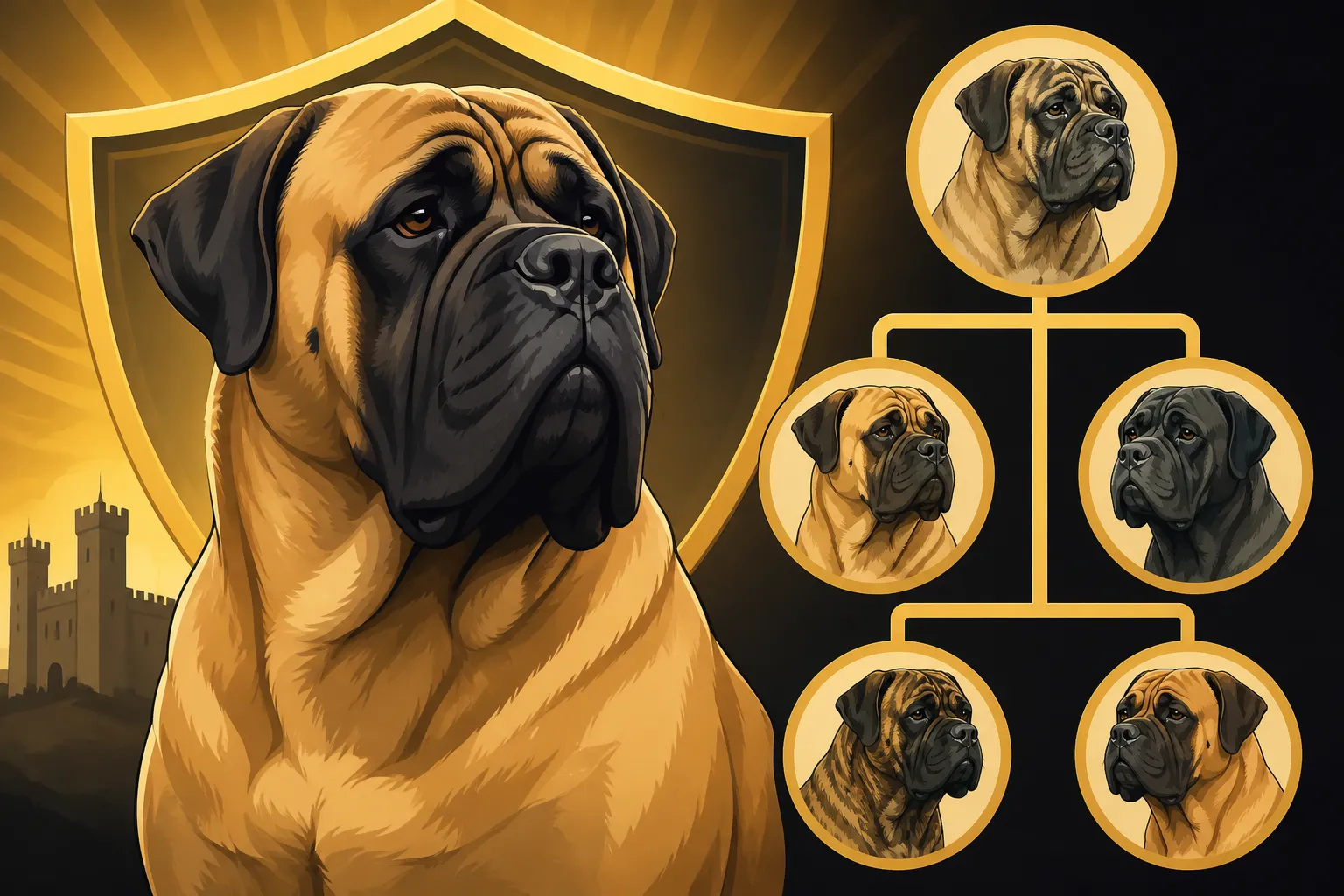
When people talk about an “unbroken line,” they may mean several different things: a family of dogs whose descendants can be traced through pedigrees, a breeder’s kennel that operated continuously, or a population of dogs that was never crossed with outside stock. Those are not interchangeable claims.
A kennel may stop breeding for years, change owners, or close altogether while dogs from its breeding program continue in other kennels. In that case, the kennel did not survive as an institution, but its ancestry may still appear in later pedigrees. Conversely, a kennel can keep the same name while making outcrosses that change the genetic makeup of its dogs.
For the Mastiff, this distinction matters because British breeding was disrupted by war, dwindling numbers, and changes in who had dogs available to breed. The survival of the breed does not automatically mean every individual line remained untouched. A pedigree can show descent from named ancestors; it cannot, by itself, demonstrate that a line was genetically isolated or uninterrupted in every sense.
Breed continuity is broader than one family line
A breed is generally understood as a population shaped over time by shared ancestry and breeding practices. It does not depend on one kennel or one celebrated family continuing without interruption. A breed may survive through several families, even if some have disappeared and others have been combined.
That is the more useful way to think about the British Mastiff’s survival. The breed endured, but the historical record does not support a simple claim that one famous British kennel line alone carried it forward without breaks or outside influence. The breed’s continuity and an individual line’s continuity are different questions.
This is also why claims about a “pure old line” deserve careful wording. A dog may have ancestors from a historic kennel, but that does not prove an unbroken kennel operation or an unchanged bloodline. For context on how sharply population size affects what breeders can preserve, see How Narrow the Mastiff Gene Pool Is.
What happened to British Mastiffs through the wars
The numbers fell, and breeding choices narrowed
Mastiff numbers declined during the first half of the twentieth century, with wartime conditions making it difficult to keep and breed very large dogs. Feeding a giant dog required substantial resources, and shortages could make that burden especially hard for households. As the population shrank, breeders had fewer dogs to choose from and fewer opportunities to maintain separate families.
That squeeze affects continuity in practical ways. If only a small number of dogs are available, a breeder may need to use the dogs that can be found rather than preserve a particular family branch. Some lines may vanish because no breeding descendants remain. Others may survive only through dogs that were moved, exchanged, or bred into another kennel’s stock.
The breed’s near-collapse during the Second World War is often discussed in very stark terms. The article Fewer Than Twenty Mastiffs Survived the Second World War explores that period in more detail. Whatever precise count a source uses, the key point for lineage questions is the same: the surviving population was extremely small, and recovery depended on more than keeping one old British kennel operating as before.
Postwar recovery involved dogs from outside Britain
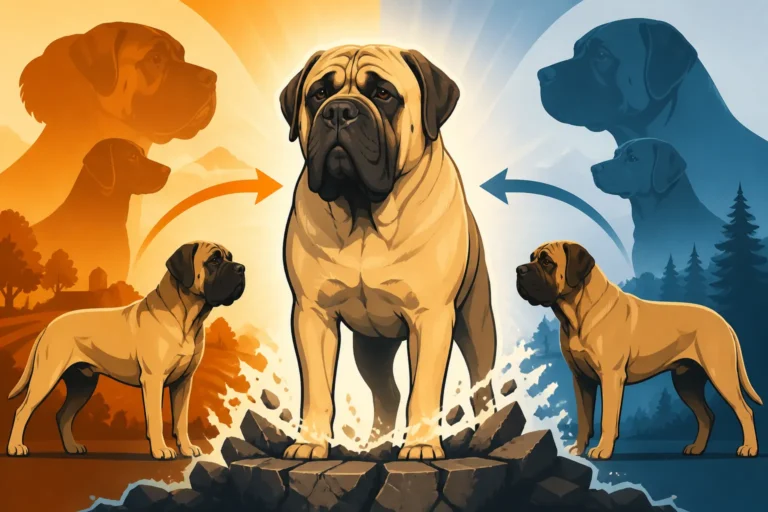
After the war, Mastiffs in Britain were rebuilt with help from dogs brought from North America, including American and Canadian stock. That restoration helped preserve the breed, but it complicates any claim that a prewar British line continued without interruption or outside contribution.
A breed can remain recognizably the same while its postwar population includes imported dogs and their descendants. In fact, adding dogs from another population can be important when the number of available breeding animals has become dangerously limited. It may preserve the breed as a whole even as it changes the ancestry of particular families.
The rebuilding story is covered further in How American and Canadian Dogs Rebuilt the Mastiff and The American Kennels That Sent Mastiffs Back to Britain. These histories help explain why the modern British Mastiff should not be described as a simple, untouched continuation of a single prewar line. The breed survived through a broader recovery effort.
Lyme Hall and the question of an old British line
Why Lyme Hall is so closely associated with Mastiffs
Lyme Hall in Cheshire is one of the best-known names in Mastiff history. Its dogs and breeding program became closely associated with the breed, so it is natural for people researching old British lines to ask whether the Lyme Hall strain survived.
But a historic kennel and a continuing line are not the same thing. A kennel may be influential without remaining active indefinitely, and the end of a kennel’s operation does not necessarily mean that all its dogs’ descendants disappeared. Establishing a direct, unbroken line requires evidence that connects generations through reliable records—not simply the continued use of a famous kennel name in later descriptions.
For more background, see How Long Lyme Hall Bred Mastiffs and How Lyme Hall Mastiffs Appear in Modern Pedigrees. Those questions are related, but they are not identical: one concerns the kennel’s breeding history, while the other concerns whether its ancestry can be found in later dogs.
Does the Lyme Hall Mastiff strain survive?
The careful answer is that Lyme Hall ancestry may be represented in later pedigrees, but that is not enough to establish that a distinct Lyme Hall strain survived continuously and unchanged. A family can contribute ancestors to the wider breed without continuing as a separate, closed line. The further back a pedigree goes, the more likely it is that an old kennel’s dogs appear alongside many other sources of ancestry.
It is also worth distinguishing a documented pedigree connection from a popular historical claim. A breeder may describe dogs as coming from an old strain, but the strength of that statement depends on records that support the connection. Without a traceable chain of breeding records, “descended from” can be more credible than “unbroken line,” and “influenced by” may be more accurate still.
The dedicated history Whether the Lyme Hall Mastiff Strain Survives examines that distinction. The safest conclusion is not that Lyme Hall had no lasting influence, but that its influence should not be confused with proof of an isolated line surviving intact through every disruption.
| What people may mean by a surviving line | What would support the claim | What the claim does not prove on its own |
|---|---|---|
| A kennel continued operating | Records showing breeding activity over time | That its dogs had no outside ancestry |
| Descendants of a historic kennel remain | Pedigrees connecting later dogs to recorded ancestors | That the kennel itself continued |
| A distinct family remained separate | Long, traceable breeding records for that family | That the wider breed population stayed unchanged |
| The Mastiff breed survived | Evidence of a continuing breeding population | That one prewar British line survived untouched |
What can be said about British Mastiff lines today
The strongest conclusion is about the breed, not one unbroken line
The British Mastiff survived as a breed, but its survival should be described as a recovery of a population rather than the uninterrupted preservation of one identifiable British kennel line. The wartime decline and postwar rebuilding make a simple “one line survived unchanged” story difficult to support.
That does not diminish the value of historic British ancestry. Dogs from influential kennels can leave a lasting mark even when their descendants are later bred with dogs from other families or countries. Their contribution may remain visible in pedigrees and breed history, while the specific kennel or family ceases to exist as a separate breeding population.
The modern breed also differs in important ways from earlier populations, as discussed in How the Modern Mastiff Differs From the Prewar Type. Reading that history alongside How Far Mastiff Numbers Fell After the First World War helps put lineage claims in context: the breed’s story includes survival, loss, and rebuilding, not simply an uninterrupted chain.
How to assess a claim about a historic line
If you encounter a claim that a Mastiff descends from an unbroken British line, ask what “unbroken” means in that specific claim. Is the breeder referring to a kennel that remained active, a documented ancestry reaching back to historic dogs, or a family that was never crossed with outside stock? A precise claim is easier to evaluate than a broad one.
Then look for pedigrees and records that connect the generations being discussed. A name appearing in a pedigree is useful evidence of ancestry, but it does not establish that every branch of the family remained distinct. If the claim concerns a particular kennel, check whether the kennel’s breeding records show continuous activity or whether the dogs’ descendants continued after the kennel closed.
A sensible summary is that no single famous British kennel should be treated as the sole, demonstrably unbroken line behind the modern Mastiff. The breed’s survival was collective: it depended on the dogs and breeders who kept the population going, including postwar contributions from outside Britain. That is a more accurate—and more interesting—account than a neat but unsupported story of one untouched line.
Disclaimer
This article is for general informational purposes only and does not constitute professional advice. Laws, prices and regulations vary by location and change over time. Consult a qualified professional for guidance on your specific situation.