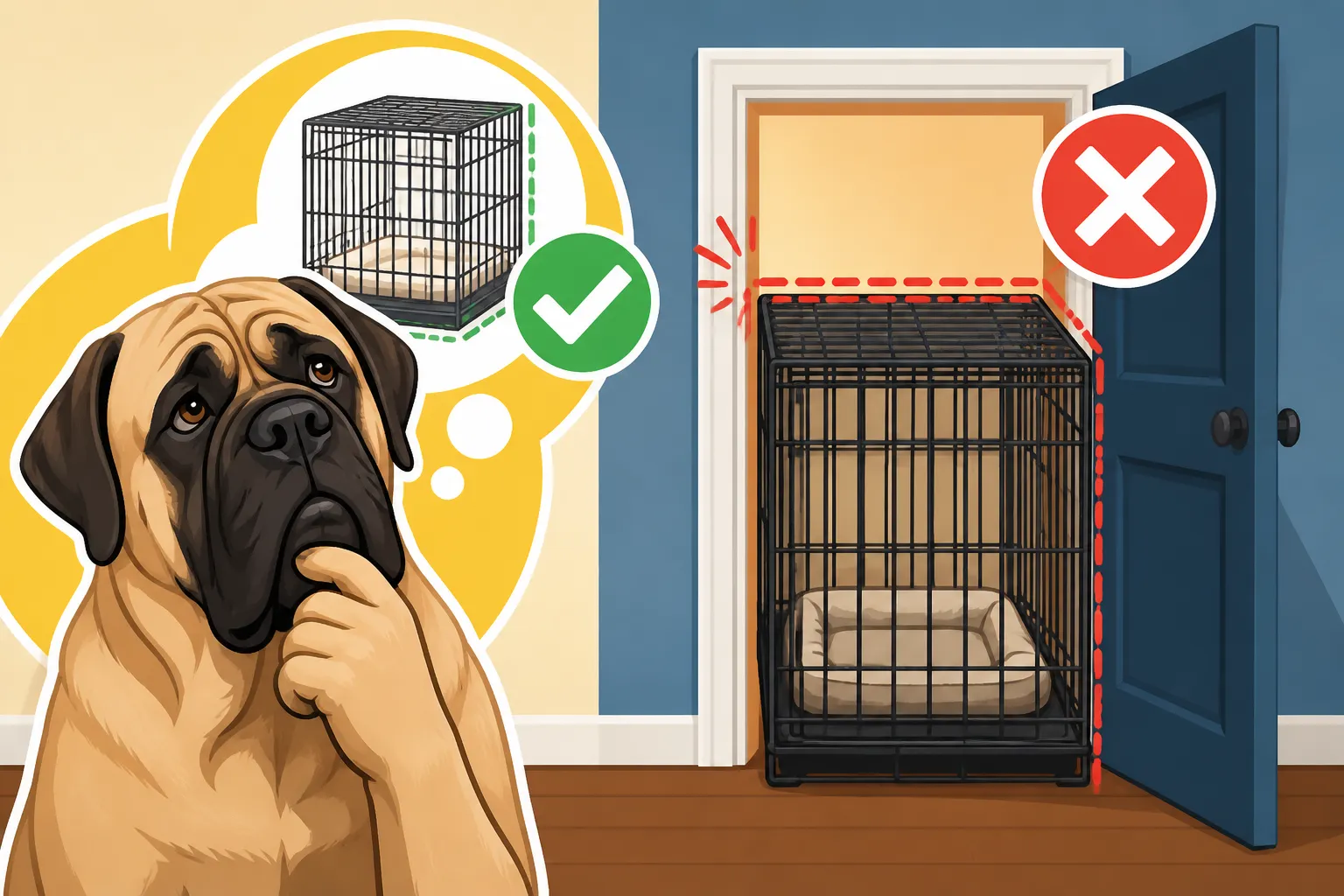
Whether a Mastiff’s Crate Fits Through a Doorway
Anyone who has welcomed a Mastiff into their home quickly learns that "large dog" doesn't quite capture the reality. These magnificent giants bring immense joy, but they also bring immense stuff. One of the first headaches many new Mastiff owners encounter is the sheer physical size of the equipment needed, and nothing highlights this more starkly than the dog crate. It’s not just about finding a crate big enough for your gentle giant; it’s about whether that colossal crate will even fit through your existing doorways, or if you're about to undertake an unexpected home renovation project just to get it inside. This guide will walk you through the surprising challenges of Mastiff crate dimensions and offer practical solutions to help you navigate this truly oversized problem.
The Reality of Giant Crate Sizes: Beyond "Large"
When you’re looking for a dog crate, you typically see categories like "small," "medium," "large," and perhaps "extra-large." But for a Mastiff, you're not just venturing into "extra-large"; you're in a league of your own, requiring something more akin to a small garden shed. The crates designed to comfortably house a full-grown Mastiff are genuinely massive, far exceeding what most people envision when they picture a dog crate. We're talking about structures that often measure well over four feet in length, three feet in width, and three-and-a-half feet in height. These aren't minor dimensions, and they introduce a whole host of logistical challenges that breeds of smaller stature simply don't present.
Why a Mastiff Needs Such a Colossal Crate
It's not just about fitting their impressive bulk. A Mastiff needs ample space to stand up, turn around comfortably, and lie down stretched out in various positions. Imagine being forced to spend time in a space where you can barely adjust your posture – it's uncomfortable and can quickly lead to stress and even physical issues for a dog, especially a giant breed prone to joint problems. A crate that is too small can exacerbate conditions like arthritis or hip dysplasia by forcing them into awkward positions for extended periods. When you factor in their average adult weight, often ranging from 150 to well over 200 pounds, a tight squeeze becomes even more problematic for their joints and overall comfort. This is why A Mastiff Lying Two Hundred Pounds on One Elbow All Day is a real concern, and a proper crate minimizes this kind of strain.
The Disconnect Between Dog Size and Home Infrastructure
Most homes are built with standard doorway widths, usually somewhere between 28 and 36 inches. While this is perfectly adequate for human passage, furniture, and even most conventional dog crates, it becomes a significant bottleneck for a Mastiff's accommodation. Many owners find themselves staring in disbelief as their newly purchased, flat-packed giant crate arrives, only to realize that once assembled, it’s a non-starter for getting into the intended room. This isn't just an inconvenience; it can be a genuine source of frustration and even panic if you have a puppy arriving soon and nowhere safe to put them. The sheer scale of everything associated with a Mastiff, from their food bowls to their beds, often catches new owners off guard, and the crate is often the first glaring example of this reality. The Furniture, Vehicle and Doors a Mastiff Changes is a concept you'll become very familiar with.
Measuring Up: What You Need to Know Before You Buy
Before you click "add to cart" on that gargantuan crate online, or drive hours to pick one up, you absolutely must do your homework. Trust me, learning the hard way by trying to wrestle an assembled crate through a doorway that's clearly too small is an experience you want to avoid. It involves a lot of grunting, potential wall damage, and possibly having to re-box and return an item that weighs as much as a small person. This proactive approach will save you time, money, and a significant amount of exasperation.
Standard Doorway Dimensions vs. Giant Crate Measurements
Let's talk numbers. As mentioned, interior doorways typically range from 28 to 36 inches wide. Standard exterior doors are often around 36 inches wide. Garage doors, patio sliders, and double doors offer more leeway, but your Mastiff's crate likely isn't going to live in the garage or perpetually outside. The crate you need for a full-grown Mastiff will often have a width (the shorter side) of 30 to 36 inches, and a length (the longer side) of 48 to 54 inches. The height can easily hit 36 to 40 inches.
Here's a quick comparison to illustrate the potential squeeze:
| Crate Dimension (Approx.) | Common Doorway (Interior) | Common Doorway (Exterior) | Potential Issue |
|---|---|---|---|
| Width: 30-36 inches | 28-32 inches | 36 inches | Tight fit or impossible |
| Length: 48-54 inches | N/A (for turning) | N/A (for turning) | Turning radius needed |
| Height: 36-40 inches | N/A (for clearance) | N/A (for clearance) | Depends on how you tilt |
Notice that the width of the crate can very easily be wider than your standard interior doorways. Even if it's the exact same width, you need to account for door frames and hinges, which effectively reduce the usable opening. Furthermore, getting a long, wide, and tall object through a doorway isn't just about the smallest dimension; it's about maneuvering the entire bulk. You might have to tilt it, which then brings the height into play against the doorframe.
Measuring Your Space Accurately
Don't just eyeball it! Grab a tape measure and be precise.
- Measure the narrowest point of your doorway: This is typically from the inside edge of one door frame to the inside edge of the other. Don't forget to account for hinges if they protrude.
- Measure the height of your doorway: From the floor to the top of the door frame.
- Measure the crate's dimensions: Look up the exact specifications for the crate you intend to buy. Pay attention to length, width, and height. Remember, manufacturers often round, so consider adding an inch or two as a buffer for any protruding latches or handles.
If you plan to assemble the crate inside the room it will live in, that solves the doorway issue for initial placement. However, consider if you'll ever need to move it out for cleaning, houseguests, or moving house. It’s a huge factor when you think about long-term ownership. And speaking of long-term, remember that your Mastiff puppy will grow at an astonishing rate. How Fast a Mastiff Puppy Grows means that crate you initially bought might feel too small surprisingly quickly, necessitating an upgrade you'll have to get through the door.
Solutions for the Crate Conundrum
So, what do you do when your desired Mastiff crate seems like an immovable object destined to meet your unyielding doorway? Don't despair! There are several strategies you can employ to ensure your big dog gets the comfortable, safe space they need without requiring you to knock down walls.
Assemble It Where It Stays
This is by far the most common and often simplest solution. Many large wire crates come disassembled or fold flat, making them much easier to transport into a room. Once inside, you can expand or assemble it according to the instructions. This bypasses the doorway width issue entirely for initial placement.
However, consider the implications:
- Cleaning: If the crate becomes soiled or needs a deep clean, moving it out of the room might still be impossible, meaning you'll be doing the heavy cleaning in situ.
- Re-arrangement: Deciding to rearrange your furniture or move the crate to a different room will present the same problem all over again.
- Moving House: When it comes time to move, you'll either have to disassemble it, or find a moving company with the specialized equipment to handle such a large, bulky item.
Opt for a Collapsible or Foldable Design
Most large wire crates are designed to collapse for transport and storage. This is a huge benefit. Look for models that fold down relatively flat. Even if the assembled dimensions are too wide for your doorway, the collapsed form factor will almost certainly fit. Once folded, you can easily slide it through doors, up stairs, and into vehicles.
When choosing a collapsible crate, particularly for a Mastiff:
- Durability is Key: A Mastiff can put a lot of force on a crate, even a calm one. Ensure the latches, hinges, and wire gauge are robust. You want something that will withstand their immense weight and power if they lean against it or shift around inside.
- Ease of Folding: Some crates are easier to fold and unfold than others. Practice it a few times when it first arrives, so you're not fumbling with it in a rush.
- Chewy and other major pet supply retailers often carry a wide selection of heavy-duty, collapsible crates specifically designed for giant breeds. It’s worth reading reviews from other Mastiff owners to see which brands hold up best to daily use.
Consider a Soft-Sided or Fabric Crate (with caveats)
For very temporary uses, like a car ride or a short visit to a quiet friend's house, a soft-sided crate might seem appealing because it's lightweight and flexible. However, for a Mastiff, this option comes with serious limitations.
- Security and Containment: A soft-sided crate offers very little in the way of true containment for a determined Mastiff. They can easily chew through the fabric or zipper, especially if they experience any anxiety. This type of crate is really only suitable for a fully crate-trained, calm Mastiff for very short periods, and never when unsupervised.
- Durability: The fabric will likely not stand up to the wear and tear of a giant breed for long.
- Cleaning: While often washable, the sheer volume of fabric and potential for accidents makes them less practical for everyday use compared to easily wiped-down metal or plastic.
- Ventilation: Ensure adequate ventilation, as Why Bulk Makes a Mastiff Overheat is a serious concern, and a fabric crate might restrict airflow more than a wire one.
Utilizing Alternative Entry Points
If your desired room has no standard doorway that works, think outside the box (or, rather, outside the doorframe).
- Patio Doors/Sliding Doors: These are often wider than interior doors and can provide ample clearance. If the room has one, it might be your best bet for getting an already-assembled crate inside.
- Double Doors: If you have a room with double doors, opening both can create a much wider entrance.
- Window Removal: In extreme cases, if a window is large enough and easily removable, this might be a last resort. This is obviously much more involved and might require professional help.
Planning for the Long Term
Remember that your Mastiff will be a part of your family for Six to Ten Years Is What a Mastiff Gets. That means the crate you choose now needs to be a long-term solution. Think about its placement. Do you need a bed that holds a Mastiff inside the crate? Probably, to make it more comfortable. What a Bed That Holds a Mastiff Costs can be substantial, and you want it to fit perfectly inside the chosen crate. Consider also the implications of travel. Why Airlines Will Not Fly a Mastiff means road trips are your primary mode of transport, and you'll need to figure out how to get that colossal crate into a suitable vehicle if you plan to bring it along.
Living with a Giant Crate: Placement and Practicality
Once you've successfully wrestled (or easily assembled) your Mastiff's enormous crate into your home, the next challenge is integrating it into your living space. These aren't subtle pieces of furniture; they dominate a room and require careful consideration for placement, cleaning, and daily use.
Strategic Placement for Harmony
Finding the right spot for a crate that feels like a small car can be tricky. It needs to be in a location that provides comfort and security for your Mastiff, without becoming an obstacle course for the humans in the house.
- Quiet Corner: A calm, low-traffic area is ideal. Your Mastiff's crate is their den, their safe haven. Placing it in the middle of a bustling hallway or directly in front of a frequently used doorway can make them feel exposed and stressed.
- Temperature Control: Mastiffs are susceptible to overheating due to their size. Avoid placing the crate in direct sunlight or next to a heating vent. Conversely, avoid drafty areas in winter. The Temperature at Which a Mastiff Should Stay Indoors is an important consideration for crate placement.
- Visibility: While it should be a quiet spot, most Mastiffs appreciate being able to see their family. A corner in a living room or family room that allows them to observe without being directly in the action can be perfect.
- Proximity to Outdoors: Especially for puppies learning to be house-trained, having the crate near an accessible outdoor area can make potty breaks easier. How Long a Mastiff Puppy Takes to House Train can vary, and easy access helps.
- Avoid Main Thoroughfares: This sounds obvious, but you’d be surprised how often a giant crate ends up partially blocking a walkway. Not only is this a tripping hazard for people, but it also creates an awkward passage for your Mastiff themselves. They need a clear path to enter and exit their den.
Keeping the Crate Clean and Inviting
A clean crate is essential for your Mastiff's health and happiness. Given their size and drool potential, this isn't a task to overlook.
- Regular Cleaning: Wire crates are relatively easy to wipe down. Use pet-safe cleaners. The tray at the bottom (if removable) should be cleaned frequently, especially if any accidents occur.
- Bedding: Choose durable, washable bedding that fits snugly inside. For giant breeds, a truly orthopedic bed can be a blessing for their joints. Look for options with removable, machine-washable covers. Even the most robust bedding might need replacing sooner than you expect; How Often a Mastiff Destroys a Bed can be surprising, even for a calm dog.
- Drool Management: Mastiffs are champions of drool. Consider placing a mat or old towel underneath the crate to catch any drips or water splashes from their bowl. The Puddle a Mastiff Leaves After Drinking can be impressive! Regularly wiping down the crate bars and surrounding floor will keep things hygienic.
- Water Access: While some people put water bowls inside crates, for a Mastiff, this can lead to massive spills. A sturdy, non-tip bowl placed immediately outside the crate door is often a better solution, particularly for unsupervised crating, or a hanging bucket secured to the crate bars.
The Crate as a Safe Haven
Ultimately, your Mastiff's crate should be a positive space. It’s not just a containment device; it’s a personal den where they can feel safe, rest, and retreat from the hustle and bustle of family life. Properly introduced and used, a crate can greatly reduce separation anxiety and provide a sense of security. Whether you are crating a [Mastiff puppy] or an adult, ensure it is a comfortable, positive space. Filling it with favorite toys, a comfy bed, and the occasional treat will encourage them to view it as their personal sanctuary. This positive association is crucial for their well-being and helps them cope when How Many Hours a Mastiff Can Be Left alone.
Disclaimer
This article is for general informational purposes only and does not constitute professional advice. Laws, prices and regulations vary by location and change over time. Consult a qualified professional for guidance on your specific situation.