Whether a Mastiff Puppy Should Be Carried Downstairs
Bringing home a Mastiff puppy is an incredible joy, but it also comes with a lot of questions, especially when you're looking at those big paws and those flights of stairs in your home. It’s completely natural to wonder if those little joints, which are growing at an astonishing rate, are safe to navigate the world vertically, and many new owners feel a deep anxiety about doing something that could harm their beloved giant-breed baby. This guide is here to walk you through the nuances of carrying your Mastiff puppy downstairs, why it's often the best approach, and how to protect their vulnerable developing joints during those critical early months.
The Unique Vulnerability of a Growing Mastiff's Joints
Let's be honest, few dogs grow as fast or get as heavy as a Mastiff. This incredibly rapid growth, while fascinating to watch, places immense stress on their developing skeletal system. Unlike smaller breeds where a jump off the couch might be a minor concern, for a Mastiff puppy, repetitive high-impact activities like running up and down stairs can have serious, long-term consequences. You're trying to give your puppy the best start in life, and that includes understanding the specific biological challenges their breed faces.
Understanding Growth Plates and Giant Breed Vulnerability
At the ends of your Mastiff puppy's long bones are areas called growth plates (or epiphyseal plates). These are areas of cartilage where new bone is formed, allowing the bones to lengthen as your puppy grows. They're soft and far more vulnerable to injury than the surrounding bone, especially in large and giant breeds like Mastiffs. Think of them as the "construction zones" of the skeletal system; you wouldn't want to put excessive stress on a building while it's still being framed, right? The same principle applies here. Any significant impact or twisting motion can damage these delicate growth plates, potentially leading to abnormal bone growth, pain, and lifelong joint problems such as hip and elbow dysplasia. These conditions are already concerns for Mastiffs, so minimizing early trauma is paramount. Why a Mastiff's Hips Fail Under Its Own Weight is a topic many new owners grapple with, and protecting those growth plates early on is a huge part of prevention.
The sheer size and weight of a Mastiff puppy, even at a young age, amplifies this vulnerability. A puppy that weighs 40-50 pounds at three months old is already a substantial animal, and the forces acting on its joints when it jumps or lands are significantly higher than those experienced by a smaller breed puppy. This isn't just about pain in the moment; it's about setting the stage for healthy joint development that can impact their entire, unfortunately short, lifespan. It's a delicate balance trying to let them be a puppy while also shielding them from themselves.
The Risks of Repetitive Impact
Imagine repeatedly jumping off a small wall. Even for a human, that repeated impact would eventually take a toll on your knees and ankles. For a Mastiff puppy, navigating stairs is a similar, albeit magnified, experience. Going down stairs is particularly jarring because it involves a concentrated impact on the front limbs and shoulders as the puppy uses them to absorb the descent. This can stress the developing elbow joints and shoulders. Going up stairs can place undue strain on the hips and spine, as the puppy pushes off with its hind legs.
The cumulative effect of these small impacts, day in and day out, can lead to micro-traumas that impede proper joint formation. It's not usually one single tumble down the stairs that causes a problem, but rather the consistent, repetitive stress over weeks and months during their most critical growth phase. This period, roughly up to 12-18 months of age, is when their bones are still fusing and strengthening. You might feel like you're being overly cautious, but with a Mastiff, caution is truly a virtue. This commitment to gentle growth also extends to understanding The Walk Length That Damages a Mastiff Puppy and ensuring they get appropriate, low-impact exercise.
Why Carrying Your Mastiff Puppy Downstairs Is Crucial
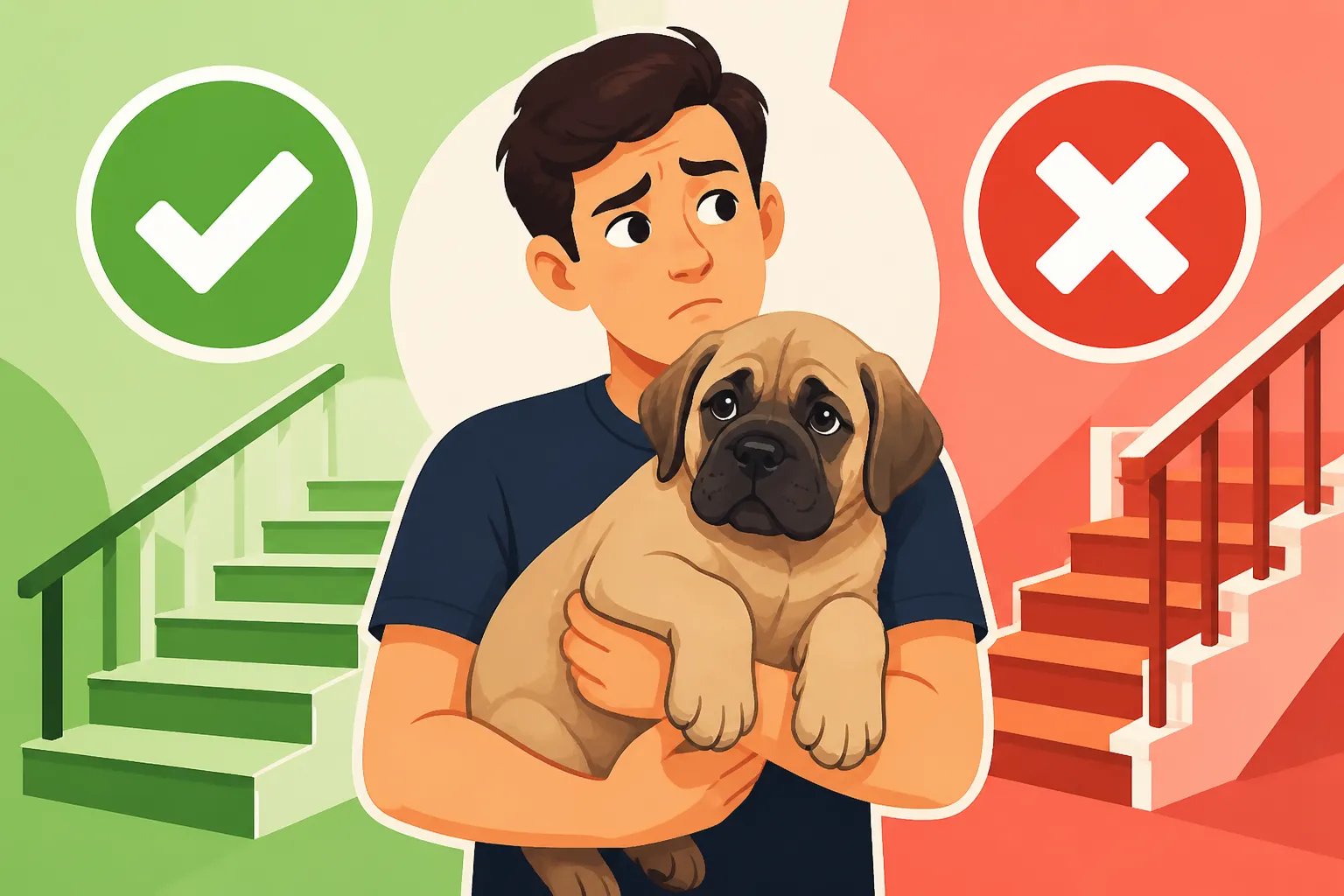
Given the vulnerabilities, the simple answer is yes, you absolutely should carry your Mastiff puppy downstairs whenever possible, especially during their first six to twelve months of life. This isn't about coddling; it's about proactive health management and safeguarding their future mobility. It's a small effort now that can potentially save you and your dog a lifetime of discomfort and expensive veterinary bills. Think of it as a crucial investment in their long-term well-being, even if it means a little extra heavy lifting for you!
Safe Lifting Techniques for a Growing Puppy
Carrying a rapidly growing Mastiff puppy requires some technique, both for their safety and yours. These dogs get heavy, fast! By three or four months, they can already weigh 60-80 pounds, and that's a significant load to manage, especially on stairs.
Here's a breakdown of safe lifting techniques:
- Assess the Weight: Before you even try, make sure you can safely lift your puppy. If they're getting too heavy for one person, don't be afraid to ask for help from another family member. Two people lifting is always safer than one struggling.
- Support the Entire Body: The key is to support both the front and hind ends of the puppy to prevent any strain on their spine or joints.
- Method 1 (Smaller Puppies): For puppies still small enough (typically up to 40-50 lbs), one hand can go under their chest, supporting their front legs, and the other hand can go under their rump, supporting their hindquarters. Hold them close to your body for stability.
- Method 2 (Larger Puppies/Two-Person Lift): As they grow, you'll need one person to support their chest and front legs, and a second person to support their abdomen and hind legs. Coordinate your lift to ensure it's smooth and even.
- Maintain a Straight Back: When lifting, always bend at your knees, not your waist, to protect your own back. Keep your core engaged and lift with your legs.
- Slow and Steady: Avoid sudden movements. Lift and lower your puppy gently.
- Practice: Practice lifting them in a flat, safe area before attempting it on stairs. This builds confidence for both you and your puppy.
Remember, the goal is to prevent stress on their developing joints. If lifting becomes too difficult, it's time to explore alternative strategies, which we'll cover shortly. You'll be amazed at How Fast a Mastiff Puppy Puts On Weight, so these techniques will quickly become part of your daily routine.
When to Transition to Stair Training (and How)
The decision of when to stop carrying your Mastiff puppy and start allowing them to use stairs is a gradual one, and it largely depends on their individual growth rate, muscle development, and your veterinarian's advice. Generally, most giant breed owners aim to keep their puppies off stairs until at least 6-8 months of age, and often longer, up to 12 months, particularly for steep or numerous stairs. The crucial factor is that their growth plates are closed or significantly strengthened, and their musculature is developed enough to support their growing frame.
When you do decide it’s time to introduce stairs, do it as a controlled training exercise, not a free-for-all.
| Age Range (Approx.) | Joint Vulnerability | Stair Recommendation | Training Focus |
|---|---|---|---|
| 8-16 Weeks | Extremely High | Always carry | Basic obedience, socialization on flat ground |
| 4-8 Months | High | Carry as much as possible | Continue carrying, gentle incline exposure if possible |
| 8-12 Months | Moderate to High | Limited, supervised use. Carry if possible | Introduce 1-2 steps at a time, slow pace, positive reinforcement |
| 12-18 Months+ | Moderate | Gradual, supervised access | Encourage slow and steady navigation |
Tips for Stair Training:
- Start Small: Begin with just one or two steps, perhaps a porch step, rather than a full flight of stairs.
- Positive Reinforcement: Make it a positive experience! Use high-value treats and praise. Brands like BAXTER & Bella often emphasize positive reinforcement techniques in their online puppy training programs, which can be invaluable for teaching safe habits.
- Leash Control: Keep your puppy on a leash for their first few supervised attempts. This allows you to guide them and prevent them from rushing.
- Go Slowly: Teach them to go one step at a time, rather than bounding up or down. Downstairs is often harder, so focus on slow, controlled descents.
- Never Force: If your puppy is hesitant or afraid, don't force them. Revert to carrying and try again another day. Fear can make them rush or slip.
- Consult Your Vet: Always discuss your puppy's development and readiness for stairs with your veterinarian. They can provide personalized advice based on your dog's specific health and growth trajectory.
Remember, even when they're older and trained, Mastiffs can still be prone to joint issues. Encouraging a slow, deliberate approach to stairs throughout their lives is a good habit.
Practical Solutions for a Stair-Filled Home
Living in a home with stairs and owning a Mastiff puppy doesn't have to be an impossible feat, but it does require some thought and proactive solutions. You're not alone in navigating this challenge; many giant breed owners face the same dilemma. The good news is there are practical ways to manage stair access to keep your puppy safe.
Gates and Ramps as Everyday Aids
When carrying your growing Mastiff puppy becomes physically unsustainable, or you simply need to manage their access to certain areas, physical barriers and aids become your best friends.
- Baby Gates / Pet Gates: These are fantastic for restricting access to stairs. Install sturdy gates at both the top and bottom of any staircases. Look for extra-tall or extra-wide gates that can withstand a determined Mastiff. Many options are available through online retailers like Amazon, offering various sizes and mounting types to fit your specific doorways or stairwells. You'll want something that mounts securely, not just pressure-mounted, once your Mastiff gets some real size and strength behind them. This is especially important as your puppy reaches that "toddler" phase where they start testing boundaries and gaining immense strength.
- Indoor Ramps: For some homes, particularly those with only a few steps or a very wide staircase, an indoor ramp can be a viable option. However, finding a ramp sturdy enough for a full-grown Mastiff, let alone a growing puppy, can be challenging. The ramp needs to be wide, have good traction, and be set at a gentle incline. While they're more common for outdoor use or vehicle access, some specialized pet ramps might work for interior applications, especially if you have a short set of stairs leading to a sunken living room or similar. Always prioritize stability and grip to prevent slips and falls. This ties into the general concern about What Bare Floors Do to a Growing Mastiff.
Making Smart Choices for Future Joint Health
Beyond the immediate concern of stairs, cultivating a lifestyle that supports long-term joint health for your Mastiff is absolutely critical. Their entire development trajectory is influenced by their environment and care.
- Appropriate Exercise: As mentioned, over-exercising a growing Mastiff puppy is detrimental. Focus on short, controlled walks on soft surfaces (like grass), supervised play, and mental stimulation. Avoid forced runs, long hikes, or intense jumping activities until they are fully mature. Why a Mastiff Puppy Must Not Be Exercised Hard is an article worth reading for more detailed guidance on this.
- Nutrition for Slow Growth: The right diet plays a huge role. Opt for a high-quality large or giant breed puppy food that is specifically formulated to support slow, steady growth, not rapid weight gain. These foods typically have controlled calcium and phosphorus levels. Avoid free-feeding, as it can lead to overeating and excessive weight gain, which puts even more strain on developing joints.
- Supportive Bedding: Provide orthopedic dog beds with dense foam in every area your Mastiff rests. This minimizes pressure on their joints and calluses. Lying on hard floors constantly can contribute to issues like hygromas and further stress on elbows and hips. A Mastiff Lying Two Hundred Pounds on One Elbow All Day describes this issue in detail. You can find excellent orthopedic beds on platforms like Amazon designed for giant breeds.
- Weight Management: Keep your Mastiff lean. Excess weight, even a few extra pounds, significantly increases the load on their joints. Regularly check their body condition score and adjust food intake as needed. You should be able to feel their ribs easily without seeing them prominently.
- Veterinary Care: Regular veterinary check-ups are essential. Your vet can monitor your puppy's growth, assess their gait, and offer advice on joint supplements or other preventative measures if needed. Early detection of any issues can make a significant difference in management.
By being mindful of stairs, implementing safe lifting practices, using appropriate gates or ramps, and making informed decisions about exercise, nutrition, and environment, you can significantly contribute to a healthy and comfortable life for your cherished Mastiff.
Disclaimer
This article is for general informational purposes only and does not constitute professional advice. Laws, prices and regulations vary by location and change over time. Consult a qualified professional for guidance on your specific situation.