How Show Mastiffs Differ in Size From Pet Mastiffs
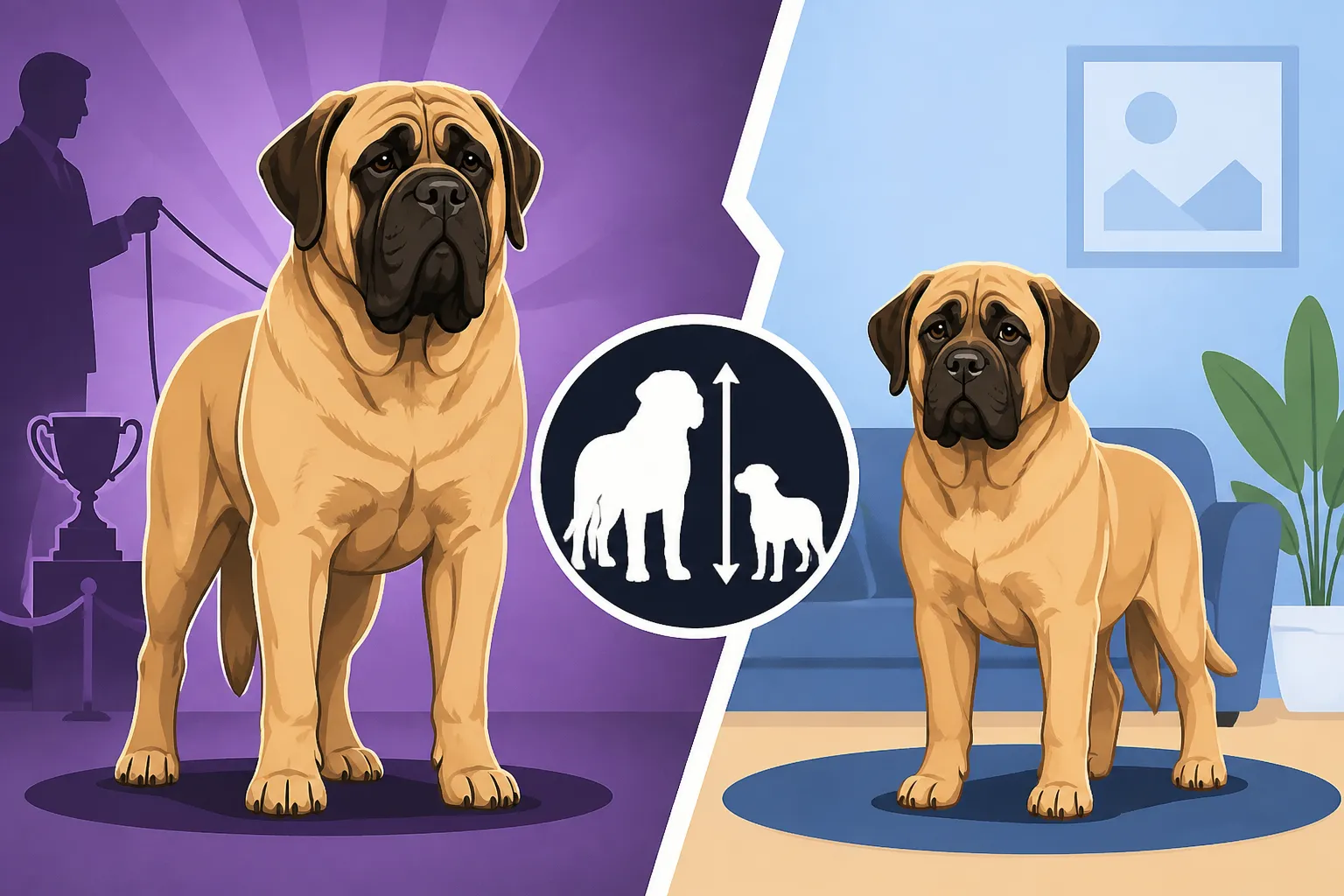
A show Mastiff may look enormous beside the other dogs in the ring, but that does not mean show dogs are automatically larger than family pets. The real difference is usually how each dog is bred, presented, conditioned, and judged. This guide explains what the breed standard says, why pet Mastiffs vary so much, and how to compare size without confusing bulk with soundness.
What the Mastiff breed standard says about size
Height and weight are not the same measurement
The American Kennel Club breed standard sets minimum height requirements: adult males should be at least 30 inches at the shoulder, and adult females at least 27.5 inches. It also describes desirable weight ranges, commonly given as 160 to 230 pounds for males and 120 to 170 pounds for females. Those figures help put the breed’s scale in context, but they do not mean every dog within a range has the same build or proportions.
A dog’s height is measured at the shoulder, not to the top of the head. Weight, meanwhile, reflects bone, muscle, body condition, and sometimes excess fat. Two Mastiffs can stand at similar heights yet look very different: one may be broad and substantial, while another is taller-looking and more athletic. For a broader overview of the breed’s measurements, see What a Mastiff Actually Weighs.
A standard is a guide to the desired breed type, not a promise that every individual will match a particular number. A dog can meet the height minimum and still be lighter or heavier than another dog of the same height. That is one reason a single weight figure is a poor way to decide whether a Mastiff is “show size” or “pet size.”
The standard values overall structure, not maximum bulk
In the show ring, judges assess how a dog fits the breed standard as a whole. Size matters, but so do balance, proportions, movement, temperament, head, topline, and overall condition. A heavier dog is not automatically a better example of the breed. Extra weight that comes from excess fat can make a dog look imposing while making movement and health less favorable.
Mastiffs are meant to be powerful, substantial dogs, so a well-conditioned show dog may look strikingly massive next to a typical companion dog. But the impression of size can come from more than the number on a scale. A broad chest, heavy bone, large head, and well-developed frame can create a sense of great presence without the dog being unusually tall or overweight.
A judge is looking at the dog in motion as well as standing still. If a dog’s weight interferes with comfortable movement or makes it difficult to assess its structure, more bulk is not an advantage. In practical terms, the show ring rewards a dog that looks like a sound, balanced Mastiff—not simply the heaviest one entered.
Why show Mastiffs can look larger than pet Mastiffs
Breeding goals shape the impression
Show breeders select dogs with the aim of preserving and improving traits associated with the breed standard. Over generations, that selection can produce dogs with a more consistent look in areas such as bone, proportions, head shape, and overall substance. A pet Mastiff may come from similar lines, but companion homes are not usually selecting dogs based on how closely they resemble a show winner.
This does not mean every show-bred dog is larger than every pet-bred dog. A pet Mastiff can be tall, broad, and heavy, while a show Mastiff can be comparatively moderate in size. Individual inheritance is variable, and puppies from the same litter can grow into noticeably different adults. Parent size can offer clues, but it cannot guarantee an adult dog’s final dimensions; Whether Parent Size Predicts a Mastiff's Adult Weight explains why.
Sex also affects typical size. Males are generally larger and heavier than females, though there is overlap between individuals. Comparing a mature male in the ring with a young female at home can create a misleading impression of what “show size” means. For separate context on the usual differences, see How Much a Male Mastiff Weighs and How Much a Female Mastiff Weighs.
Show presentation can make a dog seem more imposing
A show dog is groomed, handled, and posed so its features can be seen clearly. The handler may place the dog in a stance that shows its outline, while the dog’s coat and overall presentation make its structure easier to appreciate. That polished appearance can make a dog seem larger or more dramatic than a family pet viewed lounging on a rug or leaning against the kitchen counter.
Photography adds another wrinkle. A low camera angle, close framing, or a person standing behind the dog can exaggerate its scale. A photo rarely tells you the dog’s exact height, weight, body condition, or proportions. If you are comparing dogs online, try to look at several images, including side views and photos with a familiar object or person nearby.
Age matters, too. Mastiffs grow for a long time, and a young adult may still be developing muscle and filling out. A fully mature dog can appear more substantial than a lanky adolescent even if their height is similar. For more on late development, see Whether a Mastiff Fills Out After Two.
| What you are comparing | What it tells you | What it does not tell you |
|---|---|---|
| Height at the shoulder | The dog’s standing height | Whether the dog is healthy or well-proportioned |
| Weight | The dog’s total mass | Whether that mass is muscle, bone, or excess fat |
| Show-ring appearance | How the dog is presented and evaluated | A guaranteed size for all show-bred Mastiffs |
| A single photo | One view of the dog at one moment | Reliable scale, body condition, or adult size |
| Parents’ size | Useful context for possible growth | A precise prediction of a puppy’s adult measurements |
Why pet Mastiffs vary so widely in size
Age, sex, genetics, and body condition all matter
A pet Mastiff is not one fixed size category. Differences in sex, family lines, age, and individual growth can all affect the adult dog’s appearance. A puppy still has a great deal of development ahead, while an older adult may lose muscle or carry weight differently. The dog’s current build is not always a good preview of the way it will look at full maturity.
Body condition is especially easy to misread in a giant breed. A Mastiff can be large and heavy without being overweight, but a thick coat of muscle and bone does not make extra fat harmless. Instead of judging by a scale alone, owners can ask a veterinarian to assess body condition and learn how to feel for the ribs beneath the dog’s bulk. Feeling for a Mastiff's Ribs Under Its Bulk offers a practical way to think about that distinction.
If a Mastiff is much heavier than expected, do not assume the difference is simply “big-boned.” Weight can affect joints and mobility, and giant dogs already place considerable load on their bodies. Keeping a Mastiff lean is a useful part of long-term care; How Weight Shortens a Mastiff's Life looks at why excess weight deserves attention rather than celebration.
“Pet size” does not mean smaller or less authentic
The phrase “pet Mastiff” describes a dog living as a companion, not a separate size variety. A family dog can be purebred, large, and entirely representative of the breed without ever entering a show. Conversely, a show dog is still a companion animal at home; competing does not make it a different kind of Mastiff.
Some families meet a breeder’s show prospects and assume they need to find a puppy that will grow to the same size. That is a risky way to choose. Even experienced breeders cannot promise an exact adult height or weight for a puppy, and selecting for maximum size can distract from soundness, temperament, and the practical demands of living with a giant dog.
A more useful question is whether the adult dog’s likely size fits your household. Consider the space needed for a large bed, the room to move through doorways, the ability to manage a dog safely on leash, and the cost and logistics of veterinary care. If you are sorting through those everyday trade-offs, Whether a Mastiff Is Too Much Dog for Most People can help you think beyond the number on the scale.
How to compare a show Mastiff with a pet Mastiff fairly
Compare mature dogs and assess the whole outline
For a meaningful comparison, look at dogs of similar age and sex. Then consider height, body length, chest, bone, muscle, and movement together. A side-by-side comparison can be more informative than a weight listing, but even then, the dogs may have different proportions or body condition.
If you are meeting a breeder, ask how mature relatives from previous litters developed. Ask whether the breeder has adult photos, health information, and a realistic range of expected sizes—not a guarantee. A responsible conversation should include temperament and health as well as appearance. You can also ask how the breeder evaluates movement and body condition, rather than focusing only on the largest dog in the pedigree.
For a puppy, avoid trying to predict adulthood from oversized paws or a dramatic early growth spurt. Growth varies, and feeding extra food to make a puppy bigger can create problems rather than a better adult. A veterinarian can help you monitor steady growth and body condition as the puppy develops.
Plan for the dog you have, not the biggest dog in a photo
Mastiff owners often discover that size affects ordinary chores long before they worry about show-ring measurements. A bed needs to support a heavy dog, a vehicle needs enough room for safe entry and travel, and a clinic must be able to handle a giant patient. These practical questions matter whether your dog is show-bred, pet-bred, or somewhere in between.
Shopping for appropriately sized supplies can take some thought. When checking options at a retailer such as Chewy, measure the dog and the space first rather than relying on a product label that says “large.” A bed that looks generous in a listing may not leave room for a Mastiff to stretch out, and a bowl or harness still needs to suit the individual dog’s proportions.
The same approach helps with food and care supplies: choose based on the dog’s needs and your veterinarian’s advice, not on assumptions tied to show status. Chewy may be one place owners browse for household supplies, but product dimensions and fit are more useful than a broad size label. If you are preparing for a growing puppy, recheck measurements as the dog changes; a setup that worked a few months ago may no longer fit comfortably.
Most importantly, do not treat an unusually heavy dog as a goal to copy. A healthy Mastiff’s ideal size depends on its frame and condition. If you are unsure whether your dog is too thin, too heavy, or simply built differently from a show dog, ask your veterinarian to assess the individual rather than comparing it with a photograph or an online weight claim.
Disclaimer
This article is for general informational purposes only and does not constitute professional advice. Laws, prices and regulations vary by location and change over time. Consult a qualified professional for guidance on your specific situation.