How Much of the Lyme Hall Mastiff Story Is Legend
A famous Mastiff tale links Lyme Hall in Cheshire to Sir Piers Legh and the Battle of Agincourt. The story is memorable, but its details are not all equally well supported: family history, later breed accounts, and legend have become tangled together. This guide separates what can be responsibly said from what remains uncertain, and explains why Lyme Hall still matters to Mastiff history.
What the Lyme Hall story says
The link between Sir Piers Legh and Agincourt
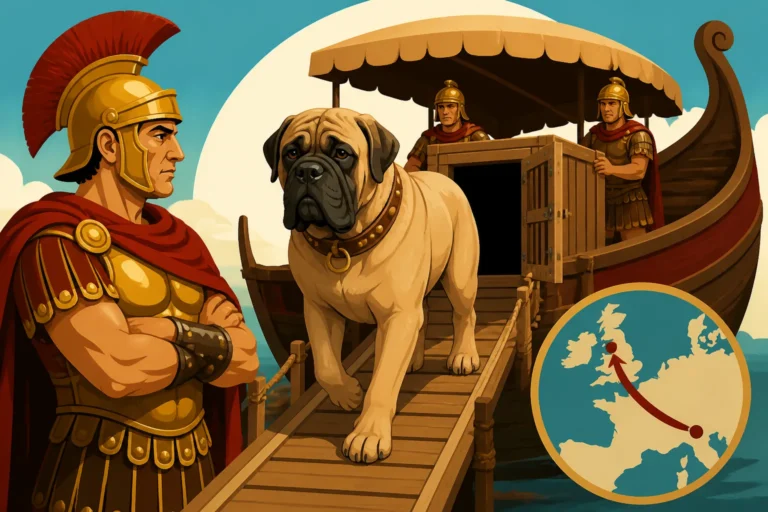
The tale begins with Sir Piers Legh, a member of the Legh family associated with Lyme Hall, and the Battle of Agincourt in 1415. In the familiar version, Legh was badly wounded during the battle, and his Mastiff stayed beside him, protecting him while he lay on the field. Some tellings say the dog returned with him to England; others make the animal’s loyalty the central episode without settling precisely how the journey home happened.
That image—a powerful dog refusing to leave its injured owner—has become one of the breed’s most enduring historical stories. It is also easy to see why it lasted. Mastiffs are imposing dogs, and the tale fits the familiar picture of a steady, devoted guardian. But an appealing story is not the same thing as a fully documented account. To understand the legend, it helps to separate the broad family and place history from the vivid battle scene.
The story is often presented as the origin of a long-running Lyme Hall Mastiff line. In that telling, the dog’s descendants were kept and bred at the estate, and their reputation became part of the breed’s history. For a fuller look at the man and the battle tradition, see Who Sir Piers Legh Was to the Mastiff and What a Mastiff Did at Agincourt in 1415.
Why the dog became central to the legend
The dog is more than a character in the story: it gives the history an emotional center. A battle account can feel distant, but a loyal animal standing watch over a wounded person is easy to picture. The episode turns a family’s connection to an estate and a breed into a story about courage and attachment.
That emotional force can also make the story seem more certain than it is. Repeated retellings often smooth out gaps, so details that may have begun as hearsay or later interpretation start sounding like eyewitness testimony. Over time, a tale may acquire a specific dog, an exact sequence of events, or a claim about descendants even when the surviving evidence does not establish those details.
There is no need to dismiss the story simply because parts of it are uncertain. It can be meaningful as family and breed lore while still being described carefully. The useful question is not only “Did this happen exactly as told?” but also “Which parts can be checked, and which parts belong to tradition?”
What is documented and what is legend
The difference between a historical setting and a proven episode
Agincourt is a documented historical event, and Sir Piers Legh is associated with the battle in the Legh family tradition. That setting gives the Mastiff story a plausible historical frame, but it does not by itself prove that a particular dog guarded Legh on the battlefield. A reliable account needs evidence for the specific episode, not merely evidence that the people and place existed.
The dog’s actions are the part that requires the most caution. Later breed histories and local traditions repeat versions of the tale, but repetition across books or articles does not necessarily mean there are several independent contemporary records. If one retelling draws on another, the same claim can circulate widely without acquiring new evidence.
A careful account therefore uses phrases such as “according to the tradition” or “the story says” when describing the battlefield episode. Those phrases do not ridicule the tale. They signal that the claim has a different evidentiary status from the existence of the battle or the Legh family’s association with Lyme Hall. For a focused discussion of the evidence, see Whether the Agincourt Mastiff Story Is Documented.
How later retellings can turn tradition into certainty
Breed histories often compress long periods into a few memorable paragraphs. A story may be passed from family accounts into local histories, then into dog books, show literature, and online summaries. Each retelling may preserve the core idea while changing details or leaving out the original uncertainty.
That process can create a familiar problem: a claim becomes “known” because it is repeated, even though readers cannot easily trace it back to a contemporary document. Details such as the dog’s precise route home, the start of a breeding program, or an unbroken line of descendants should be treated especially cautiously unless a source demonstrates them.
A practical way to read the tale is to sort its claims into three groups:
| Claim | How to treat it | Why |
|---|---|---|
| Agincourt took place in 1415 | Established historical context | The battle is part of well-documented history |
| The Legh family is connected with Lyme Hall | Historical family and estate context | The family’s association with the property is part of its history |
| A Mastiff guarded Sir Piers Legh after he was wounded | Traditional account, not a detail to state as proven without evidence | The dog’s battlefield actions are the specific part requiring stronger documentation |
| The dog founded a continuous Lyme Hall breeding line | Claim needing careful qualification | A dramatic origin story does not establish generations of pedigrees |
This distinction is useful well beyond one breed story. “A tradition says” is not a way of saying “false”; it is a way of preserving the story without overstating what the evidence can show.
Lyme Hall and the Mastiff line
The estate’s place in Mastiff history
Lyme Hall, near Disley in Cheshire, is closely associated with the Legh family and is widely linked with the history of Mastiff keeping and breeding. The estate’s importance to the breed is not solely dependent on the Agincourt episode. The long-standing association between the Legh family, Lyme Hall, and Mastiffs is itself part of the breed’s historical narrative.
The difficulty is that “a famous kennel” and “a continuous, fully recorded bloodline” are not interchangeable claims. A family may keep and breed dogs over an extended period without every mating, litter, and transfer being documented in a way that meets modern pedigree standards. Historical breeding practices were not necessarily recorded with today’s expectations for registration and traceability.
For that reason, it is safer to say Lyme Hall was an important historical center associated with Mastiffs than to claim that every modern Mastiff descends directly from one Agincourt dog. The distinction may sound small, but it changes the claim from a dramatic, definitive origin story to a more defensible account of influence and tradition. More context is available in How Long Lyme Hall Bred Mastiffs and Whether the Lyme Hall Mastiff Strain Survives.
What a “strain” can mean in older breed accounts
Older writing may use “strain” to describe a recognizable group of dogs associated with a particular kennel, family, or region. It does not always mean a closed, formally registered line with complete records across every generation. The word can refer to a practical breeding influence or a reputation for a certain type of dog.
That matters when reading claims about the Lyme Hall strain. A kennel might have influenced the Mastiffs bred elsewhere through dogs that were sold, gifted, or used for breeding. Over time, that influence could become part of the wider population without a single uninterrupted family tree that can be followed back to one named animal.
So when a source says a modern Mastiff “comes from” Lyme Hall, it is worth asking what kind of connection it means. Is there a documented pedigree? Is the writer describing a broad historical influence? Or is the phrase repeating a traditional claim? Those are different levels of evidence, and a good history makes the distinction clear.
What the story means for the modern Mastiff
Why the legend still matters
The Lyme Hall story survives because it gives the breed a human-scale history. Mastiffs are often described through size, strength, and guarding instincts; the tale adds loyalty, companionship, and a particular place in England. It connects a dog breed to a family estate and a defining moment in medieval history.
The story also shows how breed identity is shaped by more than pedigrees. Local traditions, kennel reputations, family memories, and later writing all influence how people understand a breed’s past. Even when a specific episode cannot be verified in every detail, the tradition can still be culturally important—as long as it is not presented as settled fact.
For readers interested in the wider timeline, The Mastiff That Stood Over Sir Piers Legh at Agincourt explores the legend as a breed story, while How the Modern Mastiff Differs From the Prewar Type puts the old accounts beside later changes in Mastiff breeding and appearance. Those topics help show that “Mastiff history” is not one unbroken narrative but a series of traditions, records, and changes.
A sensible way to tell the story
If you are sharing the Lyme Hall tale, a balanced version is simple: tradition connects Sir Piers Legh’s Mastiff with Agincourt and links the dog to the later reputation of Mastiffs at Lyme Hall. The Legh family and Lyme Hall have a genuine place in Mastiff history, but the dog’s precise battlefield actions and the claim of a direct, continuous line should be treated as unverified unless supported by specific historical records.
That wording preserves what makes the story memorable without making the evidence carry more weight than it can bear. It also avoids the opposite mistake of declaring the entire account invented just because its most dramatic details are uncertain. History often contains a mixture of documented context, family tradition, and later embellishment.
In the end, Lyme Hall’s significance does not depend on proving every scene in the Agincourt story. Its lasting connection to Mastiff history can be discussed on its own terms, while the battlefield episode remains a compelling tradition rather than a fully established fact. That is a more careful—and more interesting—way to understand how a famous breed story takes shape.
Disclaimer
This article is for general informational purposes only and does not constitute professional advice. Laws, prices and regulations vary by location and change over time. Consult a qualified professional for guidance on your specific situation.