How a Mastiff’s Weight Compares With a Newfoundland’s
A Mastiff usually outweighs a Newfoundland, often by a noticeable margin, but the difference isn’t as simple as comparing the biggest dogs you’ve seen. Sex, build, body condition, and individual genetics all matter. This guide explains typical adult weight ranges, what those numbers look like in everyday life, and how to tell healthy size from excess weight in either breed.
Typical Mastiff and Newfoundland weights
Adult weight ranges at a glance
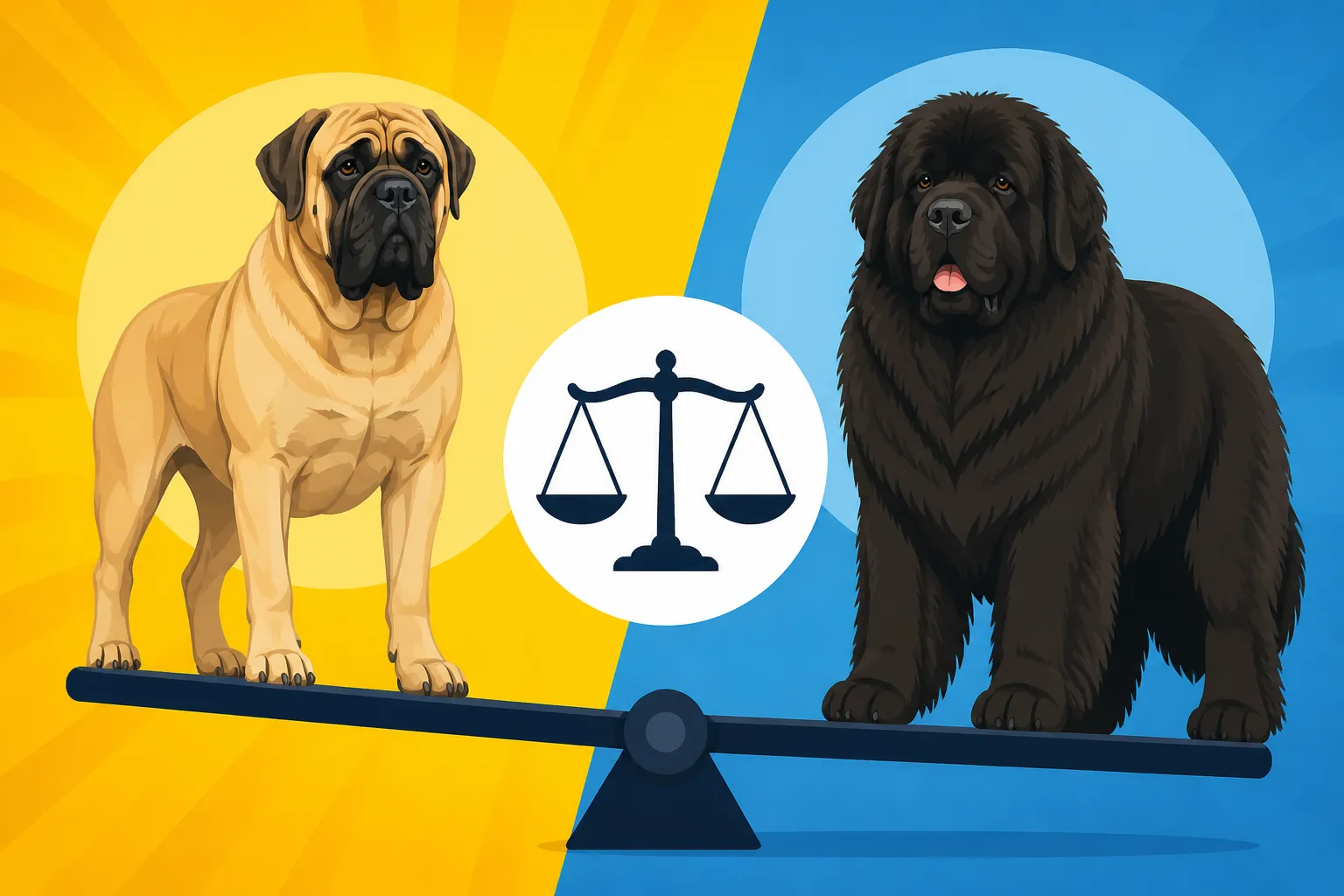
Mastiffs are generally heavier than Newfoundlands, especially males. A mature male Mastiff may weigh roughly 160 to 230 pounds, while females are often around 120 to 170 pounds. Adult male Newfoundlands commonly weigh about 130 to 150 pounds, with females often around 100 to 120 pounds.
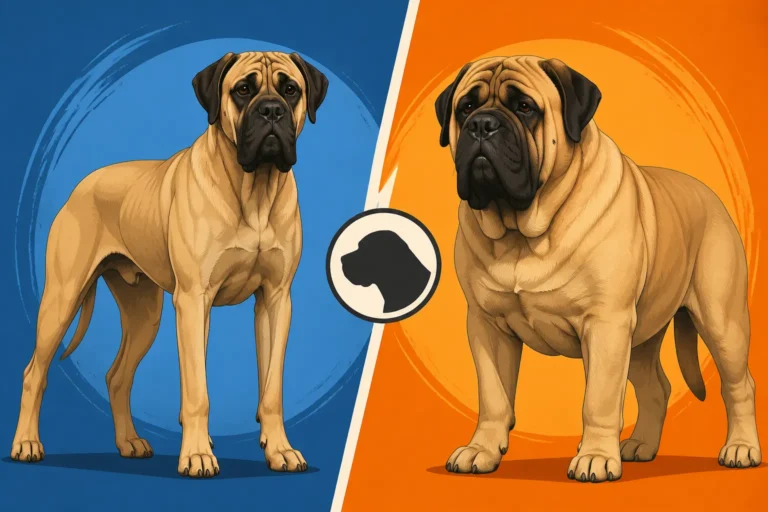
These are broad breed ranges, not targets every dog must reach. A large-framed Newfoundland can overlap with a lighter Mastiff, and an individual Mastiff may fall below the usual range while still being healthy. The breed’s overall shape matters too: a Mastiff often looks massive through the head, chest, and body, while a Newfoundland’s substantial coat can make its frame appear larger than the scale suggests.
| Breed and sex | Typical adult weight range | How the size often presents |
|---|---|---|
| Male Mastiff | About 160–230 pounds | Very large frame with substantial bone and a broad, heavy-looking body |
| Female Mastiff | About 120–170 pounds | Usually smaller than a male, but still an exceptionally large dog |
| Male Newfoundland | About 130–150 pounds | Powerful, broad-bodied dog with a thick coat |
| Female Newfoundland | About 100–120 pounds | Often lighter than a male, with a sturdy frame and dense coat |
Breed standards generally emphasize proportion, substance, and soundness rather than requiring every dog to reach a particular number on the scale. For a broader sense of the breed’s size, see How Much a Male Mastiff Weighs and How Much a Female Mastiff Weighs. Newfoundland weights also vary by sex and individual build, so use the comparison as a starting point—not a pass-or-fail test for your dog.
Why the Mastiff is usually heavier
A Mastiff’s build is designed to look and feel substantial. Even at a similar height to another large breed, a Mastiff may carry more mass through its body and bones. Many have a broad chest, thick limbs, and a large head, all of which contribute to their imposing appearance and high body weight.
Newfoundlands are also large, heavy dogs, but their appearance can be misleading. Their dense coat adds visual volume, particularly around the neck, chest, and hindquarters. A Newfoundland standing beside a Mastiff may look just as large—or even larger—while weighing less. That’s one reason the scale and a hands-on body-condition check are more informative than a quick glance.
A simple comparison: imagine lifting a damp, thickly coated Newfoundland onto a scale after a swim. The dog may look enormous, but the waterlogged coat doesn’t tell you how much body fat or muscle it has. A Mastiff’s shorter coat reveals more of its outline, though its sheer body mass can still make it difficult to judge whether it is carrying extra weight.
Size overlap between individual dogs
The ranges overlap enough that a specific Mastiff won’t always be heavier than a specific Newfoundland. A smaller female Mastiff might weigh less than a large male Newfoundland. A large male Mastiff, on the other hand, may outweigh most Newfoundlands by a considerable amount.
Age also changes the comparison. Young dogs are still growing, and giant breeds can take a long time to reach adult size and fill out. A lanky adolescent Mastiff may weigh less than an adult Newfoundland, then gain height and muscle as it matures. Avoid using an adult range to assess a puppy or adolescent; your veterinarian can help interpret growth over time.
If you’re comparing breeds before choosing one, remember that weight is only one part of daily life. Room to turn around, traction on slippery flooring, vehicle access, grooming needs, and the ability to safely manage the dog all matter. The related guide What a Mastiff Actually Weighs explores how much variation there can be within the Mastiff breed itself.
What weight means in everyday life
Lifting, transport, and veterinary care
A dog’s weight affects practical tasks long before it becomes a number on a chart. If a 200-pound Mastiff refuses to get into the car, or a Newfoundland slips and can’t stand, the problem is not just finding someone strong enough to help. You need a safe plan that protects both the dog and the people assisting.
Consider your home setup before bringing home either breed. Check whether the dog can enter your vehicle without a steep jump, whether the veterinary clinic can accommodate a giant patient, and whether a ramp or non-slip flooring would make everyday movement safer. An older dog that suddenly struggles to rise may need veterinary attention, not simply encouragement to try harder.
Veterinary procedures can also require extra planning for very large dogs. A clinic may need suitable equipment, a team to move the dog, or referral care for certain procedures. For a Mastiff-specific look at the practical challenges, read What a Mastiff's Weight Does to Every Line on the Vet Invoice. The same broad lesson applies to Newfoundlands: larger bodies can make routine handling more involved.
Food, supplies, and household logistics
Food portions should be based on the dog’s age, activity level, health, and body condition—not just breed or scale weight. Two dogs of the same weight may need different amounts of food. A calm, neutered adult who gets gentle walks may need less than a more active dog of the same size. Ask your veterinarian to help establish a feeding plan, then adjust based on the dog’s condition and measured progress.
Food storage is another unglamorous but real consideration. A giant dog can go through a substantial amount of food, so it helps to plan where bags or containers will fit and how you’ll keep food dry and fresh. Some owners use a retailer such as Chewy to arrange food delivery or compare suitable products, but the important step is choosing an appropriate diet with veterinary guidance—not selecting food because its packaging says “large breed.”
Supplies also need to fit the dog’s actual measurements. Collars, harnesses, beds, crates, and vehicle restraints should be chosen by fit and the manufacturer’s sizing guidance, not a general breed label. A Newfoundland’s thick coat can affect how a harness sits, while a Mastiff’s broad chest and neck may make standard sizing awkward. Chewy may be one place owners look when comparing sizes and product options, but check return policies and measure carefully before ordering.
How body weight affects movement
Extra weight places more strain on joints, particularly in giant breeds. A dog may become less willing to walk, slower to rise, or more reluctant to climb steps. It’s easy to dismiss those changes as “just a big-dog thing,” but new or worsening stiffness deserves attention. Pain, arthritis, injury, and other health concerns can all affect movement.
Weight management is not about making a Mastiff or Newfoundland look lean by human standards. It is about supporting comfortable movement and reducing avoidable strain. A gradual plan is safer than a sudden reduction in food, especially for a growing dog. For Mastiffs, the guide Keeping a Mastiff Lean on Purpose offers more detail on managing body condition.
If you’re buying food or a feeding tool, focus on what makes the plan easier to follow: a container that seals well, a measuring scoop or kitchen scale, and a feeding routine everyone in the household can stick to. Chewy can be a convenient option for comparing basic supplies, but a product won’t replace portion guidance or regular weight checks.
How to tell whether a giant dog is at a healthy weight
Look beyond the number on the scale
A number alone cannot tell you whether a dog is underweight, fit, or carrying excess fat. Two dogs with the same weight may have different frames and different amounts of muscle. A large-boned Newfoundland may be healthy at a weight that would be too high for a smaller-framed dog.
In general, you should be able to feel the ribs with gentle pressure without having to dig through a thick layer of fat. From above, there should be some visible waist behind the ribs, and from the side, the abdomen should usually rise slightly toward the hind legs. These checks can be harder in a Newfoundland because the coat obscures the outline. Use your hands and ask your veterinarian to demonstrate what a healthy condition feels like on your dog.
For a Mastiff, the dog’s broad shape can make subtle weight gain easy to miss. A belly that gradually becomes rounder, less visible waist definition, or a change in stamina may be more noticeable than a dramatic shift on the scale. If you are unsure whether your dog is heavy because of muscle, build, coat, or excess fat, a veterinary assessment is a better guide than comparing photos online.
Track weight changes steadily
Weighing a giant dog at home can be difficult, and lifting one onto a household scale is rarely a sensible solution. Your veterinary clinic may be able to weigh the dog during appointments, or advise you about an accessible scale nearby. Keep a simple record of weights and dates so you can spot a pattern rather than reacting to a single reading.
Pay attention to gradual changes in daily life too. Does your dog tire more quickly on a familiar walk? Is it harder to feel the ribs than it was a few months ago? Has the dog’s appetite changed? These details can help your veterinarian decide whether the change reflects normal aging, reduced activity, a health issue, or a need to adjust feeding.
For a puppy, consistency matters particularly because giant breeds should grow at a controlled pace. Rapid growth is not a goal in itself, and extra calories or supplements should not be added without professional advice. See The Age a Mastiff Stops Growing and Why a Mastiff Puppy Must Not Be Exercised Hard for related guidance on growth and activity.
When weight changes need veterinary attention
Contact a veterinarian if your dog gains or loses weight unexpectedly, stops eating, seems weak, has trouble rising, or becomes short of breath with ordinary activity. Sudden changes can be related to illness, pain, medication, or a change in routine. Don’t assume that a large dog is simply “getting old” when a new mobility problem appears.
A gradual weight-loss plan may involve measured meals, fewer uncounted treats, appropriate activity, and regular follow-up. A veterinarian can help set a realistic goal and make sure the plan suits the dog’s age and health. Avoid crash diets or sharply reducing food on your own; an overly restrictive approach can leave a dog hungry and may not address the underlying reason for weight gain.
Weight loss can also be difficult to judge in a thick-coated dog. The coat may disguise a changing outline, and seasonal grooming can make the dog appear suddenly smaller without any real change in body condition. Keep the scale, hands-on checks, and veterinary advice in the picture rather than relying on appearance alone.
Choosing between a Mastiff and a Newfoundland
Think about handling as well as maximum weight
If weight is a concern, ask what you will realistically manage in an ordinary week—not only how much the dog might weigh at its largest. Think about walking on a wet sidewalk, getting into a vehicle, bathing, nail care, and helping the dog during an injury or illness. Even a dog at the lower end of its breed’s range is a serious physical commitment.
Mastiffs tend to be heavier and have a short coat that makes routine brushing relatively straightforward, although they can drool heavily. Newfoundlands usually have a substantial coat that needs regular care and can make grooming more time-consuming. Neither breed is automatically the easier choice; the right fit depends on which practical demands suit your household.
Temperament, training, health, and living environment matter at least as much as weight. Both breeds need early, thoughtful training because pulling or jumping becomes difficult to manage as they grow. A gentle dog can still knock someone over by accident, and a dog that is hard to move can create a challenge if it becomes ill or refuses to walk.
Make a realistic home and budget plan
Before choosing either breed, measure doorways, sleeping spaces, and the area where a bed or crate would go. Check whether your vehicle can accommodate a giant dog safely, including when the dog is older and less willing to jump. Consider non-slip rugs or runners if your floors are slick, especially in the areas the dog will use most.
Budget for more than food. Large dogs may need appropriately sized equipment, grooming support, veterinary care, and a plan for emergencies. Ask local clinics about their ability to handle giant breeds and consider how you would transport a dog that cannot walk into the building.
A good decision is not simply “Which breed gets bigger?” It is “Which dog’s size, care routine, and temperament can I support for the dog’s entire life?” A Mastiff will often be heavier, but a Newfoundland’s coat and grooming needs can be just as important to your day-to-day planning. Meet adult dogs where possible, speak with responsible breed contacts, and ask your veterinarian what to prepare for before bringing a giant-breed puppy home.
Disclaimer
This article is for general informational purposes only and does not constitute professional advice. Laws, prices and regulations vary by location and change over time. Consult a qualified professional for guidance on your specific situation.