How High a Mastiff Can Reach on a Counter
Oh, the counter-surfing Mastiff! If you've ever walked into your kitchen to find a half-eaten pizza or a suspiciously empty butter dish, you know the particular brand of exasperation that only a giant breed can deliver. It’s not just about losing your lunch; it’s about a potential safety hazard for your beloved companion. This guide will dive deep into exactly how high your Mastiff can reach, why they're so tempted by your countertops, and most importantly, what practical, empathetic steps you can take to keep both your food and your gentle giant safe and happy.
Understanding Your Mastiff's Reach and Motivations
Before we can even begin to tackle the problem, we need to understand it from your Mastiff's perspective. It's not just naughtiness; it's often a blend of natural curiosity, powerful instincts, and sheer physical capability that makes your kitchen counters so irresistible.
The Anatomy of a Counter-Surfing Mastiff: How High Can They Really Get?
Let's be brutally honest: your Mastiff is a walking, breathing, drooling counter-height vacuum cleaner. Their sheer size is often underestimated when picturing what they can access. A standard kitchen counter is typically about 36 inches (3 feet) high. Now, think about your Mastiff.
A male Mastiff can easily stand 30 inches or more at the shoulder, with females slightly smaller but still substantial. When they stand on all four paws, their head, with its magnificent jowls and keen nose, is already well above counter level. They don't even need to stretch much to sniff out that forgotten sandwich.
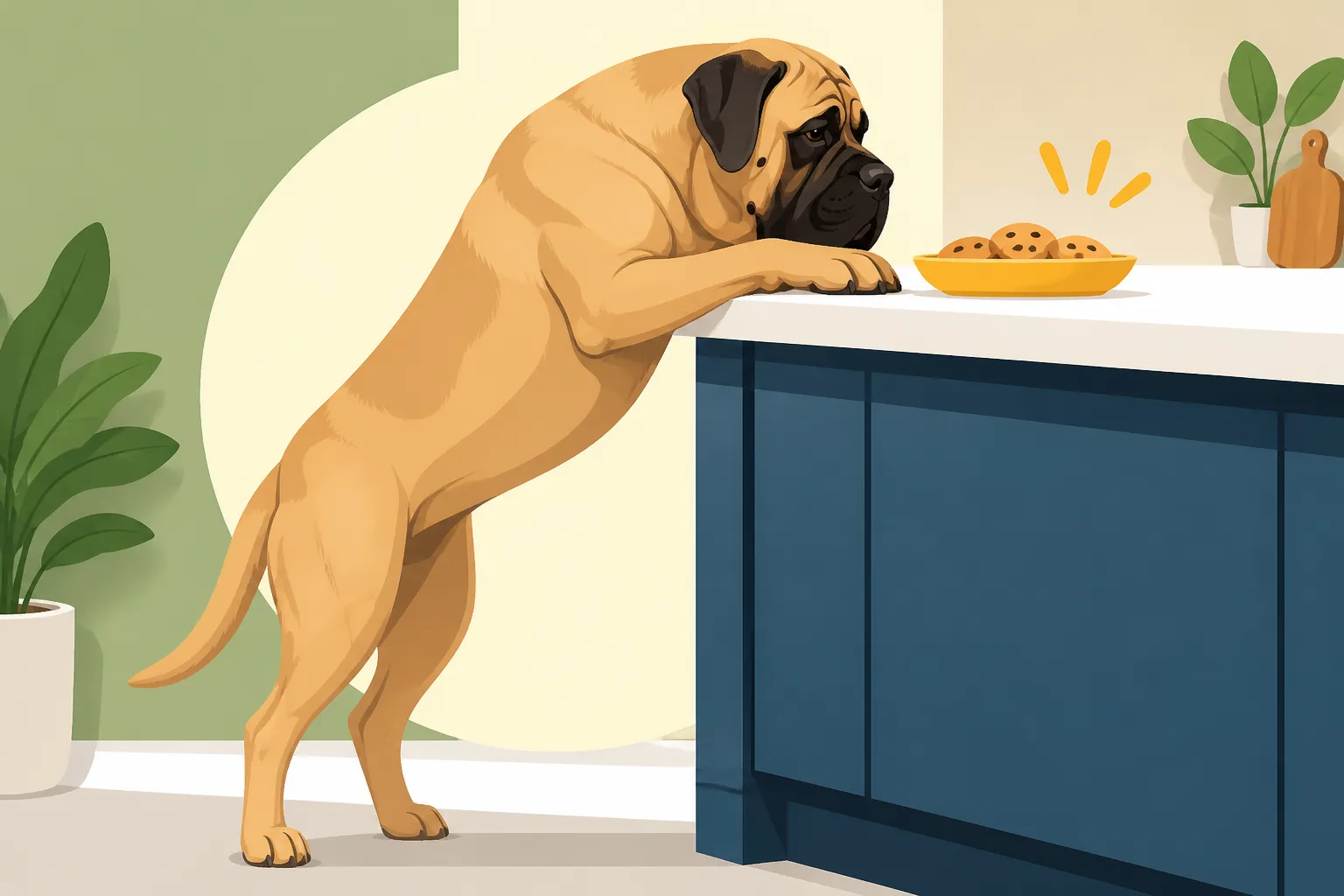
But it gets "better." A Mastiff can, and often will, prop themselves up on their hind legs with their front paws on the counter. In this stance, a 30-inch-tall Mastiff can easily add another 12-18 inches (or more!) to their vertical reach, placing items a staggering 42 to 48 inches (3.5 to 4 feet) or higher well within their grasp. That's almost eye-level for many adults, and certainly high enough to clear most standard counter items. They aren't jumping so much as reaching and leaning. Their immense weight provides stability for this maneuver, making them surprisingly adept at clearing a path to whatever deliciousness has been left out.
Consider this table for a rough idea:
| Mastiff Stance | Approximate Shoulder Height (inches) | Head Height (inches) | Maximum Counter Reach (inches) | Notes |
|---|---|---|---|---|
| On All Fours | 27-32 | 30-36 | 36-40 (with stretch) | Can easily sniff, lick, and pull items close to the edge. |
| Front Paws Up | N/A | N/A | 42-55+ | Can easily reach the middle of most counters, stable on hind legs. |
| Full Stand | N/A | N/A | 60+ (rare, unstable) | Less common for counter-surfing, but shows their impressive vertical scale. |
This means that virtually anything on your counter, unless pushed far back against the wall, is fair game. And let's be honest, even pushed back, a persistent Mastiff can sometimes use their nose or a paw to drag things closer. It's a testament to their strength and determination! You can see how How Tall a Mastiff Stands directly translates to kitchen accessibility.
Why Your Mastiff is Driven to Counter-Surf: More Than Just Hunger
It's tempting to think your Mastiff is just perpetually hungry, but counter-surfing is usually a mix of several factors beyond basic caloric need.
First and foremost, it's often an opportunistic behavior. Dogs are scavengers by nature. If they detect food and it's within reach, why wouldn't they try to get it? They're not thinking about your dinner plans or the health implications; they're thinking "free food!" If they've been successful even once, that positive reinforcement creates a strong association: counter = potential reward.
Second, for a Mastiff, boredom or lack of mental stimulation can play a huge role. While they are known for their calm demeanor, a bored Mastiff can get into trouble. Sniffing out food is a mentally engaging activity. If they're not getting enough mental exercise or their physical needs met (even if it's just their one hour of activity a day, as we discuss in Why a Mastiff Only Needs One Hour a Day), their clever minds will seek out other forms of entertainment, and your kitchen often becomes the most exciting playground.
Third, some Mastiffs are simply curious and exploring their environment. They use their mouths and noses to investigate the world, and that includes anything new or interesting on the counter. The scent of a forgotten banana or a sizzling pan is incredibly powerful to their sensitive noses.
Identifying What Tempts Them Most: The Irresistible Aromas
It's not always the full meal that tempts them; sometimes it's the smell of something utterly mundane to us that becomes an irresistible beacon for your Mastiff. Any food left unattended is a prime target, of course, but think about the strong smells:
- Freshly baked goods: The aroma of bread, cookies, or a pie is like a siren call.
- Meat products: Leftover chicken, a raw steak thawing, or even a plate with meat drippings will be incredibly appealing.
- Dairy products: Butter, cheese, or yogurt left out.
- Fruit and vegetables: While not always their first choice, things like grapes (which are toxic!), avocados, or even a forgotten apple can pique their interest.
- Unusual scents: Sometimes it's not even food, but something with an interesting smell. A used tea bag, a crumpled paper napkin with food residue, or a dishtowel used to wipe up a spill can be enough to draw them in.
The key here is understanding that your Mastiff's sense of smell is astronomically more powerful than yours. What might be a faint, barely perceptible scent to you is a vibrant, unmistakable invitation to them. They can literally smell opportunity from another room, making a quick dash to the kitchen when your back is turned seem entirely logical to them. This keen sense of smell also means that even crumbs or residue can be enough to signal "food here," encouraging further investigation.
Practical Strategies to Deter Counter-Surfing
Knowing why your Mastiff is doing it and how they manage it is the first step. The next is putting practical, consistent strategies in place. This isn't about punishment; it's about prevention, management, and clear communication through training.
Environmental Management: Making Your Kitchen Less Appealing
The easiest way to stop counter-surfing is to remove the temptation entirely. This requires a shift in your household habits, but it's crucial for success.
- Clear the decks: Make it a strict rule that counters are always clear when you're not actively using them. This means no cooling pies, no forgotten snacks, no thawing meat. Ever. If it's not there, they can't get it. This might sound simple, but it requires diligent effort from everyone in the household.
- Secure your trash: Your Mastiff will be very interested in the trash can, especially if it contains food scraps. Invest in a heavy-duty, Mastiff-proof trash can with a secure lid. A step-on can that a paw can't open easily, or one that locks, is essential. This also prevents them from ingesting something dangerous.
- Use baby gates or restrict access: When you can't supervise your Mastiff, consider using baby gates or closing kitchen doors to prevent access entirely. Given a Mastiff's size, you'll need sturdy, tall gates, possibly even those designed for larger breeds, to ensure they can't just lean over or push through. This is particularly important during busy times, like meal prep, or when you have guests over and can't dedicate full attention to your dog. For specific situations, an extra-tall gate found on Amazon might be a lifesaver.
- "Booby traps" (used with caution): Some owners try harmless deterrents like stacking empty soda cans on the edge of the counter (out of reach but balanced) so they fall and make a startling noise if nudged. However, this must be used with extreme caution and never with anything that could injure your dog or make them fearful of the kitchen itself. The goal is surprise, not terror. A better, non-aversive alternative might be to ensure the counters are always boring and empty.
Remember, consistency is key. One slip-up where they find a reward can reinforce the behavior and set you back weeks.
Training for a "Leave It" Command: A Crucial Life Skill
Beyond managing the environment, teaching your Mastiff a rock-solid "Leave It" command is invaluable. This command is not just for counter-surfing; it's a critical safety command for anything you don't want your Mastiff to touch, whether it's a dropped pill, discarded food on a walk, or indeed, your dinner on the counter.
Here's a basic approach to teaching "Leave It":
- Start easy: Hold a low-value treat (something they like but aren't crazy about) in your closed hand. Say "Leave It" and present your fist to your Mastiff.
- Wait it out: Your Mastiff will likely sniff, lick, or paw at your hand. Ignore this. The moment they stop trying and look at you, even for a split second, say "Yes!" (or click) and reward them with a different, higher-value treat from your other hand. This teaches them that ignoring the first treat gets them a better reward.
- Increase difficulty: Once they understand this, place the low-value treat on the floor, cover it with your hand, and repeat the process. Gradually lift your hand, then eventually place the treat on the floor without covering it.
- Introduce distractions: Practice in different environments and with increasingly tempting items. Eventually, you want them to "Leave It" when it's on a counter. This will take time, patience, and many repetitions. For guidance on a structured training program, online resources like BAXTER & Bella offer fantastic modules that cover essential commands like "Leave It" in depth, tailored for all stages of a puppy's development. Consistency in training is also something we explore in Whether Positive Training Alone Works on a Mastiff.
The goal is for "Leave It" to mean: "Don't touch that, and you'll get something even better from me." This builds trust and reinforces that listening to you is always more rewarding than self-rewarding.
Consistent Reinforcement and Routine: Building Good Habits
Mastiffs thrive on routine and clear expectations. Their seemingly stubborn nature, as highlighted in The Stubbornness That Is Actually a Mastiff Thinking, often means they are simply thinking through what you're asking, rather than outright defying you.
- Everyone on board: Ensure every member of your household, and even regular visitors, understands and adheres to the "no food on counters" rule and knows the "Leave It" command. Inconsistency is a Mastiff's greatest weakness when it comes to training. If one person allows counter-surfing, your Mastiff will learn that the rule is flexible.
- Scheduled meals: Feed your Mastiff on a regular schedule, with appropriate portions of high-quality food. A hungry Mastiff is a motivated Mastiff. While it won't stop a seasoned counter-surfer completely, a well-fed dog is less likely to be ravenously seeking out extra calories. We discuss portion sizes in How Much an Adult Mastiff Eats by Weight Each Day.
- Enrichment activities: Provide plenty of appropriate mental and physical enrichment. This could be puzzle toys, chew bones, short training sessions throughout the day, or even just spending quality time together. A content, stimulated Mastiff is less likely to invent their own "fun" by raiding the kitchen.
- Positive reinforcement for desired behavior: When your Mastiff isn't counter-surfing, or when they walk past the counter without a second glance, praise them! Reward them for being calm and staying on the floor in the kitchen. Celebrate the absence of the unwanted behavior, not just the success of a command. This is crucial for strengthening good habits.
- Management over confrontation: If you catch your Mastiff with their paws on the counter, a firm "Off!" or "Leave It!" is appropriate, followed by redirecting them to an approved activity or moving them away from the kitchen. Avoid scolding or harsh punishment. This can create fear and anxiety, and Mastiffs are particularly sensitive, as noted in The Sensitivity Nobody Expects in a Two Hundred Pound Mastiff. They might just learn to counter-surf when you're not around.
Addressing Common Challenges and Misconceptions
Even with the best intentions and consistent effort, challenges can arise. It’s important to stay realistic and adaptable in your approach.
When Counter-Surfing Becomes a Safety Issue: Protecting Your Mastiff and Your Home
Beyond the annoyance of lost food, counter-surfing can be genuinely dangerous for your Mastiff.
- Toxic foods: Many human foods are toxic to dogs, including chocolate, onions, garlic, grapes, raisins, xylitol (a common sugar substitute), and certain nuts. Ingesting these can lead to severe illness or even death. A Mastiff's large size often means they can consume a significant amount of a toxic substance before you even notice. What a Mastiff Can Reach on a Counter and Should Not Eat delves into this further.
- Sharp objects and hot surfaces: Knives left on the counter, hot pans, or even broken glass from a knocked-over item pose serious risks. A Mastiff investigating a counter could easily cut themselves, get burned, or ingest glass.
- Foreign objects: Things like plastic wrap, foil, wooden skewers, or small appliances could be pulled down and ingested, leading to choking or internal obstructions requiring emergency veterinary intervention.
- Heavy objects: If your Mastiff pulls down a heavy mixer, a cast-iron pan, or a stack of plates, it could cause serious injury if it falls on them, or on a child or another pet.
This is why environmental management is paramount. You simply cannot rely solely on training a Mastiff whose instincts are so strong and whose physical capabilities are so immense. Your diligence in keeping counters clear is their primary safeguard.
Diet and Exercise: Are They Getting Enough?
Sometimes, persistent counter-surfing can be a signal that something is lacking in your Mastiff's daily routine, or that their diet isn't quite right.
- Appropriate nutrition: Ensure your Mastiff is eating a high-quality, nutritionally complete diet suitable for giant breeds. While quantity is important (and Mastiffs eat a lot!), quality ensures they feel satisfied and are getting all the nutrients they need. Consult your vet to confirm the right type and amount of food for your Mastiff's age, weight, and activity level. Also, keeping them lean helps with overall health, as discussed in The Weight Range a Male Mastiff Should Hold and The Weight Range a Female Mastiff Should Hold.
- Adequate exercise (the right kind): While Mastiffs aren't marathon runners, they still need regular, moderate exercise. This isn't just for physical health but mental well-being too. A good, consistent walk, some playtime in the yard, or even focused training sessions can help burn off excess energy and provide mental stimulation, making them less inclined to seek out "trouble" in the kitchen. Remember, Mastiff puppies should have restricted exercise to protect their developing joints, as covered in The First Year With a Mastiff Puppy That Doubles in Size.
- Mental stimulation: Don't underestimate the power of mental games. Scent work, puzzle toys, or even just learning new tricks can be incredibly tiring for a dog. A mentally stimulated Mastiff is often a calmer, more satisfied Mastiff who is less likely to raid the counter out of sheer boredom. This could be as simple as hiding treats around the house for them to find or rotating their toys to keep things interesting.
If you suspect your Mastiff's counter-surfing is rooted in hunger or boredom despite your best efforts, discuss it with your veterinarian or a certified professional dog trainer. A trainer, as mentioned in Whether a Mastiff Needs a Professional Trainer, can offer tailored advice and help you identify underlying causes.
Dealing with a Relapse: Back to Basics
Even the most well-behaved Mastiff might have a moment of weakness. Perhaps a new, irresistible scent wafted from the counter, or a family member accidentally left something out. If your Mastiff relapses, don't despair or get angry. It happens.
- Re-evaluate your management: The first step is to revisit your environmental management. Were the counters truly clear? Was the trash secured? Was a door left ajar? A relapse is often a sign that your management system needs tightening.
- Increase vigilance: For a period, increase your direct supervision in the kitchen. Be proactive. If you see your Mastiff even looking at the counter with too much interest, redirect them with a toy or a "place" command.
- Reinforce "Leave It": Go back to basic "Leave It" training sessions, making them fun and rewarding. Practice in different areas of the house, gradually increasing the distractions. Remind your Mastiff what What Actually Motivates a Mastiff is and use it to your advantage.
- Identify triggers: Was there a specific item left out? Was it an unusual time of day? Understanding what triggered the relapse can help you prevent it in the future. Perhaps you need to be extra diligent on specific days, like baking day, or when guests are over.
- Patience and persistence: Training a Mastiff, especially for behaviors tied to strong instincts, takes immense patience and consistency. It's a marathon, not a sprint. Celebrate small victories, and don't let a single setback derail your efforts. Your Mastiff relies on you for clear guidance and a safe home.
Counter-surfing in a Mastiff is a formidable challenge, but it's not insurmountable. By understanding their capabilities and motivations, implementing strict environmental management, and consistently applying positive reinforcement training, you can create a safe, harmonious home for everyone – and keep your snacks exactly where they belong.
Disclaimer
This article is for general informational purposes only and does not constitute professional advice. Laws, prices and regulations vary by location and change over time. Consult a qualified professional for guidance on your specific situation.