Why a Tibetan Mastiff Is Not Related to the Mastiff
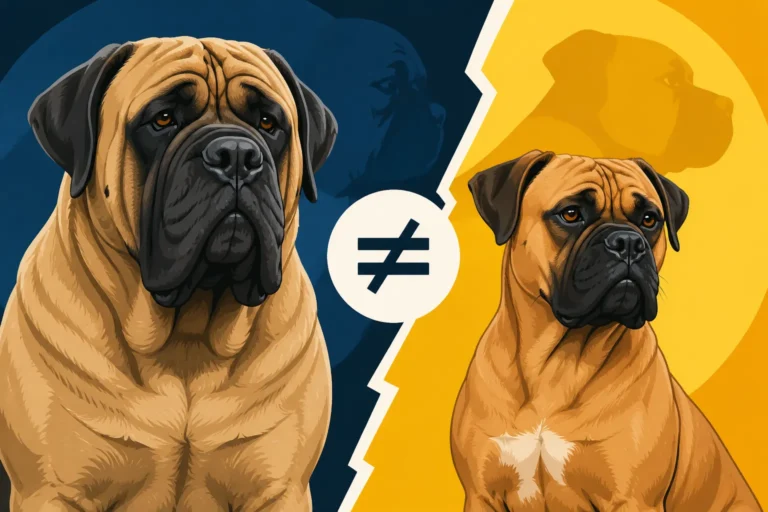
People often assume the Tibetan Mastiff is a close relative of the English Mastiff because both names include “Mastiff,” and both dogs were developed as guardians. The name is misleading: these are distinct breeds with different histories, environments, builds, and coats. This guide explains what they share, where they differ, and why the label alone does not prove a close family connection.
Why the names make the breeds sound related
“Mastiff” can describe a type as well as a breed
The word Mastiff has two uses that are easy to mix up. It is the official name of a particular breed commonly called the English Mastiff, but “mastiff” is also used more broadly for certain large, powerful dogs. That broader usage can describe a look or general type rather than a precise pedigree. So when a breed name contains “Mastiff,” it does not automatically mean that breed descended from the English Mastiff.
The Tibetan Mastiff is a separate breed, associated with the Tibetan Plateau and neighboring Himalayan regions. The Mastiff, often called the English Mastiff to distinguish it in everyday conversation, developed as a British breed. Their names reflect a shared category of large guardian dogs as much as a proven family tree. They are not simply two regional versions of the same breed.
This naming confusion is not unique to these dogs. Breed names often preserve old descriptions, local traditions, or labels given by outsiders. For a useful comparison of naming and breed distinctions, see Why Some Call It the Old English Mastiff and What the AKC Officially Calls the Mastiff.
Similar guardian jobs do not establish close ancestry
Both breeds have been associated with guarding, but similar work can shape dogs in similar ways without making them close relatives. A livestock guardian in a remote, exposed landscape benefits from confidence and independence. A dog expected to guard a home or estate may also need size, composure, and a willingness to assess unfamiliar people. Those shared demands can produce some familiar traits across very different dog populations.
That is why the two breeds can seem alike at first glance: both are large, substantial dogs, and neither is known for being a lightweight, highly animated companion. Yet a broad resemblance is not the same as evidence that one breed came directly from the other. Their physical features and temperaments need to be understood in the context of their separate histories.
The broad historical category of powerful, large dogs is sometimes discussed through terms such as molosser. That label can help explain why unrelated or distantly related breeds are grouped together in discussions of size and build, but it does not settle the ancestry of any individual breed. The Molossus in the Mastiff's Ancestry explores that distinction in more detail.
How their histories and environments differ
The Tibetan Mastiff developed as a regional guardian
The Tibetan Mastiff is linked to the high-altitude regions of the Tibetan Plateau and the Himalayan area, where communities relied on dogs to guard property and livestock. In such settings, a dog might need to notice activity from a distance, respond without waiting for a handler’s constant direction, and cope with cold and challenging conditions. Its background helps explain why the breed is often described as independent and watchful.
Those traits can be appealing, but they have practical consequences for household life. An independent guardian may not treat every visitor as an instant friend, and early, thoughtful socialization matters. A Tibetan Mastiff’s size and self-possession can also make consistent boundaries important: a polite, manageable adult is much easier to live with than a dog that has been left to make every decision on its own.
The Tibetan Mastiff’s history is not simply “the English Mastiff, but from Tibet.” It is a distinct regional breed shaped by a different working environment and cultural setting. Breed histories can be difficult to trace through ancient periods with modern precision, so it is sensible to distinguish well-established regional roles from confident claims about exact ancient parent breeds.
The English Mastiff developed along a different path
The English Mastiff’s breed history is tied to Britain, where the dog became associated with guarding and other roles that changed over time. Its modern identity is distinct from that of the Tibetan Mastiff, even though both are large guardian-type dogs. The two breeds should not be treated as interchangeable simply because their names and some broad characteristics overlap.
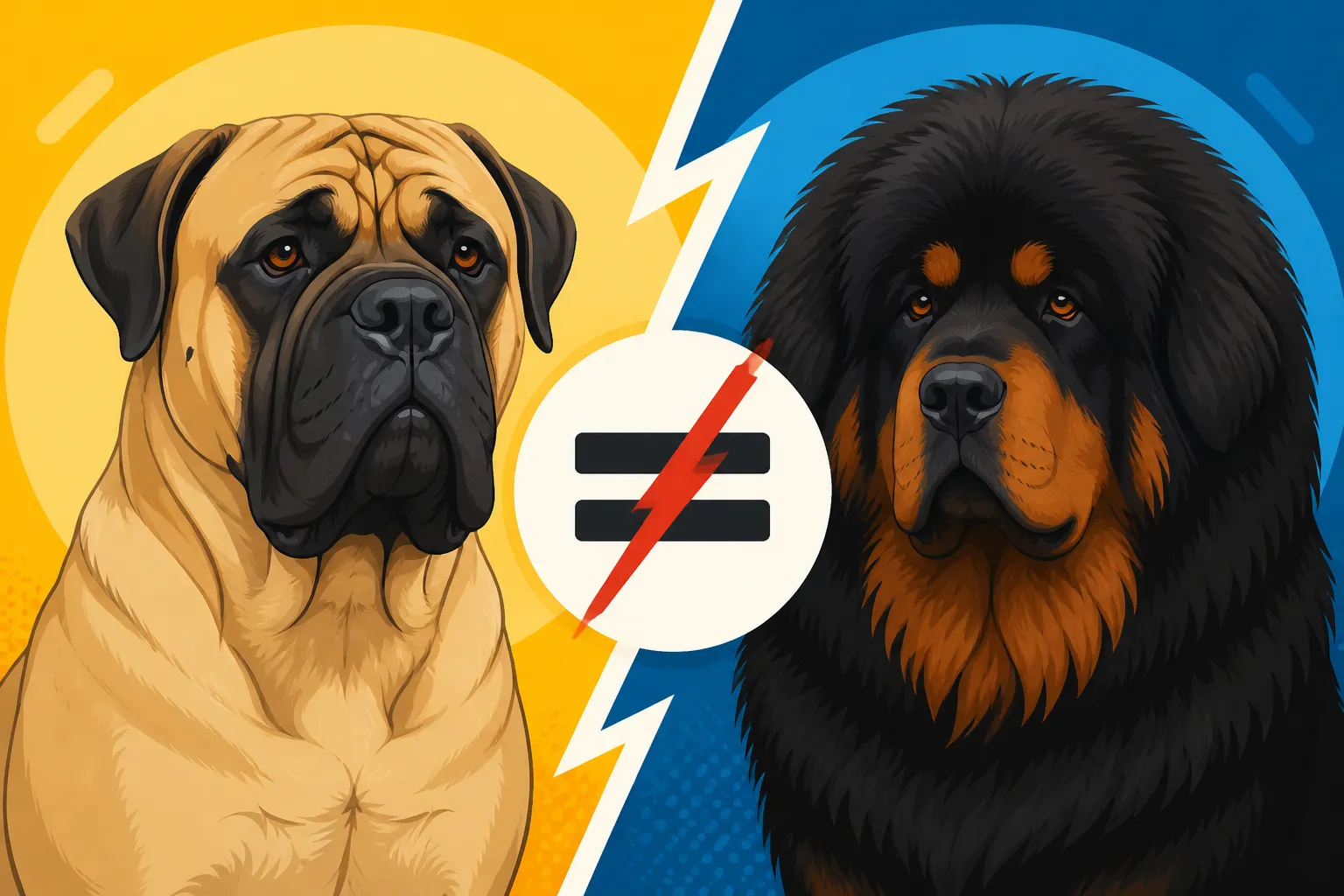
Their different histories also help explain why their bodies and coats look so unlike one another. The English Mastiff is generally a short-coated, exceptionally heavy dog with a broad head and loose facial skin. The Tibetan Mastiff has a dense coat suited to colder conditions and often has a mane-like appearance around the neck and shoulders. Individual dogs vary, but these are useful visual clues when someone is trying to tell the breeds apart.
The Mastiff’s own history includes changes in how people expected the breed to behave and what roles it served. How the Mastiff Was Bred Away From Fighting gives context for how a breed’s purpose can shift over generations. For comparisons with other large guardian breeds, see The Mastiff Against the Bullmastiff and the Cane Corso.
How to tell the breeds apart in everyday life
Coat, outline, and overall build
The coat is one of the clearest differences. A Tibetan Mastiff has a heavy double coat, with a dense undercoat and a longer outer coat. Its coat may look especially full around the neck and shoulders, though fullness varies by dog, sex, season, and individual. That coat requires regular attention, especially during shedding periods, when loose undercoat can build up quickly.
The English Mastiff has a short coat that is much simpler to brush, though “short-haired” does not mean “no maintenance.” Regular brushing can help manage shedding, and folds, ears, nails, and skin still need routine care. A short coat also does not make the English Mastiff suited to every climate; comfort depends on the individual dog and conditions, not coat length alone.
| Feature | Tibetan Mastiff | English Mastiff |
|---|---|---|
| Breed identity | A distinct Tibetan and Himalayan-region breed | A distinct British breed, often called the English Mastiff |
| Coat | Dense double coat, often fuller around the neck | Short coat |
| Historical role | Guardian associated with livestock and property in its home region | Guardian breed with a separate British history |
| General impression | Substantial, often heavily coated, watchful | Extremely heavy, broad-bodied, short-coated |
| Care consideration | Coat brushing and seasonal shedding management | Drool, skin folds, weight, and joint-friendly handling |
If you are comparing dogs because of coat-care needs, be realistic about the time and space involved. A Tibetan Mastiff’s thick coat can mean brushing sessions, loose hair on furniture, and more work during seasonal shedding. If you shop for grooming tools through Chewy or another retailer, check that the brush is appropriate for a double coat and that the tool feels comfortable to use on a large dog. A brush that is too small or uncomfortable can turn a routine task into a struggle.
Temperament, training, and household fit
Neither breed should be chosen on appearance alone. Both can be powerful dogs, and both need careful management, but their behavior is shaped by individual temperament, socialization, breeding, and training. A Tibetan Mastiff’s guardian background may show up as strong alertness or reserve around unfamiliar people. An English Mastiff may also be protective and imposing, but that does not mean every dog of either breed behaves the same way.
A prospective owner should consider what happens in ordinary situations: a delivery at the door, a guest entering the home, a child running through the room, or a dog encountering another dog on a narrow sidewalk. Good training is not about forcing a dog to greet everyone. It is about teaching calm, safe behavior and giving the owner reliable ways to manage the dog in real settings.
Think beyond the home, too. A large dog needs suitable transport, secure containment, and a vet clinic prepared to handle its size. For Mastiff owners, practical issues such as weight and handling deserve serious planning; How a Mastiff's Weight Compares With a Newfoundland's offers one helpful comparison. If the household is quiet and prefers a predictable, low-visitor routine, it is worth considering what a watchful guardian breed may need to feel settled. Whether a Mastiff Suits a Quiet Household discusses that question for the English Mastiff.
What “not related” means and how to choose responsibly
Separate breeds, not completely separate dog history
Saying the Tibetan Mastiff is “not related to the Mastiff” is a useful shorthand for correcting the common assumption that the Tibetan breed is a direct offshoot or regional form of the English Mastiff. It should not be read as a claim that the dogs have no canine ancestry in common. All domestic dogs share a broad ancestry, and large guardian breeds may also be discussed within wider historical or morphological groupings.
The key point is more specific: the Tibetan Mastiff and the English Mastiff are separate breeds with different regional histories. A shared word in their names, a powerful build, or a guarding role does not establish a close direct relationship. Where exact ancient ancestry is unclear, careful language is more honest than a tidy but unsupported family-tree story.
If you encounter claims that one breed is simply the ancestor of the other, ask what the claim is based on. Does it refer to a documented, breed-specific lineage, or is it inferring ancestry from similar appearance and function? Those are not equivalent. Breed labels, historic descriptions, and modern genetic relationships each answer different questions.
Questions to ask before bringing either breed home
Before choosing a puppy or adult dog, look at the individual animal and the conditions in which it was raised. Ask about health screening, temperament in everyday situations, and what support the breeder or rescue offers if the placement becomes difficult. For a Mastiff puppy, responsible planning should include checking the parents’ health information and asking how the breeder raises and matches puppies. The CHIC Tests Both Mastiff Parents Must Clear is a useful starting point for understanding health-testing conversations about the English Mastiff.
For a Tibetan Mastiff, ask specifically about coat care, socialization, guardian behavior, and the dog’s response to visitors and unfamiliar environments. A breeder should be able to talk candidly about the traits they select for and the kinds of homes that suit their dogs. With either breed, be wary of anyone promising that a huge guardian dog will automatically be easy, universally friendly, or protective in a predictable way.
Also consider the environment you can provide. A Tibetan Mastiff’s thick coat and background make climate and daily management relevant questions; Whether a Mastiff Suits a Hot Climate explores climate considerations for the English Mastiff, but the same practical habit applies: assess the specific dog, local weather, shade, indoor comfort, and safe exercise rather than relying on a breed label alone. If you are comparing grooming supplies, food, or basic care items, Chewy can be one place to look, but confirm that any product fits the dog’s size, coat, and needs rather than buying based on a generic “large breed” label.
A helpful final distinction is this: if you want the English Mastiff, look for the breed’s British history and short-coated, heavy-bodied appearance. If you want the Tibetan Mastiff, look for the separate Tibetan and Himalayan-region breed, its dense coat, and its guardian temperament. The name may invite comparison, but the better decision comes from understanding the dog in front of you. For a concise look at the naming question itself, see Whether a Tibetan Mastiff Is a Mastiff at All.
Disclaimer
This article is for general informational purposes only and does not constitute professional advice. Laws, prices and regulations vary by location and change over time. Consult a qualified professional for guidance on your specific situation.