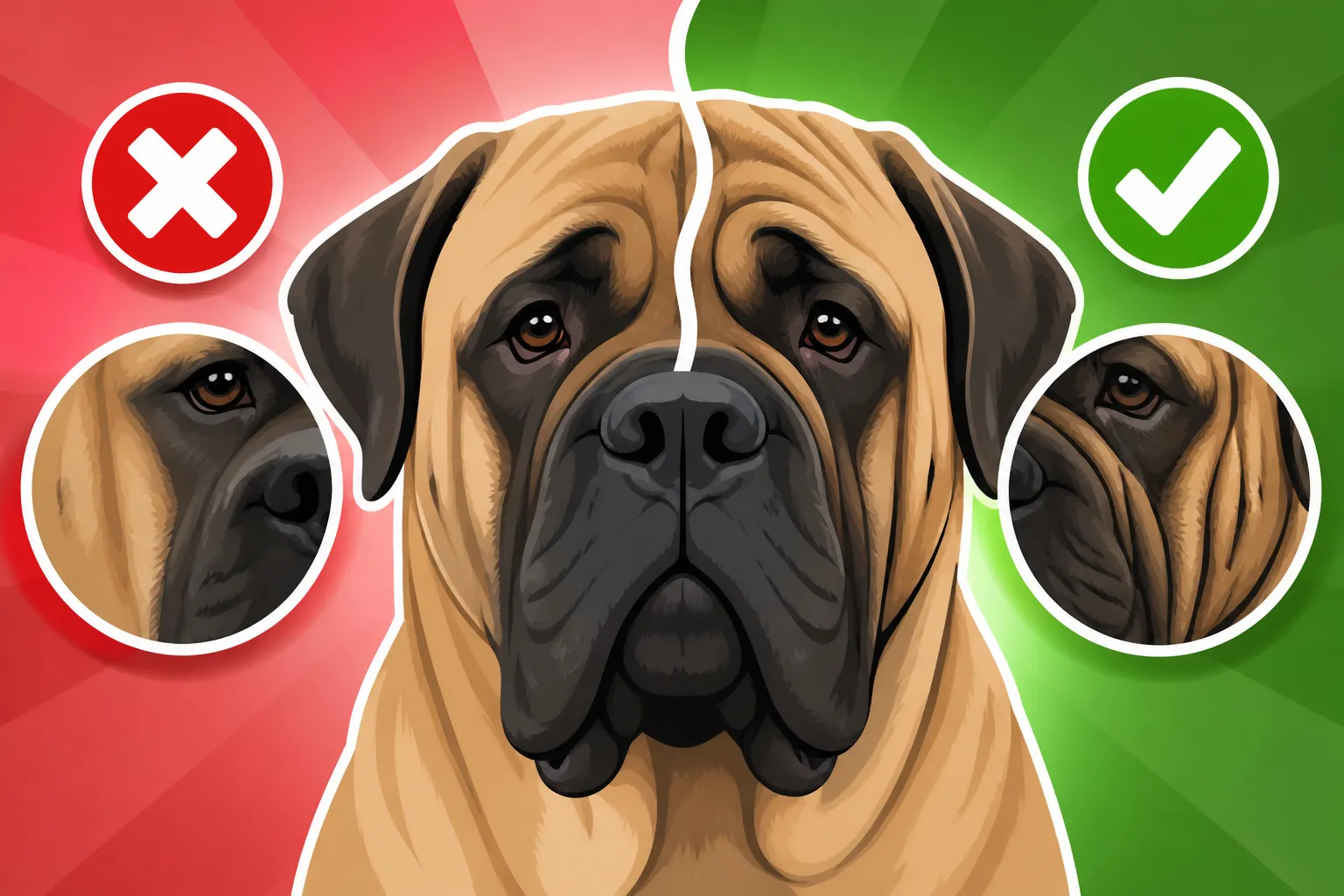
How Deep a Mastiff’s Wrinkles Should Be
A Mastiff’s forehead wrinkles should be noticeable when the dog is alert, but they should not look like deep, crowded folds that stay damp or irritated. The breed’s expression can make it hard to tell what is normal and what needs attention. This guide explains what Mastiff wrinkles are meant to look like, how to assess them at home, and when a change deserves a veterinarian’s advice.
What normal Mastiff wrinkles should look like
Forehead wrinkles are most visible when a Mastiff is attentive
A Mastiff’s forehead is generally broad and relatively flat when the dog is relaxed. When the dog becomes interested in something—a knock at the door, a treat, or a new person—the skin across the forehead may crease into wrinkles. That shifting expression is normal. It is not a requirement for the wrinkles to be sharply cut, permanently deep, or piled into heavy ridges.
This difference can be confusing if you are comparing your dog with photographs. A picture may catch a Mastiff at the exact moment its ears are forward and its attention is fixed, making its forehead look much more furrowed than it does during a nap. Lighting and camera angle can exaggerate the folds, too. Compare your dog’s face in ordinary relaxed moments as well as when alert, rather than judging by one dramatic photo.
There is no simple ruler measurement that defines the correct depth of a Mastiff’s wrinkles. The breed standard describes the expression and overall head rather than prescribing a precise fold depth. In everyday terms, a normal forehead wrinkle is a temporary crease that appears with expression and does not cause discomfort or interfere with the dog’s eyes, skin, or normal activity.
Facial folds are not all the same
People often use “wrinkles” to describe every crease on a Mastiff’s face, but forehead creases and skin folds around the nose, lips, and other areas are not identical. Some folds are more permanent because of the shape of the skin and soft tissue. Those areas need to be judged by their condition as well as their appearance: clean, comfortable skin matters more than a particular depth.
A fold may look prominent without being a problem. A fold that is persistently wet, red, sore, or smelly deserves more attention, even if it does not look especially deep. Conversely, a deep-looking crease that stays clean and comfortable is not automatically infected or unhealthy. The dog’s skin and behavior provide more useful clues than appearance alone.
For a practical map of the areas owners commonly mean when they talk about facial folds, see Where a Mastiff's Skin Folds Are. If you are unsure whether a particular crease is part of your dog’s normal facial structure, take a clear photo and ask your veterinarian to look during a routine exam. They can assess the skin in person and help you distinguish ordinary anatomy from a fold that is causing trouble.
How to assess wrinkle depth at home
Look at the skin, not just the crease
Start by observing your Mastiff when it is calm and comfortable. Look at the forehead, nose area, and lip folds in good light, without pulling or stretching the skin. Notice whether the skin looks its usual color and whether the folds are dry, clean, and free of obvious irritation. Then check again when your dog is attentive. The forehead may crease more at that moment, and that change by itself is not a warning sign.
A useful home check is less about asking, “How deep is this wrinkle?” and more about asking, “Is the skin healthy, and is my dog comfortable?” Watch for redness, swelling, tenderness, crusting, discharge, a persistent unpleasant odor, or repeated rubbing and pawing at the face. These signs do not tell you exactly what is wrong, but they are good reasons to contact your veterinary clinic for guidance.
Do not try to open a tight fold forcefully or dig into it to inspect the bottom. Pulling can make a dog uncomfortable and may irritate sensitive skin. If the fold is difficult to see or clean gently, mention that at your next appointment. Your veterinarian can show you a safe approach for your individual dog.
Compare with your Mastiff’s usual appearance
A Mastiff’s face may change as the dog grows, gains or loses weight, or ages. The most helpful comparison is often with your own dog’s normal appearance over time, not with another Mastiff’s face online. Take occasional photos in similar lighting and from a similar angle if you are tracking a change. A new area of redness or swelling will be easier to spot when you have a clear sense of what is usual for your dog.
| What you notice | What it may mean | A sensible next step |
|---|---|---|
| Forehead creases appear when your Mastiff is alert and soften at rest | Normal expression is likely | Keep observing during routine grooming |
| A fold looks prominent but the skin is comfortable and clean | Depth alone may not signal a problem | Ask your veterinarian about it at a routine visit if uncertain |
| The skin is persistently damp, red, sore, or has an unusual odor | Irritation or infection may be possible | Contact your veterinary clinic for advice |
| Your dog rubs its face, squints, or resists touch | Discomfort may be present | Arrange veterinary assessment, especially if symptoms persist |
| There is sudden swelling, bleeding, or discharge | A new medical problem may need prompt attention | Call your veterinarian promptly |
A change in the face can sometimes overlap with an eye or eyelid concern, particularly if the dog squints, has unusual tearing, or seems sensitive around the eyes. For related signs and conditions, read Eye and Eyelid Disease in a Mastiff. If the change is sudden or your dog seems painful, do not wait for a routine grooming day to see whether it settles.
Caring for Mastiff wrinkles without over-cleaning
A gentle, consistent routine is usually better than scrubbing
Some Mastiffs need little more than a quick visual check, while others have folds that collect moisture, food, or debris and benefit from regular gentle cleaning. How often depends on your dog’s skin, the location of the fold, and your veterinarian’s advice. If a fold stays clean and dry, cleaning it aggressively every day may be unnecessary and can irritate the skin.
When cleaning is needed, keep it simple. Use a soft, clean cloth or a product your veterinarian has recommended. Wipe gently where you can reach without forcing the fold open, then dry the area carefully. Avoid using harsh household cleaners, fragranced products, or human skin treatments unless your veterinarian specifically approves them. “Natural” on a label does not automatically mean suitable for a dog’s face.
The details matter because folds can trap moisture. A quick wipe that leaves the skin damp may not solve the problem, and vigorous rubbing can make sensitive skin worse. The goal is to remove visible residue while keeping the skin comfortable—not to make the fold look polished or perfectly crease-free. For more on frequency and technique, see How Often a Mastiff's Folds Need Cleaning, What to Clean a Mastiff's Wrinkles With, and Whether a Mastiff's Folds Need Drying After Cleaning.
Pay attention to nose and lip folds
The nose wrinkle and lip folds can need slightly different attention from forehead creases. Food, saliva, and water may collect around the muzzle, especially after meals or drinking. If your Mastiff has a fold that stays moist, a gentle check after eating can help you notice residue before it builds up. Avoid repeatedly scrubbing the same area if the skin already looks sore.
If you buy basic grooming supplies through a retailer such as Chewy, choose items based on your veterinarian’s guidance and the needs of your dog’s skin, not on claims that a product will “fix” deep wrinkles. A clean, soft cloth and a suitable drying towel may be all that is needed for some dogs. If a medicated product is suggested, confirm how and where it should be used before applying it near the eyes or nose.
The nose wrinkle may not need the same routine as the lip folds. A dog with a dry, comfortable nose area may need only periodic checks, while another may collect debris more often. Whether a Mastiff's Nose Wrinkle Needs Daily Attention and Whether a Mastiff's Lip Folds Trap Food cover those areas in more detail. If you are shopping for supplies on Chewy, it can be useful to compare the product ingredients and intended use with your veterinarian’s recommendations rather than choosing a cleanser based only on the word “wrinkle.”
When wrinkle depth becomes a health concern
Signs that warrant a closer look
Depth is only one small part of the picture. A fold that has become red, moist, swollen, or painful deserves attention, as does a sudden change in how your dog’s face looks. A persistent odor, discharge, crusting, or repeated face rubbing can also suggest that the skin needs veterinary assessment. These signs do not confirm an infection on their own, but they should not be dismissed as “just how Mastiffs look.”
A Mastiff may not make it obvious that a facial fold is uncomfortable. Some dogs quietly pull away when touched, turn their head, or resist having the face wiped. Others rub the muzzle on a carpet or furniture. Treat those reactions as useful information rather than assuming the dog is being difficult. If cleaning seems to hurt, stop and ask your veterinarian what to do next.
For a more detailed list of possible warning signs, see Signs a Mastiff's Fold Has Become Infected. Do not start leftover medication or put ointment deep inside a fold without professional advice. The right treatment depends on what is causing the irritation, and some products are not appropriate for use near a dog’s eyes or mouth.
Ask for help when appearance or comfort changes
A veterinarian can check whether the skin is inflamed, whether there is a secondary problem, and whether your cleaning routine should change. Bring up the concern even if the wrinkle looks only mildly different. A simple question during an exam can be especially helpful if you are uncertain whether a fold is normal for your dog’s face or if you have been changing products and the skin has become more sensitive.
If your Mastiff is uncomfortable, has worsening redness, or develops discharge or swelling, contact the clinic rather than waiting to see whether routine wiping clears it. More urgent signs—such as marked pain, bleeding, significant facial swelling, or trouble opening an eye—should be discussed promptly with a veterinarian. The crease itself may not be the issue; the important thing is what is happening to the skin around it and how your dog feels.
When you shop for cleaning supplies, Chewy may be one of the places you compare options, but a product listing cannot tell you what is suitable for a sore or infected fold. Check with your veterinary team before using a medicated cleanser or changing treatment. And if your Mastiff’s wrinkles are simply expressive forehead creases that appear when the dog is alert, soften when relaxed, and do not bother the skin, there is generally no reason to try to flatten them.
Disclaimer
This article is for general informational purposes only and does not constitute professional advice. Laws, prices and regulations vary by location and change over time. Consult a qualified professional for guidance on your specific situation.