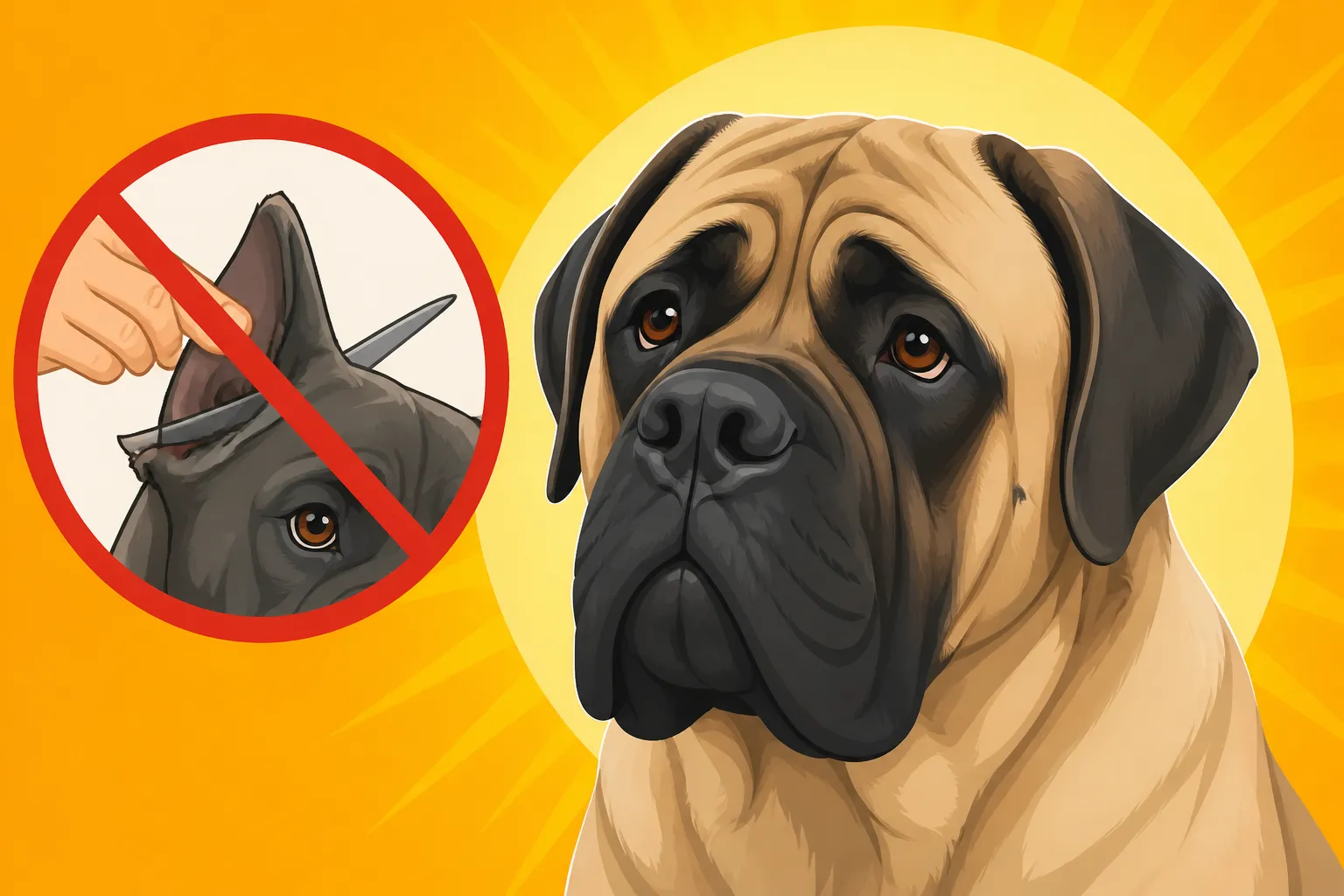
Why a Mastiff’s Ears Are Never Cropped
A Mastiff’s ears are left natural because the breed standard calls for small, thin ears that lie close to the cheeks, not ears altered by surgery. Cropping offers no proven health or hearing benefit for a Mastiff, and it can mean pain, healing complications, and extra aftercare. This guide explains the breed’s natural ear shape, why cropping is avoided, and how to care for those ears instead.
What a Mastiff’s Natural Ears Should Look Like
The breed standard calls for ears that lie close to the head
A Mastiff’s ears are naturally small and thin, set wide apart near the highest points of the skull. They lie flat against the cheeks and have a V shape with gently rounded tips. The standard also calls for ears that are dark in color, matching the dog’s mask. These are normal features of the breed—not signs that the ears have been left unfinished or need “correcting.”
That natural shape fits the Mastiff’s overall appearance: a broad head, short coat, and powerful frame. The details matter in the show ring, but a pet Mastiff’s ears do not need to meet a judge’s ideal to be healthy. If you are comparing your dog with breed descriptions or photographs, The Ear the Mastiff Standard Calls For gives you a useful starting point for understanding what “natural” means in this breed.
People sometimes assume that a large, imposing dog should have cropped ears because they have seen other breeds with upright, pointed ears. But a Mastiff’s ears are not meant to stand erect. They are soft, close to the cheeks, and move naturally with the dog. Cropping would change their appearance rather than reveal a hidden or more correct shape.
Natural ears are part of the Mastiff’s identity
The Mastiff is not one of the breeds whose familiar look depends on cropped ears. In fact, the standard describes the ears as they occur naturally. Keeping them intact preserves the dog’s ordinary anatomy and expression, including the subtle way the ears shift when the Mastiff is listening, relaxed, or responding to someone nearby.
If you are learning how the breed is described, it can help to read about its formal name and history alongside its physical traits. What the AKC Officially Calls the Mastiff provides context for the breed’s identity, while The Mastiff Standard Has Changed Since 1900 can help explain why standards are part of a breed’s recorded history rather than a reason to perform cosmetic surgery on an individual dog.
There is also a practical point: a Mastiff’s natural ears are easy to recognize and care for. They do not need to be taped upright, shaped, or maintained through a long period of post-surgical treatment. For most owners, the question is not how to make the ears look different, but how to keep the skin and ear canal comfortable and watch for signs of irritation.
Why Mastiff Ears Are Not Cropped
Cropping is a surgical alteration, not routine grooming
Ear cropping removes part of the outer ear, or pinna, to create a different shape. It is not the same as trimming hair or cleaning the ear. The procedure requires anesthesia, and recovery may involve wound care, follow-up visits, and sometimes keeping the ears positioned while they heal. The exact process and risks depend on the dog and the veterinary team.
For a Mastiff, cropping is not needed to meet the breed standard. It also does not make the ears more functional or improve the dog’s hearing. A cropped ear may look more upright, but that appearance is created by removing tissue and managing the healing process—not by uncovering a health advantage.
It is understandable to wonder whether cropping prevents ear infections, especially if you have heard that upright ears “breathe better.” Ear problems can have many causes, and changing the outer ear does not guarantee that a dog will avoid infection. If your Mastiff has recurring discomfort, odor, discharge, or head shaking, the useful next step is a veterinary examination and a plan based on what is happening in that dog’s ears. Ear Infections in a Mastiff can help you recognize the issue without assuming that cropping is a preventive treatment.
Cosmetic cropping can carry real risks
Like any surgery, cropping can involve pain, bleeding, infection, problems with wound healing, or complications related to anesthesia. A dog may also need repeated handling and follow-up care during recovery. Because Mastiffs are large, anesthesia and safe handling should be discussed carefully with a veterinarian for any procedure; cosmetic surgery adds risk without providing a health benefit that the breed needs.
The emotional and practical side matters, too. A puppy is not simply “getting its ears done” and then immediately moving on. There can be discomfort, restrictions on activity, and a period when the owner must monitor healing closely. A procedure chosen only for appearance can place a puppy and its family through that burden without improving hearing, preventing disease, or making the dog more comfortable.
Rules on cosmetic cropping differ by location, and veterinary standards and legal requirements may also apply. Before considering any elective procedure, ask a local veterinarian what is permitted and what the medical justification would be. For a Mastiff, the natural ears are the expected form, so there is usually no breed-related reason to alter them.
Cropping should not be confused with medical treatment
A veterinarian may recommend surgery on an ear for a specific medical problem. That is different from cropping for appearance. Medical procedures are considered in response to an individual dog’s diagnosis, such as injury, a growth, or another condition requiring treatment. The goal is then to address a health concern, not to create a particular silhouette.
If a Mastiff has painful ears, repeated infections, or a visible change in the ear flap, do not try to solve the problem by changing its shape yourself or relying on advice from a social media post. A veterinary professional can inspect the ear canal and outer ear, determine whether testing or treatment is needed, and explain the options for that dog.
That distinction is useful when discussing the issue with a breeder, family member, or clinic. “The ears are natural” describes a normal Mastiff. “The ears need treatment” should be based on a veterinarian’s findings. One should not be used as a substitute for the other.
Cropped and Natural Ears Compared
| Question | Natural Mastiff ears | Cropped ears |
|---|---|---|
| How do they look? | Small, thin, V-shaped, and close to the cheeks | Shortened and shaped to look more upright |
| Does the Mastiff breed standard call for them? | Yes, the standard describes natural ears | No, cropping is not required for the standard |
| Does the dog need the procedure for hearing? | No procedure is needed | Cropping does not provide a proven hearing benefit |
| Is there recovery care? | Routine observation and ordinary ear care | Surgical healing and veterinary follow-up may be needed |
| Can cropping guarantee fewer ear infections? | Ear health still depends on the individual dog and appropriate care | No; cropping is not a guaranteed prevention |
| What should an owner do if there is a problem? | Ask a veterinarian to assess symptoms | Seek veterinary care for the underlying problem rather than cosmetic alteration |
This comparison is not a substitute for a veterinary assessment. A Mastiff with an injury or diagnosed ear disease may need a specific medical plan, but that is a different question from whether healthy ears should be cropped.
Caring for a Mastiff’s Natural Ears
Check the ears gently and look for changes
A quick, calm check can become part of your ordinary grooming routine. Lift the ear flap gently and look at the visible area for redness, swelling, discharge, scabs, or a strong smell. Notice whether your dog pulls away, cries, or suddenly resists being touched around the head. Those changes are more useful than trying to clean the ears aggressively on a fixed schedule.
A Mastiff’s ears should not be poked with cotton swabs or flooded with home remedies. The ear canal is sensitive, and pushing debris deeper can cause irritation or make a problem harder to assess. If you see dirt at the opening, follow your veterinarian’s instructions for cleaning rather than reaching into the canal.
Some owners keep a basic, veterinarian-approved ear cleaner and soft pads at home. If you are shopping for supplies, Chewy is one place to browse pet ear-care products, but the label alone cannot tell you what is suitable for a dog with a particular ear condition. Ask your veterinarian which type of product, if any, is appropriate for your Mastiff before using it.
Clean only when needed and follow veterinary guidance
Healthy ears do not necessarily need frequent cleaning. Over-cleaning can irritate the skin, and a product intended for one situation may not be suitable for another. If your veterinarian recommends cleaning, ask them to show you how much solution to use, how to massage the ear safely, and what signs mean you should stop and call the clinic.
For a nervous or head-shy Mastiff, keep the experience brief and rewarding. Choose a quiet moment when the dog is relaxed, let them sniff the supplies, and handle the ear gently. If your dog becomes distressed, do not wrestle them into place. Ask your veterinary team for a lower-stress approach or help with handling.
Chewy may be convenient for comparing basic ear-cleaning supplies, but do not choose a medicated treatment just because it is easy to order. If there is pain, a bad odor, repeated head shaking, or discharge, a clinic should determine the cause first. Treating an infection without knowing what is causing it can delay the right care.
Know when to call the veterinarian
A brief scratch now and then can happen, but ongoing symptoms deserve attention. Contact your veterinarian if your Mastiff repeatedly shakes their head, scratches one or both ears, develops redness or swelling, has discharge or a strong odor, or seems painful when the ear is touched. A sudden head tilt, loss of balance, or pronounced distress should be treated as urgent.
Recurring problems may need more than a change in cleaning routine. A vet can examine the ear canal and check for infection, inflammation, parasites, foreign material, or another cause. The treatment plan depends on the diagnosis, so it is better to get an assessment than to cycle through products hoping one will work.
If you need supplies after receiving veterinary instructions, Chewy can be a convenient place to look for the specific type of cleaner or other non-prescription item your vet recommends. Keep the focus on the recommendation, not the shopping list: the right care for an individual Mastiff may be no cleaner at all, or it may involve a prescribed treatment from the clinic.
Common Questions About Mastiff Ear Cropping
Can Mastiff puppies be cropped to make them look more protective?
A cropped appearance does not determine a dog’s temperament or make the dog a more reliable guardian. A Mastiff’s behavior is shaped by genetics, socialization, training, and its individual experiences. Altering the ears for a tougher look can create a misleading impression, but it does not make the dog safer, more confident, or better trained.
If you want to understand how Mastiffs naturally respond to people and their surroundings, How a Mastiff Judges a Stranger at the Door offers a more useful lens than appearance alone. Responsible socialization and humane training are better ways to help a dog navigate visitors and unfamiliar situations.
Do natural ears need special care because they fold over?
Not automatically. The fact that the ears lie close to the cheeks does not mean they need constant cleaning or that they are unhealthy. Check them regularly, keep them dry if they become wet, and follow veterinary advice if you notice symptoms. The appropriate routine varies among dogs, so your veterinarian can help you decide what your Mastiff actually needs.
For general grooming guidance, Whether a Mastiff's Ears Need Cleaning can help you think through when cleaning may be useful. If you are also learning about the breed’s other natural features, The Colors a Mastiff Comes In offers a related look at how the standard describes appearance without implying that every feature should be altered.
Is cropping the same as docking a Mastiff’s tail?
No. Cropping refers to altering the ears; docking refers to shortening the tail. They are different procedures involving different body parts, but both are alterations that should not be confused with routine care. A Mastiff’s tail is naturally part of its appearance, just as its ears are. Why a Mastiff's Tail Is Never Docked explores the parallel question of why the breed is generally kept in its natural form.
For a healthy Mastiff, natural ears are not a flaw to fix. They are the ears the breed is meant to have. Keep them clean only as needed, pay attention to changes, and ask a veterinarian about symptoms rather than pursuing cosmetic surgery.
Disclaimer
This article is for general informational purposes only and does not constitute professional advice. Laws, prices and regulations vary by location and change over time. Consult a qualified professional for guidance on your specific situation.