How Far a Mastiff’s Mask Should Reach
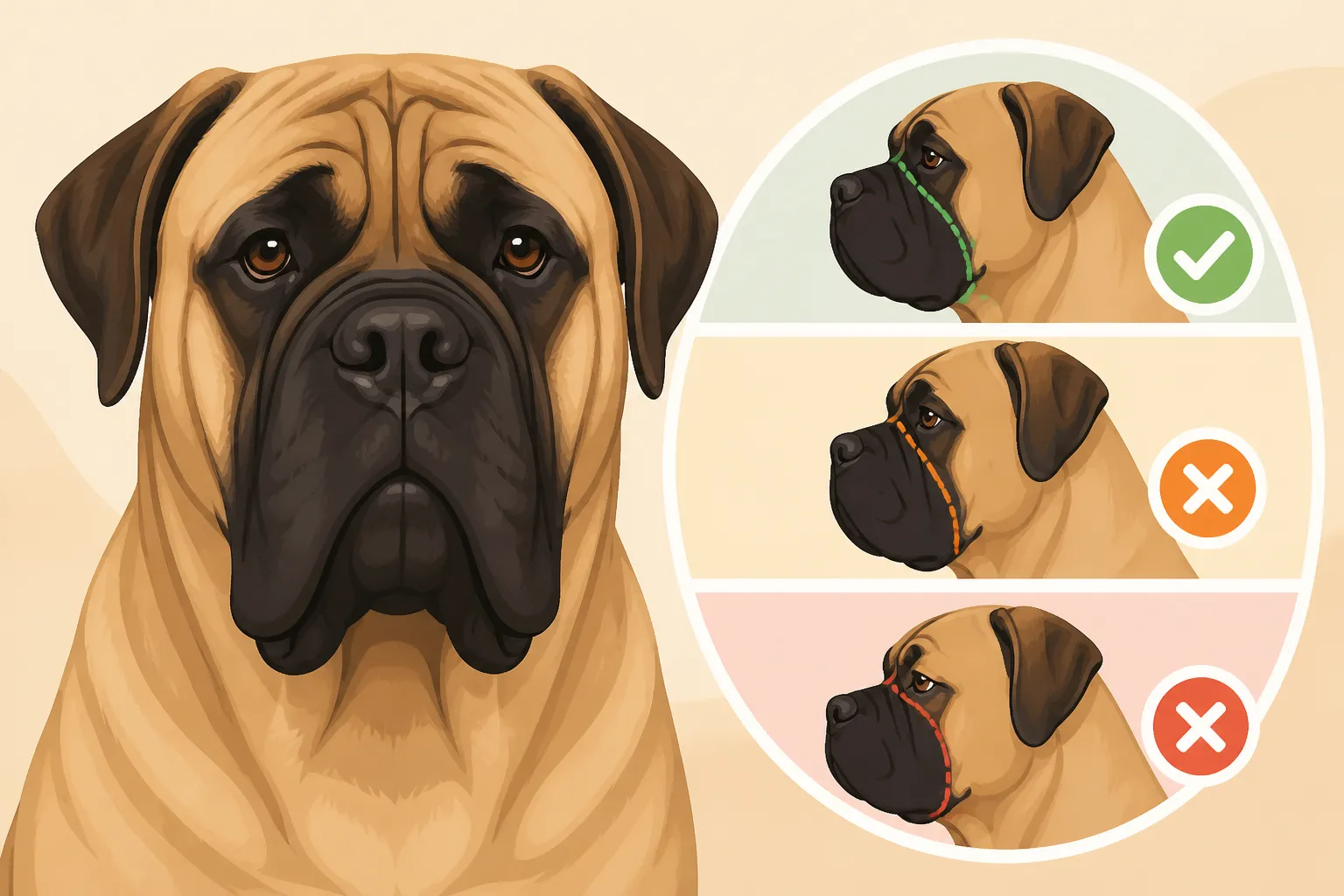
A Mastiff’s black mask should cover the muzzle and nose, reach around the eyes, and continue upward between them. The exact edge can look soft rather than sharply drawn, especially on a puppy or a brindle dog. If you are comparing your Mastiff with the breed standard, the key is the overall pattern—not a perfectly painted line or a fixed measurement.
What the Mastiff’s black mask should cover
The muzzle and nose are the foundation
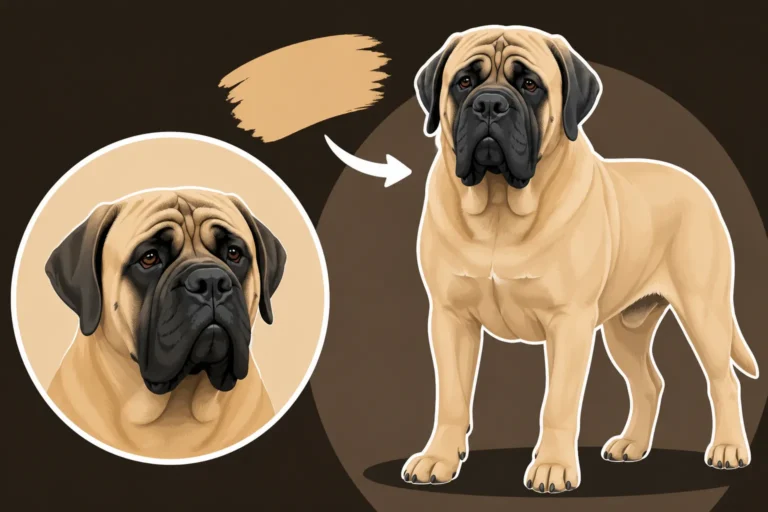
The mask is the dark coloring on a Mastiff’s face. Its most obvious part is the muzzle, including the area around the nose and lips. The nose itself should be dark, and a black mask is a defining feature of the breed’s traditional appearance.
In the breed standard, the dark color is not limited to a small patch on the nose. It should cover the muzzle and extend around the eyes, with dark coloring also reaching upward between them. The mask may look broad or narrow from one dog to another, but it should read as a connected facial marking rather than a tiny spot.
A quick visual check is to look at your dog straight on, then from the side. From the front, you should see dark coloring around the muzzle and eyes. From the side, the muzzle should still appear masked, not as though the dark coloring ends abruptly at the nose. For a wider discussion of accepted coat colors and markings, see Which Colors the Mastiff Standard Allows.
The mask should reach around the eyes
The dark coloring should surround the eyes, creating the characteristic Mastiff expression. It does not need to form two perfectly matched circles, and the edge does not have to look crisp. Natural coat color often blends gradually, particularly in fawn or apricot dogs.
The mask also extends upward between the eyes. This central bridge of dark coloring helps connect the muzzle to the area around the eyes. On some Mastiffs, that connection is bold and easy to see; on others, it may look softer because of brindling, coat shade, lighting, or the dog’s age.
There is no useful universal measurement in inches for how high a mask must reach. The standard describes the pattern and placement, not a ruler-based boundary. When people ask how far the mask “should” reach, the practical answer is: over the muzzle, around the eyes, and upward between them. That is the core feature described in Why a Mastiff Must Have a Black Mask.
Don’t confuse the mask with the whole head color
The mask is only one part of the dog’s coloring. A Mastiff may have a fawn, apricot, or brindle coat, while the mask remains dark. The contrast between coat and mask can make the marking seem more or less prominent: a light fawn face may show a strong contrast, while dark brindling can make the mask’s edges harder to pick out.
Ears are commonly dark as well, and the breed standard describes dark coloring on the ears and nose alongside the facial mask. Still, the mask itself is best judged by its placement on the face, not by assuming that every dark hair on the head belongs to one continuous patch.
If you are trying to identify your dog’s base coat as well as its mask, compare the overall body color rather than relying on the face alone. What Fawn Looks Like on a Mastiff explains one of the common coat colors, while The Colors a Mastiff Comes In offers a broader look at the range.
Why Mastiff masks vary in appearance
Coat color changes how clearly the mask shows
A black mask can appear dramatic on a pale coat and less distinct on a darker one. Brindle striping may also interrupt the visual edge, so the dark facial area can look mottled or blended instead of like a solid shape. This does not automatically mean the dog lacks a mask.
Lighting makes a difference, too. A photo taken in shade can flatten the contrast between the mask and coat; bright sunlight can make the same dog’s facial markings look sharper. Camera angle matters: a side view may show the muzzle coloring clearly but hide how the mask reaches around the eyes.
When checking a photo, look at several views in natural light. Ask for a front-facing picture and a side profile, and avoid judging from a heavily edited image. If you are comparing a puppy’s appearance with an adult dog’s, remember that coat shade and the apparent definition of markings can change as the puppy matures. How a Mastiff Puppy's Mask Changes and How a Mastiff's Color Changes With Age address that development.
Brindle can make the border look less tidy
A brindle Mastiff has stripes or streaks of darker color over a lighter background. Those markings can run through the face, making the transition between the mask and the rest of the coat look uneven. The mask may still be present even if its border is not a clean, symmetrical line.
This is one reason to avoid treating a single photograph as a pass-or-fail test. A pattern that looks patchy in a close-up may appear more coherent when you see the entire head. Conversely, a dark face in a dim photo may seem to have a larger mask than it does in person.
For an individual dog, the most helpful assessment considers the whole pattern, coat color, and visible facial features together. A breeder evaluating a show prospect may interpret the standard more closely than a pet owner simply trying to understand their dog’s appearance. In either case, a mask does not need to be perfectly symmetrical to be recognizable.
A dark face is not the same as a health problem
Coat markings are appearance features. A mask that seems higher, lower, or softer than you expected is not, by itself, a sign that something is wrong with your Mastiff. The more important distinction is between normal coat color and a change in the skin, eyes, or nose.
For example, new redness, swelling, sores, discharge, irritation, or a sudden change in pigmentation deserves attention as a health question rather than a breed-standard question. Likewise, a dark ring around an eye is part of the facial marking; it should not be confused with inflammation or a change in the eye itself. If you are concerned about eye color or appearance, Whether a Mastiff Can Have Light Eyes covers a related feature, but it cannot replace an examination when symptoms are present.
How to assess your Mastiff’s mask
Use a simple face-by-face checklist
You do not need special equipment to get a clearer view of your dog’s mask. Start with your Mastiff standing comfortably in even, natural light. Avoid using flash if it washes out the coat or makes the eyes look unusually bright.
Then check the following:
- Muzzle: Is the area around the nose and lips dark?
- Eyes: Does the dark coloring reach around the eyes?
- Bridge: Is there dark coloring that extends upward between the eyes?
- Overall pattern: Does the face read as a masked Mastiff, even if the edges are soft or uneven?
- Coat context: Could brindling, a darker base coat, lighting, or the dog’s age be affecting what you see?
This checklist is for understanding the general pattern, not scoring a dog for a show. A photograph may help you compare markings over time, but take it from the same angle and in similar light if you want a meaningful comparison. A close-up from one day and a distant picture from another can make the mask look like it has changed when only the camera conditions differ.
| Facial area | Typical appearance to look for | What can make it harder to judge |
|---|---|---|
| Nose and muzzle | Dark coloring over the muzzle and around the nose | Shadows, wet fur, or a very close crop |
| Around the eyes | Dark coloring reaching around the eyes | Brindle markings, eye-area wrinkles, or uneven lighting |
| Between the eyes | Dark coloring extending upward on the bridge | A soft border or a puppy’s changing coat |
| Ears | Dark coloring commonly accompanying the mask | The ears being folded back or outside the photo |
| Mask edge | A natural transition rather than a required sharp line | Coat shade, age, and camera exposure |
Compare the dog with the standard, not a single idealized photo
Online pictures can be useful, but they also create unrealistic expectations. Show photos are often taken in flattering light, with the dog posed in a way that emphasizes its head. A casual phone photo may show the same Mastiff with a mask that looks narrower, less even, or lighter.
If you are choosing a puppy, ask the breeder how they describe the puppy’s color and what they expect as the coat develops. A breeder can explain what they see in that particular litter, but no one can promise that every marking will look identical throughout the dog’s life. If you are considering a show prospect, ask a knowledgeable Mastiff breeder or experienced breed representative to explain the standard in context rather than relying on an isolated picture.
For a pet Mastiff, it is usually enough to know that the face has the characteristic dark mask. A minor variation in how far the edge appears to reach does not change the dog’s temperament, bond with you, or suitability as a companion.
Be careful when cleaning around the face
The mask is coat color, not a special area that needs bleaching, dye, or cosmetic treatment. Do not use products intended to darken the coat or sharpen the boundary. These can irritate sensitive facial skin, particularly around the eyes and folds.
If your Mastiff has food or drool caught around the muzzle, gently wipe the area with a soft, damp cloth and dry the skin afterward. Keep moisture and cleaning products away from the eyes. For routine household grooming supplies, some owners look at retailers such as Chewy, but choose a plain, pet-safe option and follow its label rather than using a product simply because it promises a brighter coat.
If the skin under a fold smells unusual, looks red, or stays damp, treat that as a possible skin-care issue rather than a problem with the mask. A veterinarian can help determine whether irritation or infection needs treatment. Chewy may be a convenient place to browse basic grooming items, but persistent irritation calls for veterinary guidance, not a stronger wipe or a whitening product.
Common questions about Mastiff mask reach
Does the mask have to cover the entire face?
No. The mask is a defined facial marking, not a requirement for the whole head to be black. The expected pattern centers on the muzzle, around the eyes, and upward between them. The rest of the face and body can show the dog’s base coat color and, in brindles, additional striping.
The visual effect varies. One Mastiff may have a bold mask that looks like a continuous dark area, while another may have a more blended appearance. What matters for identifying the pattern is where the dark coloring sits, not whether every part of the face is the same shade.
Should the mask be perfectly symmetrical?
Perfect symmetry is not a practical expectation. One side may look darker because of the coat pattern, the direction of the light, or the way the dog is facing. Wrinkles and facial folds can also make the edges appear uneven in a photo.
If you are assessing breed-standard appearance, consider the overall head and marking rather than focusing on a tiny difference between the left and right sides. For an individual pet, a slight mismatch is simply part of that dog’s appearance. A new or sudden change in the skin is a separate matter and should be evaluated on its own.
Can a puppy’s mask become more or less noticeable?
Yes, the apparent contrast can shift as the puppy grows and its coat develops. The dark marking may seem clearer in one stage and softer in another, depending on the puppy’s coat, pattern, and lighting. This is why a breeder may be able to describe the puppy’s current markings without guaranteeing precisely how sharp the mask will look as an adult.
When comparing puppy photos, use consistent lighting and angles. If you are deciding whether a marking is normal, focus on the general placement rather than expecting a fixed outline. The puppy’s mask should be understood as part of the overall coat pattern, not a mark that can be measured reliably from one snapshot.
Is a small or uneven-looking mask a reason to worry?
Usually, no—not if the concern is appearance alone and the skin and eyes look healthy. A mask that seems subtle, asymmetrical, or blended is not automatically a medical issue. It may reflect the dog’s coat color, brindling, age, or the conditions in which you are viewing it.
Seek veterinary advice if you notice changes such as swelling, discomfort, discharge, open skin, or sudden discoloration. For ordinary grooming, a damp cloth and careful drying are generally more sensible than trying to alter the coat. Chewy can be one option for finding everyday pet-care supplies, but avoid products that claim to recolor or bleach facial markings. The safest choice is to leave the mask’s natural color alone.
Disclaimer
This article is for general informational purposes only and does not constitute professional advice. Laws, prices and regulations vary by location and change over time. Consult a qualified professional for guidance on your specific situation.