How Rare an Apricot Mastiff Is
An apricot Mastiff can turn heads, especially in places where most people are used to seeing fawn dogs. But “rare” does not mean the color is outside the breed standard or that a puppy is automatically more valuable. This guide explains what apricot means, how often you may encounter it, why shades vary, and what to check before choosing a puppy.
How rare is an apricot Mastiff
Apricot is less familiar, not automatically exceptional
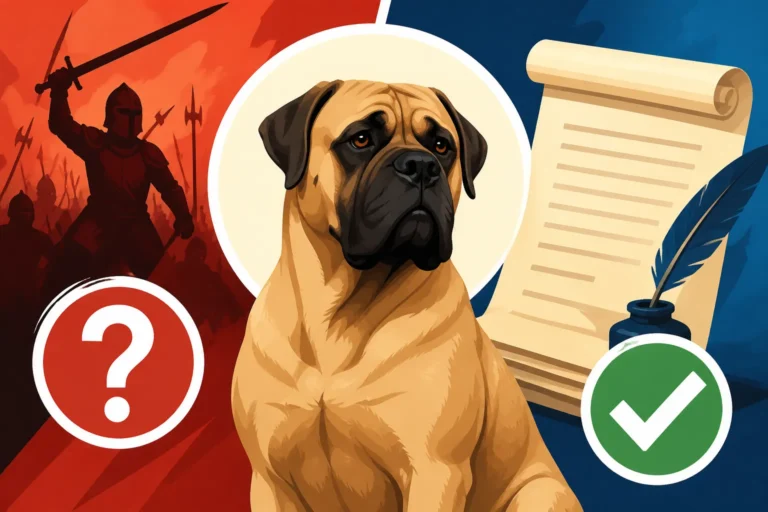
Apricot is a recognized Mastiff color, but it is less commonly noticed than the familiar fawn coat in many communities. That can make an apricot dog feel rare when you meet one at a park or see one in a breeder’s litter announcement. It does not mean the color is a new variety, a separate breed, or proof of an unusual pedigree.
There is no dependable universal percentage that tells you what share of Mastiffs are apricot. How often you see one depends on the dogs being bred in a particular area, the pedigrees represented there, and whether owners and breeders describe a coat as apricot or fawn. Two people may even label similar-looking dogs differently.
If you are comparing colors, remember that fawn, apricot, and brindle are recognized Mastiff coat colors. A black mask is an important part of the breed’s characteristic look. For a broader overview, see The Colors a Mastiff Comes In and Which Colors the Mastiff Standard Allows.
| Coat color | What it generally looks like | What to keep in mind |
|---|---|---|
| Fawn | A light tan to deeper tan or golden shade | A familiar Mastiff color, though individual shades vary |
| Apricot | A warmer orange-gold or reddish-gold shade | The boundary between apricot and deeper fawn can be subjective |
| Brindle | Darker stripes over a lighter base coat | The pattern can vary in contrast and visibility |
| Any of these with a black mask | Dark coloring around the muzzle and often the eyes | The mask is part of the breed’s expected appearance |
The table is a practical description rather than a way to judge a dog’s registration or breeding quality. If a puppy’s color matters to you, ask the breeder how they describe it and look at photographs of the puppy’s parents and relatives. Color labels alone can’t establish whether a dog is well bred or healthy.
Why online searches can make the color seem rarer
Search results and social media are a patchy sample of the Mastiff population. A breeder who posts many fawn puppies may make that color seem overwhelmingly common, while a photo of an apricot dog may be shared more widely because it looks distinctive. Neither gives a reliable count of how often the color occurs.
Local availability can differ, too. One breeder may have no apricot puppies for several litters, while another has dogs with warmer coats in its breeding lines. That is a difference in the dogs available through those breeders, not evidence that apricot Mastiffs are endangered or nearly impossible to find.
It also helps to distinguish “rare to see” from “rare in a litter.” A particular shade may be uncommon in your region, but that does not mean an individual puppy is especially rare nationwide. The most useful context comes from a breeder who can discuss the parents, relatives, and the range of coat colors in the line without making dramatic claims.
What an apricot Mastiff looks like
The shade can be hard to label
Apricot usually describes a warm golden-orange or reddish-gold coat. In practice, the color is not always crisp or uniform. A puppy may look pale in one photograph and much richer in another because of lighting, camera settings, the coat’s condition, or the color of the background.
That is why labels such as “deep apricot,” “light apricot,” and “red apricot” may be used informally. They can help people describe what they see, but they are not necessarily precise categories. One breeder’s apricot may look close to another breeder’s deeper fawn.
If you are trying to understand a specific dog’s color, compare photographs taken in natural light and ask for images from different ages. The description What Apricot Means on a Mastiff explores the color itself, while How a Mastiff's Color Changes With Age is useful if you are wondering whether a puppy’s coat will look exactly the same as it grows.
The mask and markings matter too
An apricot Mastiff still has the familiar Mastiff outline and facial features. The coat color does not change the dog’s basic build, needs, or temperament. The black mask gives the face much of its characteristic expression, and its appearance can differ in how far it extends. You can read more in Why a Mastiff Must Have a Black Mask and How Far a Mastiff's Mask Should Reach.
White markings may also come up when you look at puppies. The amount and placement of white can vary, and a photograph can make a small marking look larger or brighter than it does in person. If markings are important to you, ask the breeder to describe them clearly and check the applicable breed standard rather than relying on a social-media caption. Whether a Mastiff Can Have White Markings provides more detail.
A puppy’s face can change visually as it grows, too. The coat, mask, and overall proportions may look different at different stages, so it is sensible not to make a decision based on one especially flattering photo. How a Mastiff Puppy's Mask Changes offers related guidance on that changing appearance.
Why apricot color and rarity vary
Color descriptions are not a guarantee of a puppy’s final appearance
Coat color is inherited, but a breeder cannot responsibly promise every puppy will mature into an exact shade based only on a quick visual guess. Parent colors can offer context, but they do not tell you everything about how a puppy’s coat will look as it grows. Even littermates may have different-looking shades or markings.
Be cautious if someone presents a particular color as proof of superior lineage, unusual health, or special temperament. Color does not tell you whether a puppy’s hips and elbows have been evaluated, whether its parents have appropriate health screening, or whether the breeder has made thoughtful decisions about temperament and welfare.
If you are researching a color-specific claim, ask the breeder to explain it in plain language. A responsible answer should distinguish what they know from what they are predicting. A seller who uses “rare” to create urgency, avoids questions about health, or won’t let you learn about the parents is giving you a reason to slow down.
Color changes should not be confused with health changes
A coat may look different as a puppy matures, but a change in shade is not by itself a diagnosis. Conversely, a coat that looks attractive or unusual does not mean a puppy has fewer health risks. Mastiffs are giant dogs, and the important questions include the health of the parents, the puppy’s growth and care, and the breeder’s approach to screening.
Ask which health evaluations have been completed and how you can review the results. The answer should be specific and documented, not simply “the parents are healthy.” The breed’s common concerns are worth understanding before you focus on appearance; The Four CHIC Tests a Mastiff Breeder Must Clear is a helpful place to start.
Choosing an apricot Mastiff responsibly
Put the breeder and puppy before the shade
It is understandable to have a favorite color. People often imagine a dog’s appearance long before they meet one, and an apricot coat can be especially appealing. Still, it is safer to treat color as a preference rather than the main reason to choose a puppy.
Ask to learn about the parents’ health testing, temperaments, and daily care. Find out how the breeder raises puppies and how they match puppies to homes. A good breeder should be willing to discuss the puppies as individuals instead of presenting them as interchangeable products. They should also be comfortable with you asking questions and taking time to consider your decision.
Be wary of claims that an apricot puppy is rare enough to justify pressure or a special premium. A coat color by itself does not demonstrate health, quality, or suitability for your household. For more on how color and price are discussed, see Whether an Apricot Mastiff Costs More. The breeder’s transparency and the dog’s welfare matter far more than a label.
Ask these questions before committing
A short, practical conversation can tell you more than a long sales description. Consider asking:
- How do you describe this puppy’s color, and might the shade change as it matures?
- What health evaluations have been completed for both parents, and can I review the results?
- What are the parents’ temperaments like around people and other animals?
- How are puppies socialized, and how do you decide which puppy fits which home?
- What support do you offer if questions or challenges come up after the puppy goes home?
Notice how the breeder responds. Clear, thoughtful answers are reassuring; pressure to pay quickly or promises that seem too perfect are not. If the breeder says a puppy’s color is extremely rare, ask what they mean by that and how they know. A straightforward breeder should be able to explain the claim without turning it into a reason to rush.
Before bringing home any Mastiff, plan for the practical realities of living with a giant dog: a safe place to rest, non-slip routes through the home, a suitable vehicle plan, and access to veterinary care that can accommodate a large dog. These needs are the same whether the coat is apricot, fawn, or brindle.
Apricot Mastiffs do not need special color care
An apricot coat does not generally require a special color-enhancing routine. Focus on ordinary skin and coat care: regular brushing, occasional bathing when needed, and checking the skin for irritation or unusual changes. Choose grooming products for dogs and avoid treating a coat simply to make it look brighter unless a veterinarian or grooming professional has recommended a product for a specific reason.
If you are putting together basic supplies, pet retailers such as Chewy may be one place to compare brushes and dog shampoos. Look for products suited to your dog’s coat and skin rather than marketing that promises to deepen or preserve a particular shade. Chewy can also be convenient for restocking routine grooming items, but a local pet shop or veterinary clinic may be just as useful when you want to handle a product or ask for guidance.
For a short-coated Mastiff, a rubber curry brush can help lift loose hair without making coat care complicated. If you shop through Chewy or another retailer, read the product description and directions, and stop using anything that seems to irritate your dog’s skin. A shiny coat is nice, but comfort and skin health come first.
An apricot Mastiff is best understood as a Mastiff with a distinctive, recognized coat color—not as a separate kind of dog. You may see the color less often than fawn in some places, but rarity varies, and the label is not a measure of quality. Choose based on health, temperament, responsible breeding, and whether you are ready for life with a giant companion; let color be the appealing extra.
Disclaimer
This article is for general informational purposes only and does not constitute professional advice. Laws, prices and regulations vary by location and change over time. Consult a qualified professional for guidance on your specific situation.