The Hours a Blocked Male Mastiff Has
It’s every Mastiff owner’s nightmare: your typically calm, gentle giant suddenly seems distressed, straining, or just not themselves, and you realize they haven't peed. This isn't just an inconvenience; a urinary blockage in a male Mastiff is a dire, life-threatening emergency where every single minute can make the difference between a full recovery and devastating consequences. This guide will walk you through understanding why blockages happen in our big boys, the critical timeline involved, and exactly what urgent steps you need to take.
Understanding the Mastiff's Unique Vulnerability to Blockages
Our big Mastiff boys, with their impressive stature and calm demeanor, sometimes mask health issues until they become critical. Urinary blockages are a prime example, and their anatomy and certain breed predispositions make them particularly vulnerable. It's not just about size; it's about specific physiological nuances that can turn a seemingly minor issue into a race against time.
The Anatomy of a Male Mastiff's Urinary Tract
When we talk about urinary blockages, it's crucial to understand the male anatomy that makes them uniquely susceptible. A male dog's urethra, the tube that carries urine from the bladder out of the body, is much longer and narrower than a female's. This length and narrowness are pronounced in large breeds like Mastiffs. Critically, there's a specific anatomical curve, sometimes referred to as the "urethral groove" or "sigmoid flexure," especially near the base of the penis, where stones or gritty material are far more likely to get lodged.
Imagine a large pipe with a tight bend; any debris floating through it is going to get caught at that bend. In a Mastiff, this "pipe" is already substantial due to their size, meaning a larger stone can still get stuck, or even a build-up of smaller crystals can create a plug. The pressure behind such an obstruction builds rapidly in the bladder, which, in a dog of this size, can hold a significant volume of urine. This constant pressure on the bladder wall and the inability to void urine leads to immense pain and rapid deterioration.
Common Causes of Urinary Obstruction in Mastiffs
While any dog can develop urinary stones, Mastiffs have particular predispositions, with one standing out significantly: Cystinuria Type III. This is a genetic condition, particularly prevalent in intact male Mastiffs, where the kidneys fail to reabsorb certain amino acids, including cystine. This excess cystine then crystallizes in the urine, forming stones that can grow quickly and become quite large. It's a cruel irony that such a stoic breed can harbor this painful genetic secret. Owners often don't even realize their dog carries the gene until a stone causes an emergency. For a deeper dive into this specific challenge, you might find Cystinuria Type III and the Intact Male Mastiff to be an important read.
Beyond Cystine stones, other types of urinary stones can also cause blockages. Struvite stones, often associated with urinary tract infections, and calcium oxalate stones are also common culprits in dogs. However, due to the genetic component, many male Mastiff owners will, unfortunately, become familiar with cystine stones. Less common causes include urethral tumors, severe inflammation, or even strictures (narrowing of the urethra) which can occur after trauma or chronic inflammation. Regardless of the type, the outcome is the same: the inability to pass urine, leading to a medical crisis that needs immediate veterinary attention.
The Silent Threat: Recognizing Early Symptoms
One of the biggest frustrations with Mastiffs is their incredible tolerance for pain. They're often described as stoic giants, and while this trait can be admirable, it can also be dangerous when it comes to health issues. A Mastiff might be experiencing significant discomfort and pain from a partial or complete urinary blockage but show only subtle signs. This means owners must be incredibly vigilant and sensitive to any changes in behavior.
Initial symptoms might be incredibly vague. You might notice your Mastiff is a little more lethargic than usual, perhaps less interested in their favorite squeaky toy or even just reluctant to get up from their comfortable bed. As the blockage progresses, the signs become more apparent:
- Straining to urinate (stranguria): This is often mistaken for constipation. Your dog will squat repeatedly, often producing no urine or only a few drops.
- Frequent attempts to urinate: They feel the urge but can't relieve themselves.
- Licking at the genitals: This indicates discomfort or pain in the area.
- Blood in the urine (hematuria): If any urine is passed, it might be tinged pink or red.
- Restlessness or agitation: Pacing, an inability to get comfortable, or whining – especially uncharacteristic in a Mastiff.
- Vomiting and loss of appetite: As toxins build up, your dog will feel sick.
- Abdominal pain: Your Mastiff might guard their belly or react negatively to being touched there.
- Distended abdomen: The bladder can become visibly firm and swollen, feeling like a hard ball if you gently palpate their lower belly.
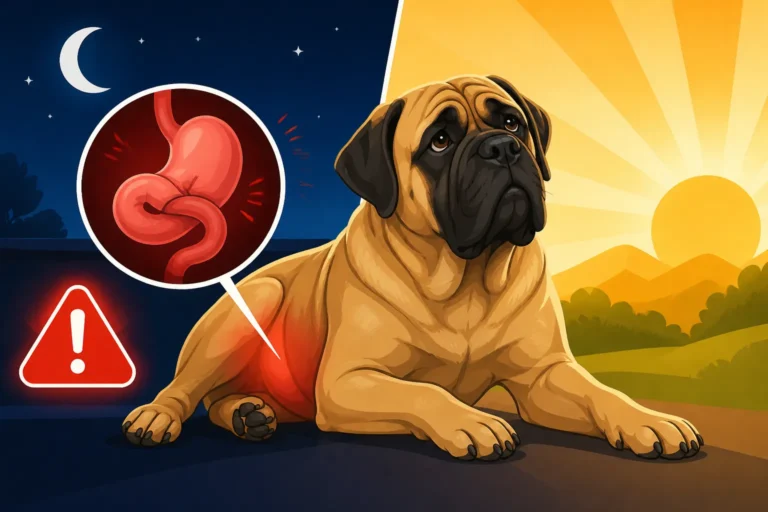
Recognizing these symptoms, even the most subtle ones, is crucial. If your intact male Mastiff is straining or trying to urinate without success, it's not a "wait and see" situation. It's an emergency that demands immediate veterinary intervention. Understanding Why a Blocked Mastiff Cannot Wait Until Morning is paramount for any owner.
The Critical Timeframe: Why Every Minute Counts
When a male Mastiff is completely blocked, time truly becomes the enemy. This isn't a situation where you can wait for your regular vet to open in the morning or "see how they do overnight." The internal damage starts almost immediately and can quickly become irreversible. The sheer volume of urine a Mastiff's bladder can hold, combined with the rapid buildup of toxins, makes this one of the most urgent emergencies a dog can face.
The Rapid Escalation of Kidney Damage
Once the urethra is completely blocked, urine can no longer exit the body. This means that all the waste products that the kidneys normally filter from the blood – like urea, creatinine, and potassium – start to build up rapidly in the bloodstream. This is essentially acute kidney failure unfolding in real-time. Within just a few hours, these toxins can reach dangerous levels.
High levels of potassium, in particular, are incredibly dangerous. This condition, known as hyperkalemia, can severely affect the heart, leading to arrhythmias, a dangerously slow heart rate (bradycardia), and eventually, cardiac arrest. The kidneys, struggling under the back pressure, can also suffer irreparable damage. While some initial kidney damage might be reversible if the blockage is relieved quickly, prolonged obstruction leads to permanent scarring and chronic kidney disease, significantly impacting your Mastiff's long-term health and lifespan. This rapid onset of systemic toxicity is precisely Why a Mastiff Is Dosed by Lean Weight and Not Scale Weight as every medication needs to be precisely calculated to avoid further strain on an already compromised system.
Risk of Bladder Rupture and Other Complications
The bladder isn't designed to hold an infinite amount of urine under high pressure. As the bladder continues to fill and stretch against a complete obstruction, its walls become thinner and more fragile. While it's relatively rare, a severely distended bladder can rupture, spilling urine and toxins into the abdominal cavity. This leads to a catastrophic condition called uroabdomen, causing severe peritonitis (inflammation of the abdominal lining) and septic shock, which is almost always fatal without immediate and aggressive emergency surgery.
Even if the bladder doesn't rupture, the extreme pressure can damage the bladder wall itself, making it less elastic and more prone to infection in the future. Furthermore, the constant straining can lead to other complications such as rectal prolapse or severe muscle fatigue. The pain from a distended bladder is excruciating and can lead to shock. The longer the blockage persists, the more likely these life-threatening complications become, turning an emergency into a desperate last-ditch effort.
The Difference Between Partial and Complete Blockage
It's tempting to think that a partial blockage is less urgent than a complete one. While a dog with a partial blockage might pass some urine, allowing some relief of pressure and some excretion of toxins, it's still a ticking time bomb. A partial blockage can become a complete blockage at any moment. The ongoing irritation from crystals or stones can cause swelling, which then closes off the remaining pathway for urine.
Even with a partial blockage, your Mastiff is still experiencing significant discomfort, straining, and the risk of infection is heightened. The bladder isn't emptying properly, leaving residual urine that can become a breeding ground for bacteria. Critically, owners might be lulled into a false sense of security, thinking that because some urine is passing, it's not an emergency. This delay can lead to the same kidney damage and complications as a complete blockage, just at a slightly slower, but no less dangerous, rate. Therefore, any difficulty or inability to urinate in a male Mastiff should be treated with the same urgency as a complete blockage. Don't wait; seek immediate veterinary care.
What to Do in the Face of a Suspected Blockage
The moment you suspect your Mastiff might have a urinary blockage, panic can quickly set in. But in this critical situation, your ability to remain calm and act decisively is your Mastiff's best chance. This isn't a problem you can solve at home; it requires immediate, professional veterinary intervention. Knowing the right steps to take can save precious minutes and potentially your beloved companion's life.
Immediate Action: Contacting Your Veterinarian
The absolute first thing you must do is pick up the phone and call your veterinarian. If it's after hours, call your nearest emergency veterinary clinic without hesitation. Do not try to diagnose or treat this at home. Trying to offer water, encourage urination, or anything else will only delay critical medical care and worsen the prognosis.
When you call, clearly state that you suspect a urinary blockage in your male Mastiff. Be precise about the symptoms: "My intact male Mastiff, who weighs X pounds, has been straining to urinate for X hours and nothing is coming out," or "He's been trying to go every few minutes, but only a few drops are appearing, and he seems very uncomfortable." This allows the veterinary staff to understand the urgency and prepare for your arrival, potentially clearing a room or readying equipment. They will likely advise you to come in immediately, often suggesting you head straight to the emergency room if your regular vet isn't equipped for overnight critical care.
Emergency Transport: Getting Your Mastiff to the Clinic Safely
Moving a distressed, possibly painful, and heavy Mastiff can be a challenge in itself, but it’s vital to do it safely and quickly. If your Mastiff is still able to walk, guide them gently to your vehicle. Avoid any unnecessary exertion. If your Mastiff is too weak, in too much pain, or simply too heavy to move easily, you’ll need assistance. This is where having another adult nearby can be invaluable.
Use a sturdy, flat surface like a rigid board, a heavy-duty tarp, or even a strong blanket as a makeshift stretcher if they cannot stand. Gently slide your Mastiff onto it and carefully lift them into your vehicle. Ideally, they should lie down comfortably, perhaps on a soft blanket or bed, to minimize pressure on their abdomen. If possible, have one person drive while another monitors your Mastiff, offering calm reassurance. Speed is of the essence, but driving recklessly won't help. Focus on getting there safely and steadily. Many Mastiff owners find that a large SUV or minivan is essential for transport in these situations, as a sedan might not even fit your giant companion.
What to Expect at the Emergency Vet
Upon arrival, be prepared for immediate action. The veterinary team will prioritize your Mastiff due to the emergency nature of a blockage. They will likely start with a quick physical exam, focusing on palpating the abdomen to assess the size and tension of the bladder.
Key diagnostic steps often include:
- Urinalysis: If any urine can be obtained, it will be analyzed for crystals, blood, and signs of infection.
- Bloodwork: This is critical for assessing kidney function, electrolyte levels (especially potassium), and overall hydration. Elevated potassium, as mentioned, is a severe concern that requires immediate intervention.
- Radiographs (X-rays): These are essential for identifying the presence, size, and location of urinary stones. For a dog as large as a Mastiff, multiple large plates might be required, or the veterinary clinic may need specialized equipment to get a full view.
- Ultrasound: An abdominal ultrasound can provide more detailed imaging of the bladder, kidneys, and urethra, helping to identify blockages not visible on X-rays or to assess for bladder wall changes.
Once the diagnosis is confirmed, the immediate goal is to relieve the obstruction. This usually involves sedating or anesthetizing your Mastiff and attempting to pass a urinary catheter. This procedure is delicate, especially in a male Mastiff's long, curved urethra. The veterinary team will work to flush the obstruction back into the bladder or out of the urethra. In some cases, if the blockage is severe or the dog is very ill, a temporary measure might be to perform a cystocentesis – drawing urine directly from the bladder with a needle – to relieve immediate pressure while further steps are prepared.
Treatment Options and Prognosis
The good news is that with rapid intervention, many Mastiffs can be successfully unblocked. However, the path to recovery can be complex, involving immediate relief of the obstruction, managing secondary complications, and then implementing strategies to prevent recurrence. The exact treatment plan will depend on the cause of the blockage, the severity of your Mastiff's condition, and the presence of any underlying health issues.
Unblocking the Mastiff: Catheterization and Beyond
The primary goal is to relieve the pressure on the bladder and allow urine to flow again. This is most commonly achieved through urinary catheterization. Under sedation or general anesthesia, a veterinarian will carefully pass a specialized catheter into your Mastiff's urethra, attempting to dislodge or flush the stone or plug back into the bladder. Sometimes, a technique called "retrograde urohydropulsion" is used, where saline is flushed against the obstruction to push it back into the bladder. Once the catheter is in place, it’s often left for several days, secured in place, to allow the urethra to heal and to ensure continuous urine flow while the Mastiff recovers from the immediate crisis.
During this period, your Mastiff will likely be hospitalized and receive intravenous fluids to flush the kidneys, correct electrolyte imbalances, and prevent dehydration. Pain medication and antibiotics will also be administered to manage discomfort and prevent infection. Regular monitoring of urine output, bloodwork, and vital signs is crucial to track their recovery. The first 24-48 hours post-unblocking are critical, as some dogs may re-obstruct, or complications like post-obstructive diuresis (excessive urination as the kidneys recover) can occur.
Surgical Intervention for Stubborn Stones
While catheterization is often the first line of defense, it’s not always successful, especially with larger or irregularly shaped stones. In these cases, or if stones are too numerous to manage medically, surgical intervention becomes necessary. The most common surgical procedure for urinary stones is a cystotomy, where the bladder is surgically opened to remove the stones directly. This is a significant abdominal surgery, and for a large dog like a Mastiff, it requires experienced surgical hands and careful anesthetic management. For a more detailed look at the financial implications, refer to What Stone Surgery Costs on a Mastiff.
For very complex cases or stones lodged stubbornly in the urethra that cannot be flushed back, a urethrostomy might be considered. This is a surgical procedure that creates a permanent opening in the urethra, usually behind the original blockage site, allowing urine to bypass the problematic area. This is often a last resort, particularly for male dogs with recurrent blockages, as it can be associated with complications like strictures or chronic infections. Deciding on surgery is a serious discussion between you and your vet, weighing the risks and benefits for your specific Mastiff.
Post-Treatment Care and Prevention
Once your Mastiff is successfully unblocked and discharged, the journey isn’t over. Post-treatment care and preventative measures are paramount, especially if the blockage was caused by a recurring issue like Cystinuria. For many male Mastiffs with cystine stones, neutering is often recommended. This is because cystine stone formation in Mastiffs is androgen-dependent, meaning it's influenced by male hormones. Whether Neutering Resolves a Mastiff's Cystinuria is a common question, and for many, it significantly reduces or even stops stone formation.
Dietary management is also a cornerstone of prevention. For cystine formers, a low-protein, alkalinizing diet helps reduce cystine excretion and prevent crystallization. For other stone types, specific therapeutic diets are formulated to dissolve stones or prevent their formation. Your vet may also prescribe medications, such as potassium citrate to alkalinize urine for cystine stones, or specific drugs to dissolve struvite stones. Maintaining excellent hydration is always key, so ensuring your Mastiff has constant access to fresh water is vital. Regular urine checks, often every few months, are recommended to monitor for crystals or signs of infection, giving you an early warning if problems are brewing. Why Neutering Changes a Cystinuric Mastiff's Diet will shed more light on dietary adjustments post-neutering. Proactive care is truly the best defense against recurrence.
Financial Realities of a Mastiff Emergency
Let’s be honest, owning a Mastiff means understanding that everything costs more. From food to preventatives, their sheer size magnifies every expense. When a life-threatening emergency like a urinary blockage strikes, the financial impact can be staggering. It's a harsh reality that can add immense stress to an already terrifying situation, but being prepared can make all the difference.
The Cost of Emergency Care
Emergency veterinary care for a urinary blockage is not cheap, and for a Mastiff, expect the costs to be at the higher end of the spectrum. The initial stabilization, diagnostic tests (bloodwork, X-rays, ultrasound), sedation, catheterization, hospitalization for several days with IV fluids, pain management, and antibiotics can quickly add up. A typical range for an uncomplicated unblocking and short hospitalization might be anywhere from $2,000 to $5,000, but it can easily exceed this depending on your location, the specific clinic, and any complications.
If surgical intervention is required, the costs escalate significantly. A cystotomy, especially if performed as an emergency overnight procedure, can add another $3,000 to $7,000 or more, bringing the total bill into the $5,000 to $10,000+ range. This doesn't even include the follow-up care, specialized diets, or medications needed for long-term prevention. It's a financial hit that can derail even well-meaning owners, highlighting the immense financial responsibility that comes with our gentle giants. This is just one of many reasons why The Mastiff's Short Life Buys the Biggest Bills.
The Value of Pet Insurance
Given the high cost of emergency care, many Mastiff owners find a good pet insurance policy to be an invaluable investment. Imagine facing a $7,000 bill for your beloved, suffering Mastiff; having insurance, like plans offered by Healthy Paws, can turn an impossible decision into a manageable one. While no insurance plan covers pre-existing conditions, if you enroll your Mastiff when they are young and healthy, a quality policy can cover a significant portion (often 70-90%) of emergency treatment, diagnostic tests, surgeries, and hospitalization for unexpected illnesses like urinary blockages.
It’s crucial to understand your policy’s deductible, reimbursement percentage, and any annual limits. Researching different providers and plans, such as those from Healthy Paws, before an emergency strikes, can provide peace of mind. Without insurance, owners are left with the heartbreaking choice between exhausting their savings, going into debt, or, in the worst-case scenario, making decisions based solely on financial limitations. For a Mastiff, where medical bills can quickly reach five figures, pet insurance can truly be a lifesaver.
Long-Term Management Expenses
Even after the immediate crisis is over, there are ongoing expenses associated with managing a Mastiff prone to urinary blockages. If neutering is recommended to prevent recurrence of cystine stones, that's an additional surgical cost, though often less than emergency stone removal. Then there's the cost of specialized prescription diets, which are often more expensive than regular kibble. These diets are typically lifelong commitments for stone formers.
Regular follow-up veterinary visits, including repeated urinalysis and blood tests, are necessary to monitor your Mastiff's health and ensure no new stones are forming. Medications, such as urinary acidifiers or alkalinizers, if prescribed, will be an ongoing monthly expense. These long-term costs, though less dramatic than the initial emergency bill, can still accumulate significantly over your Mastiff's lifespan. Being prepared for these continuous expenses is part of responsible Mastiff ownership, and understanding How Often an Intact Male Mastiff's Urine Is Checked can help you stay ahead of potential issues.
| Symptom Category | Mild / Early Signs (Partial Blockage) | Severe / Late Signs (Complete Blockage) |
|---|---|---|
| Urination | Straining, frequent attempts, small drips, red/pink urine | No urine passed despite straining, constant licking, squatting repeatedly |
| Behavior | Lethargy, restlessness, mild discomfort, reluctance to play | Pacing, whining, hiding, severe agitation, inability to get comfortable, shaking |
| Physical | Licking genitals, slightly firm lower belly | Obvious distended, hard, painful lower belly, vomiting, loss of appetite |
| Urgency | Immediate vet visit recommended | ER vet visit required within hours |
Disclaimer
The information provided in this article is for general informational purposes only and is not intended as a substitute for professional veterinary advice. Always seek the advice of your veterinarian or other qualified animal health provider with any questions you may have regarding a medical condition or treatment for your Mastiff. Never disregard professional veterinary advice or delay in seeking it because of something you have read in this article. In the event of an emergency, contact your nearest veterinary emergency clinic immediately.