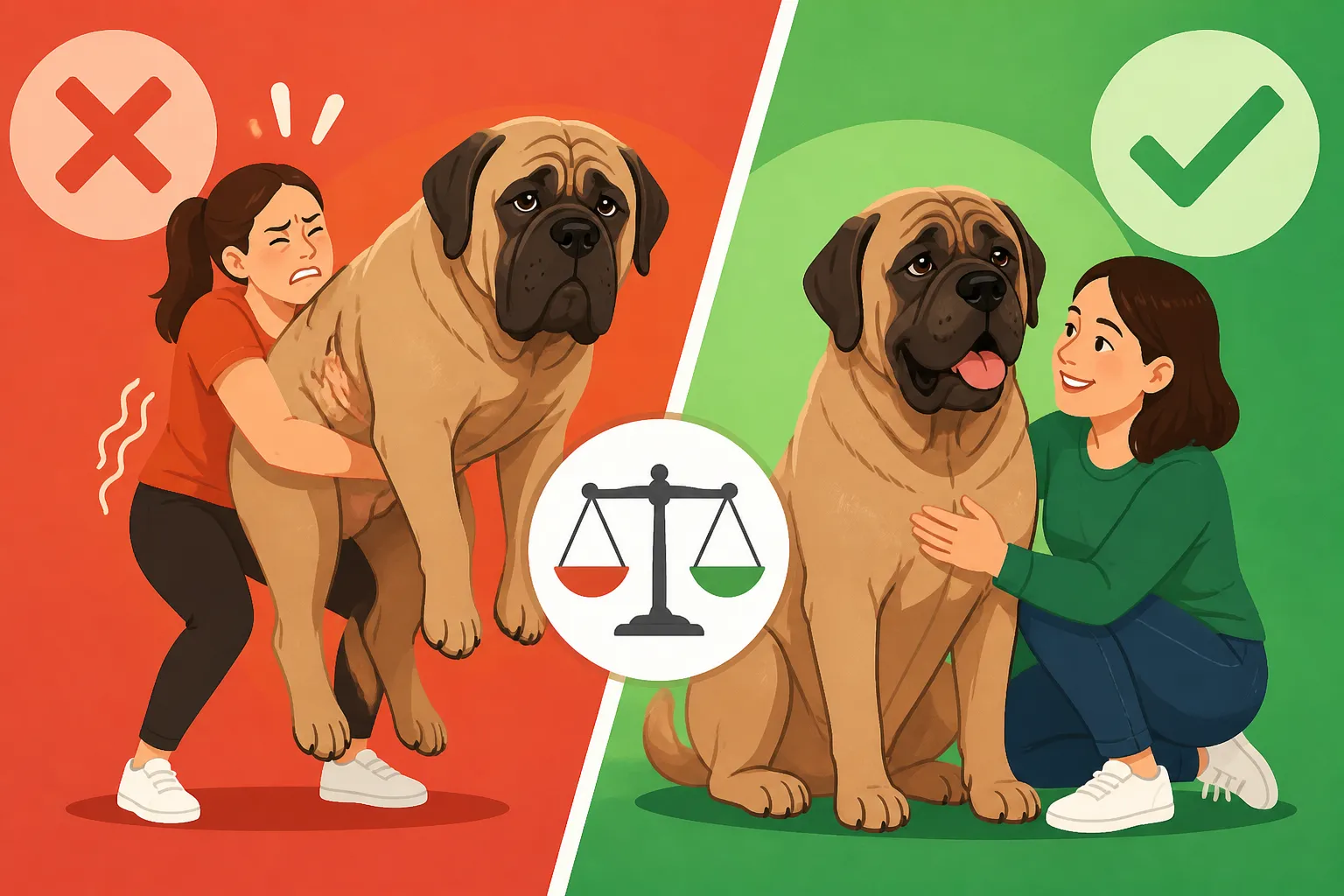
Whether a Mastiff Suits Someone Who Cannot Lift It
A Mastiff can weigh as much as an adult person, so being unable to lift one is a practical concern—not a small detail to sort out later. The good news is that many owners never need to carry their dog in ordinary life. The important part is choosing a suitable home, preventing avoidable falls, teaching useful skills, and having a realistic plan for illness or injury.
Can you own a Mastiff if you cannot lift it
Often, yes. A healthy adult Mastiff who can walk comfortably usually does not need to be picked up. But a dog who cannot be lifted still needs help in situations that are easy to underestimate: getting into a vehicle, negotiating stairs, recovering from surgery, or reaching veterinary care after a sudden collapse.
The question is less “Can I carry this dog?” and more “Can I safely manage the situations where the dog might need help?” That depends on your home, your mobility, the dog’s training and health, and whether you have reliable assistance nearby.
Everyday care is different from emergency handling
Most routine care happens at floor level. Feeding, grooming, giving medication, and checking paws do not usually require lifting a Mastiff. You can teach the dog to stand for a harness, step onto a low platform, or settle on a mat for an examination. A cooperative dog who understands those cues is much easier to manage than one who is surprised, frightened, or physically pushed into position.
Still, a dog can become unable to stand without warning. A painful joint, an injury, weakness, or an illness may turn a normal walk across the room into a situation where the dog needs help. That is when the difference between “I don’t lift my dog” and “I have no plan if my dog cannot move” matters.
If you live alone, think through who could help you on short notice. A family member, neighbor, dog walker, or nearby friend may be able to assist with transport or help contact a veterinary clinic. Do not assume that two people can automatically lift a very large dog safely. A frightened or painful dog may struggle, and an awkward lift can hurt both the dog and the people helping.
Consider your own strength, balance, and mobility
You do not have to be able to pick up a Mastiff to care for one, but you do need to be able to guide and control it safely. Consider whether you can hold a leash if the dog suddenly pulls, steady yourself if it leans against you, and walk it on a surface that may be slippery. A gentle dog can still be difficult to redirect simply because of its size.
A useful reality check is to imagine ordinary problems as well as emergencies. Could you clean muddy paws without bending in a way that hurts your back? Could you get the dog into a car if it hesitates? Would you have help if it refused to go down the front steps? If those situations feel uncertain, they are not reasons to rule out a Mastiff automatically—but they are reasons to make a support plan before bringing one home.
For prospective owners, meeting adult Mastiffs in person can help make those questions more concrete. A puppy may seem easy to guide at first, but it will grow into a powerful dog. The considerations in Whether a Mastiff Suits a Retired Owner and Whether a Mastiff Suits Someone Who Cannot Lift It overlap in an important way: success depends on the match between the dog’s needs and the person’s practical resources, not on age or strength alone.
The dog’s temperament and training matter
A Mastiff who calmly accepts a harness, pauses at thresholds, and follows a practiced cue is easier to support than one who braces, bolts, or refuses to move. This does not mean training can make a large dog physically light. It means the dog can learn to cooperate with equipment and routines that reduce the need for lifting.
Teach helpful behaviors gradually while the dog is comfortable. Reward it for stepping onto a mat, standing still while you clip on a harness, walking up a ramp, or waiting at a doorway. Keep sessions brief and positive. If a dog suddenly refuses a familiar movement, treat that as a possible sign of pain or fear rather than stubbornness. For ideas on building cooperation before the dog is fully grown, see Teaching a Mastiff Before It Outweighs You.
Set up your home so lifting is less likely
Home layout has a major effect on whether you will need to lift or physically support a Mastiff. A few changes can make daily movement safer, especially for a young dog whose joints are still developing or an older dog who is losing strength.
Reduce stairs and slippery surfaces
If possible, choose a home where the dog’s main living area, food, water, and outdoor access are on one level. Stairs can be difficult for a large dog to navigate, and a fall may be especially hard to manage if you cannot help it back up. Even a home with only a few steps can be challenging if the steps are steep, narrow, slick, or exposed to rain and ice.
Use sturdy, well-secured runners or other appropriate traction on smooth floors. Do not rely on a loose rug that slides when the dog steps on it. Make sure the dog has a clear route through the home, with enough room to turn without bumping furniture or scrambling for footing. These precautions are helpful for adults, but they matter especially during puppyhood; Why Stairs Are Worse for a Mastiff Than Any Breed explains why repeated stair use can be a concern for a growing giant-breed dog.
If stairs are unavoidable, teach the dog to use them slowly and calmly while it is healthy. Do not drag it by the collar or force it to climb when it is frightened or sore. A veterinarian or qualified trainer can help you assess whether the staircase and the dog’s condition make regular use reasonable.
Make vehicle access a planned routine
Getting a Mastiff into a car can be one of the most frustrating parts of ownership. A dog may be physically capable of jumping in but reluctant to do so; jumping down can be harder on its joints. If the dog becomes injured, a routine that depends on jumping may stop working altogether.
A ramp can reduce the need for lifting, but it needs to be stable, wide enough, and appropriate for the vehicle and dog. Introduce it on level ground first. Let the dog investigate it, reward a paw on the surface, and build toward walking across it without rushing. A ramp that shifts, flexes, or has poor traction can make a dog more fearful rather than more cooperative.
Measure the vehicle opening and available ground space before buying equipment. Online retailers such as Chewy may let shoppers compare product dimensions, but the stated size alone does not tell you whether a ramp will sit securely against your particular vehicle. Check the manufacturer’s use instructions and practice in a calm setting, not for the first time outside a busy clinic.
Prepare for aging and changing mobility
A dog who walks easily at three may need a different setup later in life. Keep pathways wide and uncluttered, provide a supportive resting place, and watch for changes such as hesitating before standing, slipping, taking shorter steps, or avoiding a familiar route. Those changes deserve attention; they are not simply an inevitable part of being a large dog.
A harness with sturdy handles may help an owner steady a dog during a short transition, but it is not a substitute for carrying the dog or a solution for every mobility problem. The fit must allow normal movement without rubbing, and the handles should be used only in a way that does not pull painfully on the dog’s body. Ask your veterinarian or rehabilitation professional what kind of support is appropriate for your dog’s condition.
| Situation | Lower-lifting approach | Important caution |
|---|---|---|
| Slippery hallway | Secure traction runners and clear the route | Loose rugs can slide underfoot |
| Vehicle entry | Introduce a stable, properly sized ramp | Practice before travel is urgent |
| A few unavoidable steps | Train slow, controlled use while the dog is well | Avoid forcing a painful or frightened dog |
| Mild difficulty standing | Ask a veterinarian about a suitable support harness | Handles do not make an unsafe lift safe |
| Sudden inability to stand | Call a veterinary clinic for transport guidance | Do not attempt a solo lift that could injure either of you |
Build skills and equipment into the routine
Training and equipment work best when they are familiar before a problem occurs. It is difficult to persuade a nervous dog to walk up an unfamiliar ramp when a car is waiting, or to accept a harness when it is already in pain. A little preparation can make daily care less stressful and give you more options if your dog’s mobility changes.
Teach a ramp and a steady walking pace
Start with the ramp flat on the ground, where it cannot wobble. Let the dog sniff it and reward calm interest. Next, reward one step onto the surface, then a few steps, and eventually a complete crossing. Keep the ramp’s surface grippy and avoid pulling the dog forward with the leash. If it backs away, lower the difficulty rather than turning the exercise into a tug-of-war.
Once the dog understands the ramp on level ground, practice with a small incline before using it with a vehicle. Make sure the ramp is secured and does not shift when the dog puts weight on it. Some dogs need many short practice sessions to feel comfortable. That is normal; confidence and safety matter more than speed.
Other useful cues include “wait,” “back up,” “stand,” and “step.” They can help you position the dog in a doorway or give it time to adjust its feet. They cannot overcome every physical limitation, so stop if movement appears painful or suddenly difficult. Whether a Mastiff Can Be Walked by One Person is also worth considering if you will usually be the only person handling the dog outdoors.
Choose support gear for fit and purpose
The right gear depends on what you are trying to do. A walking harness may help you guide a dog more comfortably than a collar alone, while a support harness may be designed to assist a dog whose mobility is reduced. A ramp addresses vehicle access; it does not help with every stairway or indoor transfer.
Take measurements carefully and check where straps sit behind the front legs and around the chest. A poorly fitted harness can rub, restrict movement, or be difficult to put on. If your dog has a medical condition, recent surgery, or a painful area, ask the veterinary team before using a device that places pressure on its body. A product description cannot determine whether a particular support method is safe for an individual dog.
Chewy can be one place to compare categories and dimensions when you are researching harnesses or ramps, but focus on fit, construction, instructions, and the dog’s comfort rather than choosing by appearance. Practice putting the equipment on and taking it off while the dog is relaxed. Keep the experience brief and reward cooperation.
Arrange help before a crisis
Write down the contact details for your regular veterinary clinic and an emergency clinic, and ask ahead about how they handle a large dog who cannot walk. You can ask whether staff can help with movement from a vehicle, what information they need when you call, and whether there are access or parking instructions to know. Clinic procedures vary, so a quick call in advance can prevent confusion during a stressful moment.
Identify one or two people you could contact if you need assistance. Be specific about the task: someone may be able to drive, call the clinic, bring a ramp, or meet you at the entrance, even if they cannot safely lift the dog. It is also sensible to keep a non-slip blanket or other appropriate transport supplies available, while remembering that improvised equipment should not be used for a lift unless the people involved know how to handle it safely.
If your dog is injured or unable to rise, call a veterinary professional promptly for instructions. Do not give human medication, drag the dog, or attempt a difficult lift alone. A painful dog may react unpredictably, and an unsafe move could worsen an injury. You can also compare practical mobility and home-care equipment through retailers such as Chewy, but an emergency transport plan should be based on guidance from your veterinarian, not on shopping alone.
Decide whether a Mastiff fits your circumstances
The most honest answer is that being unable to lift a Mastiff does not automatically make ownership unsuitable. Many dogs live comfortably with people who never pick them up. But a Mastiff is a poor fit if the household has no workable way to manage stairs, vehicle access, routine handling, or emergencies—and no one available to help when the dog is sick or injured.
Use a realistic readiness checklist
Before committing, consider these questions:
- Can the dog reach the yard or toileting area without a difficult staircase?
- Can you manage the dog safely on a leash if it stops, pulls, or becomes startled?
- Do you have a plan for car access that does not depend on jumping or lifting?
- Is there someone you can call if the dog cannot stand or travel normally?
- Can you afford and arrange veterinary care for a giant-breed dog, including transport when needed?
- Are you willing to teach handling and ramp skills before they become urgent?
A “no” does not always mean the answer is no to owning a Mastiff. It may mean you need a different home setup, a committed second handler, or a carefully chosen adult dog whose temperament and mobility are known. However, if several answers are no and there is no realistic way to change them, choosing a smaller or more mobile breed may be kinder to both you and the dog.
Consider an adult dog and the whole household
A puppy gives you time to teach skills early, but it also grows quickly and may become physically difficult to guide before it is fully trained. An adult dog may offer a clearer picture of its size, temperament, and habits, although its health history and future needs still require careful consideration. Neither option removes the need for an emergency plan.
Talk with the breeder or rescue about the dog’s comfort with handling, stairs, car rides, and equipment. Ask what happens if the placement does not work out. Be candid about your lifting limitations rather than hoping the issue will never arise. For more on matching a dog to a living situation, see Whether a Mastiff Suits a Small House, Whether a Mastiff Suits an Apartment, and What Mastiff Owners Wish They Had Known.
The most promising setup is a calm dog, a home designed around safe movement, practiced routines, and dependable backup. If you can provide those things, lifting ability alone does not determine whether you can offer a Mastiff a good life. If you cannot arrange them, recognizing that before adoption is a responsible choice—not a failure.
Disclaimer
This article is for general informational purposes only and does not constitute professional advice. Laws, prices and regulations vary by location and change over time. Consult a qualified professional for guidance on your specific situation.