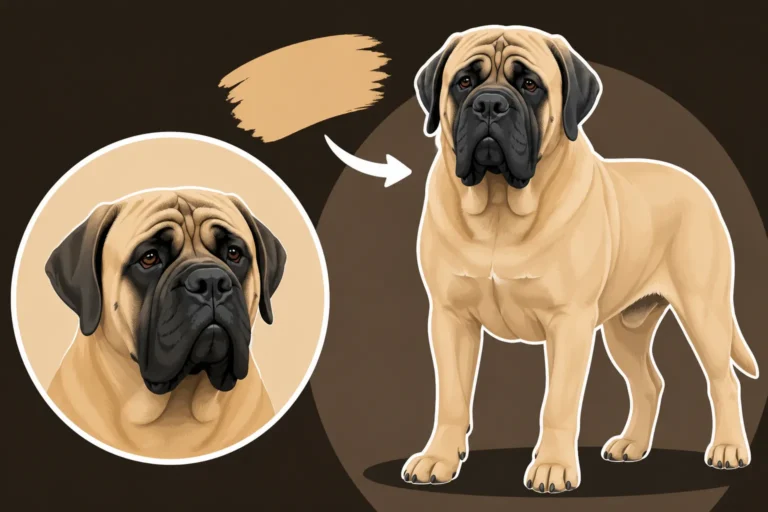
Whether a Mastiff Can Have White Markings
A Mastiff may have a small white patch on its chest, and that marking alone does not mean the dog is unhealthy or not purebred. But white on the feet, face, or elsewhere can fall outside the breed standard, which matters if you plan to show the dog. This guide explains what the standard allows, what markings can and cannot tell you, and when a vet’s advice is useful.
What the Mastiff breed standard says about white markings
A small white chest patch is permitted
The Mastiff standard allows a small patch of white on the chest. That means a puppy with a modest white spot there can still fit the standard’s description of an acceptable Mastiff. The word “small” matters: a little patch is different from a broad white area covering much of the chest.
White markings do not change the basic requirements for the breed’s coat colors. Mastiffs are shown in fawn, apricot, or brindle shades, and the standard calls for a black mask and dark pigment in key areas. For an overview of the approved coat shades, see Which Colors the Mastiff Standard Allows and The Colors a Mastiff Comes In.
If you are looking at a litter, ask the breeder how they describe the marking and whether they expect it to change as the puppy grows. A clear photo in natural light can help you compare the puppy’s coat over time. If you are buying a puppy, though, the chest patch should be only one small part of your decision. Health testing, temperament, and the breeder’s transparency matter far more than whether a white spot is especially tidy.
White elsewhere is a different question
White on the feet, legs, face, or a large portion of the body is not the small chest patch described as permissible. Depending on the size and location, it may be considered a departure from the breed standard in the show ring. That is a conformation issue, not a diagnosis.
A dog can be a purebred Mastiff and still have markings that are not preferred for competition. Breed standards describe the traits breeders and judges aim to preserve; they do not determine whether a dog is loved, suitable as a companion, or automatically healthy. A white toe or chest blaze does not, by itself, prove that a dog is mixed.
The amount and location of white a Mastiff may carry can vary. How Much White a Mastiff May Carry goes into that question in more detail. If a breeder is selling a puppy as show quality, ask them to explain how the markings fit the written standard and what they mean by that label. If you simply want a family companion, focus on the dog’s health, socialization, and fit with your household rather than treating a cosmetic marking as a warning sign.
| Marking | How it relates to the standard | What it means for an owner |
|---|---|---|
| Small white chest patch | Specifically permitted | Usually a cosmetic detail |
| Large white area on the chest | May be considered excessive | Could affect show evaluation |
| White on feet, legs, or face | Not the permitted small chest patch | A standard deviation, not proof of poor health |
| Pale fawn or apricot coat | Can be an accepted coat shade | Check the dog in natural light before calling it white |
| Black mask with a small white patch | The mask and patch are separate traits | A chest marking does not cancel the mask requirement |
A white patch does not replace the black mask requirement
The black mask is a characteristic feature of the Mastiff. It generally covers the muzzle and extends around the eyes, while the ears and other dark features contribute to the familiar expression. A small white chest patch does not affect whether the dog has a mask. The two traits are considered separately.
Likewise, a white marking around the muzzle or face is not the same as a lighter coat shade. It is worth looking carefully at the dog’s overall coloring in daylight, because indoor lighting can make pale fawn or apricot look almost cream-colored. A black mask can also appear less distinct in a poorly lit photo.
For a closer look at the expected facial pigment, see Why a Mastiff Must Have a Black Mask. And if someone claims that a dog is not purebred solely because it has white on its chest, that conclusion is too simple. Coat color alone is not a reliable way to establish pedigree; records and, where appropriate, DNA testing are more informative. The related discussion Whether a Black Mastiff Is Purebred also explains why unusual-looking color is not proof of a dog’s ancestry.
How to tell a white marking from a pale coat
Look at the color in natural light
A light fawn or apricot Mastiff can look much paler in photos than in person. Flash, shade, a bright window, and a phone camera’s automatic color adjustment can all shift the appearance of the coat. Before deciding that an area is a white marking, look at the dog outdoors in indirect daylight and compare it with the surrounding coat.
A true white patch usually has a clearer boundary: the coat changes visibly from the main color to white. A pale or cream-toned section may blend gradually into the rest of the coat. The difference can be subtle, particularly on a young puppy with a soft coat and less contrast than an adult.
It helps to take photos from the same angle and in similar lighting every few weeks. That gives you a more reliable record than trying to remember whether the patch looked larger last month. These pictures can also be useful when discussing the dog with the breeder, a veterinarian, or a show mentor.
Remember that puppy coats can change
A Mastiff puppy’s color may shift as the coat matures. The overall shade can deepen or lighten, and brindle patterning may become easier to see as the puppy grows. A marking that looks sharply defined in one photo may seem less obvious later because the surrounding coat has changed in tone.
This does not mean that a white marking will necessarily disappear. If the hair itself is white, the marking may remain visible, even as the rest of the coat changes. The important point is to avoid making confident predictions from one early photo. For more on coat changes over time, see How a Mastiff's Color Changes With Age.
If the puppy’s coat looks unusually pale, ask the breeder what color they record for the puppy and how they describe the parents’ colors. A careful breeder should be able to discuss the litter plainly, without insisting that every detail is either perfect or alarming. For a pet home, a color change is usually just part of watching the dog grow. For a show prospect, ask a knowledgeable breed mentor to assess the puppy in person rather than relying on a snapshot.
Don’t confuse a coat marking with a skin problem
White fur is not the same thing as irritated, hairless, or discolored skin. If an area appears suddenly, is losing hair, looks inflamed, or seems itchy or painful, treat it as a possible skin concern rather than a coat-color question. A veterinarian can check whether there is a medical issue.
That distinction is especially helpful when a Mastiff has wrinkles or skin folds that hide irritation. A small white patch on the chest that has been present since puppyhood is very different from a new pale area where the hair has thinned. Take note of when you first saw the change and whether your dog is licking or scratching it.
For ordinary grooming, keep the chest and folds clean and dry, particularly after meals, drinking, or a wet walk. Washable bedding and a cloth kept near the dog’s resting spot can make cleanup easier. If you shop for those supplies through Chewy or another pet retailer, check that any cleaner or wipe is labeled for use around dogs; avoid applying products to irritated skin unless your veterinarian recommends them.
What white markings mean for health, pedigree, and showing
White markings are not a diagnosis
A white patch by itself does not tell you that a Mastiff has a health problem. Nor does it establish that the dog is a crossbreed. The location and amount of white matter when assessing whether the coat matches a show standard, but they are not a substitute for health history, veterinary examination, or reliable pedigree records.
It is sensible to ask the breeder about the parents’ health testing and to review the puppy’s veterinary records. If the puppy is already home, bring up any concerns at routine appointments, especially if the marking is accompanied by a change in the skin, coat loss, or discomfort. The color alone is not a reason to assume a problem, but new physical changes deserve attention.
Be cautious of anyone who uses a small white patch to pressure you into a rushed decision, either by calling the puppy defective or by promising that the marking guarantees special value. A responsible breeder should explain what is known, distinguish appearance from health, and let you make a decision without scare tactics.
Show plans may make the marking more important
If you want to compete in conformation shows, the written standard matters more directly. A small white chest patch is permitted, while larger or differently placed white markings may be viewed as deviations. How a judge evaluates a dog can also depend on the whole animal, not one isolated mark.
Before placing a deposit on a puppy specifically for showing, ask the breeder to discuss the puppy’s markings honestly and explain how they see the dog’s prospects. Consider asking a knowledgeable Mastiff breeder or mentor to look at the puppy too. No one can guarantee that a young puppy will become a successful show dog; structure, movement, temperament, and development all matter alongside color.
For a companion home, show-ring preferences may have little practical effect. A dog with white on a foot or chest can still be a wonderful household companion. You may want to understand the marking, but you do not need to treat a standard deviation as a character flaw or a reason the dog cannot be part of your family.
Keep practical records and care for the coat normally
Take a few clear photos when the puppy comes home, and keep them with vaccination and veterinary records. If you later have questions about whether a patch has changed, the photos give you a useful baseline. This is especially helpful when a coat is very pale and the boundary between colors is hard to see.
A white chest patch may show dirt more visibly than a darker coat, so a quick wipe after outdoor play can be convenient. Use a damp, soft cloth and dry the area afterward. Keep the skin folds clean and dry as part of ordinary Mastiff care, but do not scrub a patch or use bleaching products to alter its appearance. If you need replacement towels, washable covers, or dog-safe grooming basics, Chewy is one possible place to look alongside local pet shops.
For routine grooming, there is no special care requirement simply because part of the coat is white. The dog still needs the same attention to nails, ears, skin folds, and coat condition as any other Mastiff. If the white area becomes red, scaly, damp, or unexpectedly hairless, check with your veterinarian rather than assuming it is just a color change. Chewy may carry general grooming supplies, but a product intended to mask or change coat color is not a substitute for veterinary care.
The practical answer is straightforward: a Mastiff can have a small white chest patch and remain within the breed standard. White elsewhere may be a show-standard deviation, but it does not by itself prove that the dog is unhealthy or not purebred. If your goal is a companion, judge the puppy by health, temperament, and fit; if your goal is showing, get an informed assessment of the whole dog.
Disclaimer
This article is for general informational purposes only and does not constitute professional advice. Laws, prices and regulations vary by location and change over time. Consult a qualified professional for guidance on your specific situation.