How Narrow the Mastiff Gene Pool Is
A breed can have thousands of registered dogs and still draw on a surprisingly small pool of shared ancestors. That distinction matters for Mastiffs: limited genetic diversity can make inherited risks harder to manage, even when a puppy looks healthy. This guide explains what a narrow gene pool means, how history shaped it, and what responsible breeders and prospective owners can do with that knowledge.
What a narrow gene pool means in Mastiffs
Head count is not the same as genetic diversity
When people hear that a breed has a narrow gene pool, they may picture only a small number of living dogs. But the number of dogs you can see or find in a registry is not the same as the amount of genetic variation those dogs carry. Many Mastiffs may descend from a relatively small group of ancestors, or share the same influential dogs several times in their pedigrees.
A useful comparison is a family reunion. The room might hold hundreds of people, but if many branches of the family trace back to the same few grandparents, the group is less genetically varied than its size suggests. In a breed, the equivalent is a population with many dogs but a limited range of distinct ancestral lines.
Breeders and geneticists may look at measures such as pedigree-based inbreeding coefficients, genomic data, or effective population size. Each offers a different view. A pedigree can reveal known relationships, while genetic testing can help identify shared patterns across DNA. Neither number, taken alone, explains the full picture. The result depends on which dogs were included, how many generations were considered, and what comparison is being made.
Why effective population size matters
Effective population size describes, in simplified terms, how many dogs are contributing genes to future generations in a balanced way. It can be much smaller than the total number of dogs alive or registered. If only a limited set of males and females produce most of the next generation, the genetic contribution is concentrated even when the breed has plenty of members.
The “popular sire” effect is one way this can happen. A successful or highly sought-after male may sire many litters. His qualities can become common quickly, but so can genetic variants he carries—some of which may not cause visible problems until paired with a related variant from the other parent. The same pattern can occur when a small group of fashionable lines becomes widely used.
This is one reason a pedigree that appears long and impressive may still contain repeated ancestors. A breeder evaluating diversity looks beyond how many names appear on the page and asks how often the same dogs recur, how closely related the prospective parents are, and whether other healthy lines could be considered. For a broader look at the breed’s history, see How Inbreeding Shortened the Mastiff's Life.
How a narrow gene pool can affect health
A restricted pool does not mean every Mastiff is unhealthy, nor does it mean that every inherited condition is caused by inbreeding. It does mean breeders have fewer distinct genetic options to work with, which can make it more difficult to reduce the frequency of harmful variants while preserving the traits they value.
The most direct concern is that related dogs are more likely to carry some of the same genetic variants. If both parents pass on a harmful recessive variant, a puppy may be affected. Other conditions are more complex: risk can involve many genes, body structure, environment, and chance. A narrow pool can make those problems harder to manage because there may be fewer unrelated, otherwise suitable dogs available for future breeding choices.
It is also important not to treat “genetic diversity” as a guarantee of health. A diverse pairing can still produce puppies with health concerns, and a puppy from closely related lines may live a long, comfortable life. Diversity is one part of responsible breeding, alongside health screening, temperament, sound structure, and careful placement.
How Mastiff history shaped the gene pool
A severe population bottleneck
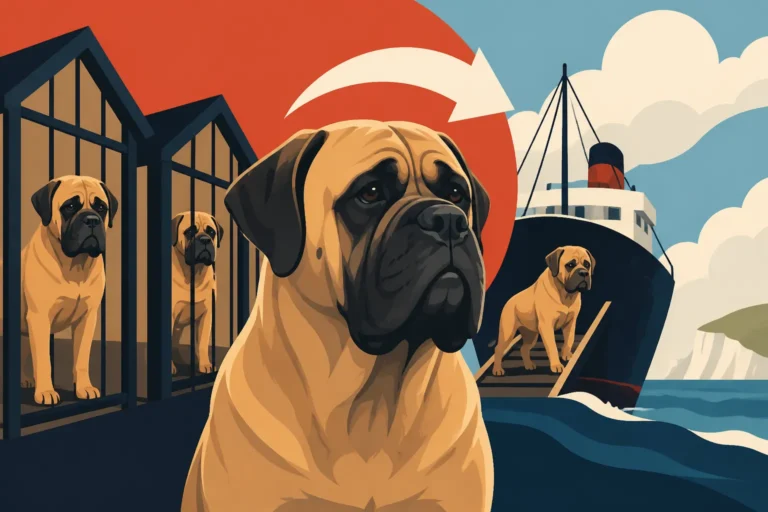
A population bottleneck happens when a breed’s numbers fall sharply, leaving fewer dogs to contribute to the next generations. The historical account that Fewer Than Twenty Mastiffs Survived the Second World War describes a particularly severe period for the breed. When a population is rebuilt from a small number of survivors, the descendants naturally share a larger proportion of the same ancestry.
That does not mean the modern breed is simply a copy of a handful of dogs. Breeding populations can recover in size, and imported or less-used lines may add variation. Still, a larger population after a bottleneck does not automatically restore every genetic option that was lost. If many later generations descend heavily from the same founders, the effects of that narrow starting point can persist.
The postwar recovery also depended on dogs from outside the immediate British population. How American and Canadian Dogs Rebuilt the Mastiff explores that part of the story. International exchange can help widen a population, but it does not automatically solve the problem: dogs from different countries may still share ancestors, and a dog’s country of origin does not tell you how genetically distinct it is.
Popular lines can narrow choices again
Even after a breed recovers numerically, repeated use of a few highly influential dogs can concentrate ancestry. This can happen for understandable reasons. A dog may be admired for its conformation, temperament, health record, or success in the show ring. Breeders may reasonably want to preserve those qualities, but widespread use can make one line disproportionately influential.
The challenge is balancing the benefits of a valued dog against the long-term consequences of relying on that dog too heavily. A single animal cannot be judged only by its own health. A breeder should also consider what it may pass on, how common its relatives already are in the population, and what alternatives exist. A dog that appears unrelated on a short pedigree may share ancestors farther back.
This is not a reason to accuse breeders of wrongdoing whenever a line becomes popular. It is a reason to ask thoughtful questions and to support breeding decisions that consider the whole population, not just the next litter. The broader discussion in The Push to Breed Healthier Mastiffs looks at why population-level thinking matters.
Why pedigree records have limits
Pedigrees are useful, but they are records of known ancestry, not a complete map of every inherited gene. Their accuracy depends on the information available, and a pedigree may not show how much genetic material a dog actually inherited from each ancestor. Two dogs with similar-looking pedigrees can have different genomic patterns; two dogs with different-looking pedigrees may still share meaningful ancestry.
A pedigree-based inbreeding coefficient is also tied to the number of generations examined and the completeness of the records. A low figure does not necessarily prove that two dogs are unrelated, especially if common ancestors are missing or appear beyond the generations included. Conversely, a higher figure is not a diagnosis and cannot predict an individual puppy’s health on its own.
Genomic tools can add information, but they require careful interpretation. Results are most useful when considered alongside pedigree data, known health outcomes, and the breed’s overall population. A single test result should not be treated as a complete verdict on whether a dog is suitable for breeding.
How breeders can manage limited diversity
Use health testing as part of a wider plan
Health tests can help breeders make more informed decisions, but they do not create genetic diversity by themselves. Screening can identify certain risks or help clarify a dog’s status for specific conditions. It cannot rule out every inherited disease, and a dog that passes a set of tests is not automatically a good breeding choice in every other respect.
For Mastiffs, prospective buyers can learn about standard screening expectations in The Four CHIC Tests a Mastiff Breeder Must Clear. It is sensible to ask which tests were completed, who performed them, whether results can be reviewed, and how the findings affected the pairing. A responsible breeder should be willing to explain the reasoning rather than relying on a general claim that the parents are “health tested.”
Breeders also need to avoid narrowing the population unnecessarily by excluding every dog with any risk marker, especially when a result is not a simple measure of disease. Decisions should reflect the inheritance pattern, the dog’s actual health, the availability of suitable mates, and the consequences for the broader gene pool. The appropriate plan can differ by condition, so a veterinary geneticist or breed-health specialist may be useful.
Look beyond a single pairing
A litter can be evaluated as one decision within a much longer breeding plan. Before pairing two dogs, a breeder can examine their shared ancestors, the frequency of those ancestors across current pedigrees, and the health history of relatives. The practical question is not only “Are these two dogs healthy?” but also “What will this pairing contribute to the next generation, and what choices will remain afterward?”
There are trade-offs. A very low-relatedness pairing may bring useful diversity but could also combine dogs with less predictable traits or introduce other health concerns. A more closely related pairing may be chosen to preserve particular qualities, but it calls for especially careful attention to the risks and the future use of the offspring. There is no one-number shortcut that replaces informed judgment.
A simple comparison can help clarify what different information sources can and cannot tell you:
| Information | What it can help show | What it cannot prove on its own |
|---|---|---|
| Pedigree review | Known shared ancestors and repeated lines | The exact DNA inherited from each ancestor |
| Inbreeding coefficient | Relatedness within a stated pedigree or dataset | A puppy’s health or complete genetic risk |
| Health screening | Results for the conditions included in the tests | Freedom from every inherited or later-life condition |
| Genomic analysis | DNA patterns and some forms of relatedness | A complete breeding decision without context |
| Family health history | Patterns of illness in relatives | Whether a specific puppy will develop a condition |
Breeders who want to understand the role of added testing can also read Which DNA Tests a Mastiff Breeder Should Add. The key is to use results as part of a transparent plan, not as a marketing label.
Keep records and share useful information
Long-term improvement depends on reliable information about dogs after they leave the breeder. Buyers can help by keeping veterinary records, sharing significant diagnoses with the breeder, and asking that relevant findings be included in the dog’s health history. A dog that develops a condition should not automatically be treated as a breeding failure; the information may help breeders understand patterns and make better decisions.
For a future litter, useful records include test results, diagnoses, age at onset where known, and health details about close relatives. Privacy and consent matter, but so does the value of accurate, responsible record keeping. The goal is not to shame owners or label entire lines as defective. It is to make decisions with better information.
Routine care matters too, even though it cannot alter inherited diversity. Owners may use retailers such as Chewy for ordinary supplies, but food, supplements, or other products should not be mistaken for a way to change a dog’s genetic background. If a Mastiff has a diagnosed condition or a specific nutritional need, discuss the care plan with a veterinarian rather than assuming a general product will address it.
What prospective Mastiff owners can ask
Ask how the breeder thinks about relatedness
A prospective owner does not need to calculate a pedigree coefficient or interpret genomic data alone. It is reasonable, though, to ask how the breeder chose the pairing and whether the parents have close or repeated ancestors. A thoughtful answer should explain the reasoning in plain language, including what the breeder values and what risks they considered.
You can also ask whether the breeder has used the same sire repeatedly, how they decide when a dog has contributed enough to the population, and whether they are willing to consider dogs from less-used lines. The point is not to demand a particular formula. It is to learn whether the breeder considers the long-term health of the breed as well as the qualities of an individual litter.
If the answer is vague, defensive, or focused only on champions and appearance, ask for clarification. A breeder may not have every answer immediately, but should be able to discuss health, ancestry, and uncertainty openly. Buying from a breeder who communicates clearly can make it easier to stay in touch if health questions arise later.
Judge the whole breeding program, not one number
A narrow gene pool is a population-level concern, so no single result can tell you whether an individual breeder is responsible. Consider how the breeder approaches health screening, temperament, structure, relatedness, and lifelong support together. Ask to see available health records and confirm that the results belong to the dogs being discussed.
It can also help to ask what happens if a puppy develops a serious inherited problem, whether the breeder wants updates as the dog matures, and how they use information from previous litters. These questions reveal whether health information is treated as part of an ongoing relationship or only as a sales document.
Be cautious of absolute claims such as “our line has no health problems” or “these parents guarantee a healthy puppy.” No breeding decision can guarantee that. A responsible breeder can describe the steps taken to reduce known risks while being honest that biology always involves uncertainty.
Keep diversity in perspective
A narrow gene pool is not a reason to assume that a Mastiff puppy will be unhealthy, and it is not a reason to dismiss every purebred dog. It is a reason to take health history and breeding choices seriously. Individual outcomes vary, and a dog’s well-being depends on much more than ancestry alone.
Some prospective owners also consider whether a crossbred dog might offer different genetic options. That question deserves careful evaluation rather than a simple promise that mixed ancestry prevents disease. The related discussion Whether a Mastiff Mix Outlives a Purebred explains why ancestry alone cannot guarantee a longer life.
If you already live with a Mastiff, you do not need to carry the burden of solving a breed-wide problem. Keep up with veterinary care, share relevant health information with the breeder when appropriate, and make decisions based on your dog’s individual needs. Owners can find routine supplies through retailers such as Chewy, but questions about screening, diagnosis, or breeding suitability belong with qualified veterinary professionals. Chewy may be part of a household’s ordinary care routine; it does not replace genetic counseling or a veterinarian’s guidance.
Disclaimer
This article is for general informational purposes only and does not constitute professional advice. Laws, prices and regulations vary by location and change over time. Consult a qualified professional for guidance on your specific situation.