Whether Parent Size Predicts a Mastiff’s Adult Weight
A Mastiff puppy’s parents can offer a useful clue about adult size, but they cannot tell you exactly how many pounds your dog will weigh. A smaller dam and a massive sire, or the reverse, may produce a puppy whose adult build surprises you. This guide explains how to read the clues, what else shapes growth, and how to track your Mastiff without chasing a number.
How much parent size can tell you
Adult size is inherited from more than two measurements
A puppy inherits genes from both parents, but adult weight is not controlled by one simple “large dog” or “small dog” switch. Many genes influence height, bone, body length, muscle, and the rate at which a dog matures. Those traits can combine in different ways within the same litter, which is why two siblings may end up noticeably different in size.
A parent’s weight is still useful information. If both parents are mature, healthy Mastiffs with similar builds, their size gives you a reasonable sense of the range their puppies might fall into. If one parent is much smaller or larger than the other, the possible range is wider. Neither situation provides a reliable exact forecast for an individual puppy.
It also helps to know what the number represents. A parent’s weight might reflect a naturally broad frame, extra body fat, or an unusually heavy show or working build. Those are not interchangeable. Ask about the parent’s height, body condition, age, and general structure—not just the figure on a scale. For breed context, see How Much a Male Mastiff Weighs and How Much a Female Mastiff Weighs.
The mother and father may offer different clues
People often look at the sire first, especially when he is a particularly impressive adult. But the dam’s size and condition matter too. A puppy receives genetic material from both parents, and the mother’s health during pregnancy and nursing also affects early development. Her weight alone, however, does not dictate how large her puppies will become.
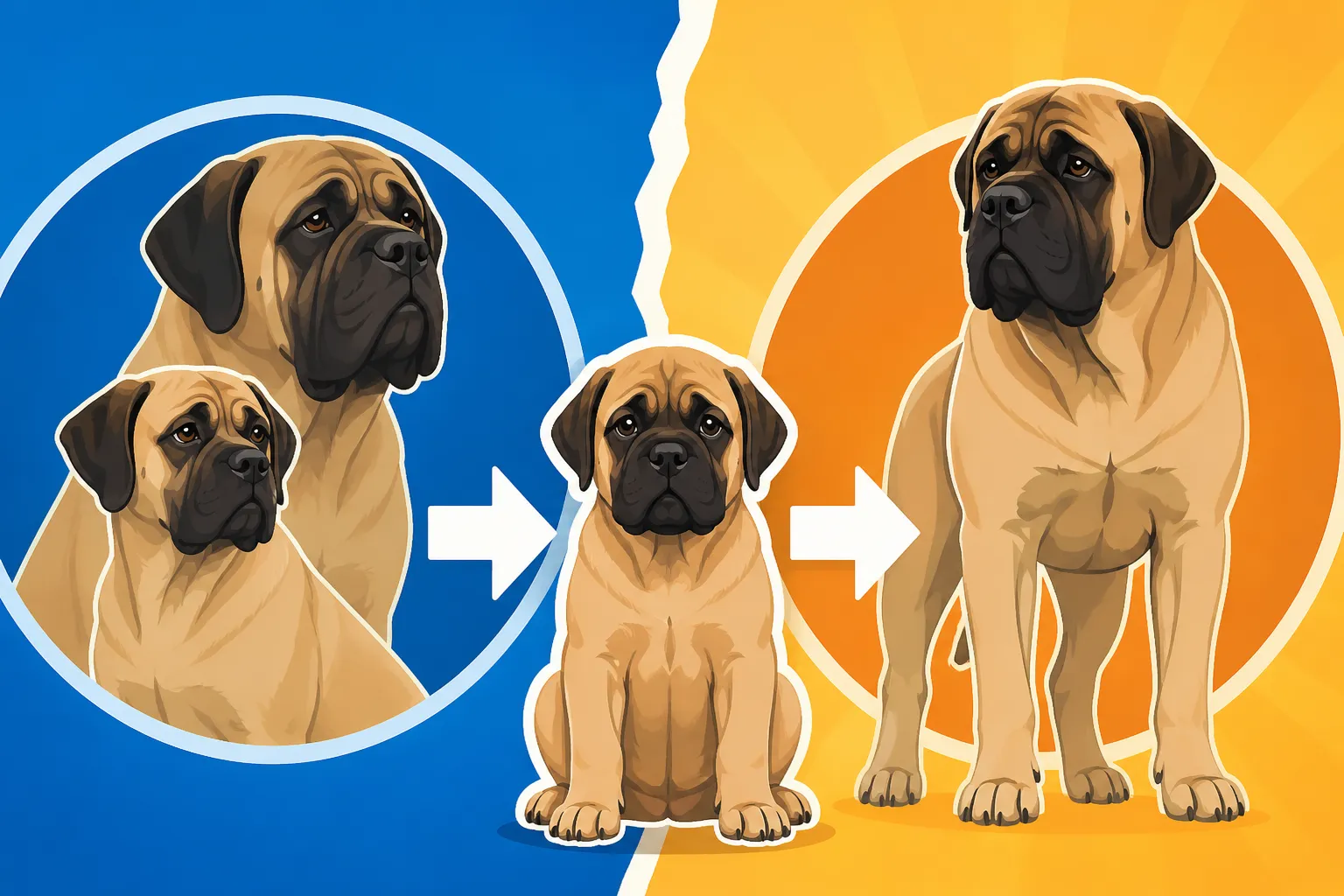
A big sire does not guarantee that every puppy in the litter will grow into a giant adult. Likewise, a smaller dam does not automatically mean the puppies will be small. The litter may include puppies with different frames and growth patterns, and a puppy that looks like the largest one at eight weeks may not remain the largest as it matures.
If you are speaking with a breeder, ask to meet or see current, accurate information about both parents. Find out whether their weights are adult weights, whether either dog is overweight, and whether close relatives tend to be larger or smaller. A responsible breeder should be comfortable discussing variation rather than promising a precise adult weight.
Why puppies from the same parents grow differently
Sex, family traits, and individual build all matter
In general, male Mastiffs tend to mature larger than females, but that is a broad pattern, not a guarantee about any particular pair of dogs. A female from large parents may outweigh a male from a smaller line. Within one litter, puppies may inherit different combinations of traits, creating a spread in adult size even when they share the same parents.
Family history beyond the parents can add useful context. Ask about adult siblings, grandparents, and previous litters if the breeder has reliable information. A family pattern may suggest that puppies often mature toward the larger or smaller end of the breed’s range, but it still cannot predict exactly where your dog will land. Individual weight can also shift with health, activity, and body condition.
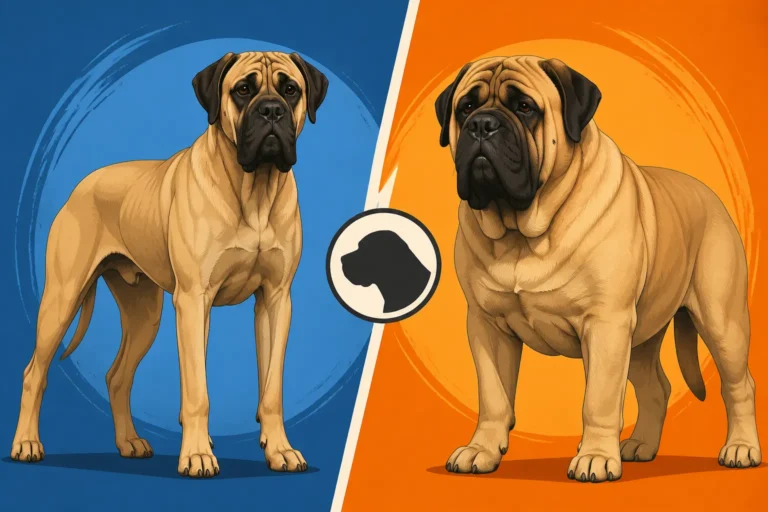
It is worth separating height and frame from weight. A tall, long-bodied Mastiff may weigh more than a shorter dog without being overweight. A compact dog with less height may be heavy because of excess fat rather than a naturally substantial build. When comparing relatives, look at their overall shape and leanness as well as the scale.
Growth rate does not set the final number
A puppy who gains weight quickly is not necessarily destined to become the heaviest adult in the litter. Growth often comes in uneven stretches: one puppy may shoot up in height, then appear lean while filling out later; another may look broader early and grow more gradually afterward. These differences are normal enough that a single weigh-in rarely tells the whole story.
Mastiffs are giant dogs, and they can continue maturing after they look close to adult height. Their bodies may keep developing in muscle and substance after the fastest phase of growth has passed. For more on that timeline, read The Age a Mastiff Stops Growing and Whether a Mastiff Fills Out After Two. A puppy’s current size is one point on a long growth curve, not a final prediction.
Online charts and rules of thumb can be tempting, especially when you want to know what to expect for food, equipment, or vehicle space. But a formula based on age and current weight can be misleading for a giant-breed puppy. How Fast a Mastiff Puppy Grows explains why growth is better understood as a pattern over time than as a straight-line forecast.
What to ask a breeder and what to track at home
Ask for context rather than a weight promise
A useful breeder conversation is specific. Ask how old the parents were when their weights were recorded, whether they were in healthy condition, and what their mature height and build are like. Ask whether the breeder has followed adult littermates or earlier litters from the same pairing. These details can help you understand likely variation without turning a guess into a promise.
You can also ask how the breeder evaluates puppies beyond size. Temperament, soundness, and overall health matter far more than choosing the heaviest puppy or the one that appears most likely to become enormous. A puppy’s early size should not be treated as a quality score. If a breeder guarantees a precise adult weight, it is reasonable to ask what that estimate is based on and how much variation they have seen.
| Clue | What it may suggest | What it cannot tell you |
|---|---|---|
| Both parents are similarly sized and lean | A somewhat narrower family size pattern | The exact weight of your puppy |
| One parent is much larger than the other | A potentially wider range among offspring | Which parent’s size a puppy will take after |
| Adult siblings are consistently similar | A possible family tendency | That every puppy will follow the same pattern |
| A puppy is the largest in its litter | That it is currently growing ahead of littermates | That it will be the largest adult |
| A puppy gains weight quickly | That its current growth rate is brisk | Its final height, frame, or healthy adult weight |
Keep a simple growth record
Weigh your puppy regularly using a consistent method and record the date, age, and weight. A veterinary clinic can help if your puppy is too large or wiggly for a household scale. The trend matters more than one number: your vet can spot a sudden change in the growth pattern and consider it alongside appetite, stool, activity, and the puppy’s body condition.
At home, take occasional photos from the side and above, ideally with your puppy standing naturally. Those pictures can make gradual changes easier to notice than memory alone. Do not try to force a precise adult-weight prediction from the log. Use it to support conversations with your veterinarian and to catch meaningful changes, not to decide that your dog is growing “too slowly” or “too fast” based on an internet chart.
When planning supplies, allow for change without buying every adult-size item far in advance. A collar, harness, or bed may need replacing as your puppy grows, and the size listed for an expected adult weight is only a rough guide. If you order food through Chewy or another retailer, choose the diet with your veterinarian’s advice rather than selecting a formula based on a guessed adult size. The same applies if you buy locally: a growth estimate is not a feeding prescription.
Support healthy growth instead of aiming for a target weight
Feed for steady development, not maximum size
Trying to make a Mastiff as large as possible can put the focus in the wrong place. The goal is healthy, steady development—not rapid weight gain or a particular number on the scale. Ask your veterinarian which complete diet suits your puppy’s age and needs, and follow guidance on portions and meal routine. Avoid adding supplements or changing food simply because one parent is unusually large.
This is especially important with calcium and other nutrients. More is not automatically better for a growing giant-breed puppy, and improvised supplements can upset the balance of a complete diet. If you are uncertain whether a food is appropriate, bring its label to the veterinary appointment. Chewy may be one place you purchase food, but the retailer or packaging cannot assess your individual puppy’s growth and health.
For further detail on feeding and growth, see Whether a Mastiff Puppy Grows Too Fast on Rich Food. Your veterinarian can also help interpret weight changes in light of your puppy’s age, frame, and condition. A puppy who seems lean to you may be developing normally, while a puppy who looks impressively bulky may be carrying more weight than is ideal.
Learn to judge body condition, not just pounds
A large Mastiff can be at a healthy weight, and a smaller Mastiff can be overweight. Your dog’s ribs should be assessable by touch without having to press through a thick layer of fat, and the body should have a visible waist when viewed from above. Heavy wrinkles, loose skin, and a broad chest can make visual assessment tricky, so ask your veterinarian to show you how to check your puppy’s body condition.
This is a better guide than trying to make your dog match a parent’s weight. If the puppy’s weight rises rapidly, the vet can assess whether that reflects normal development, a change in body condition, or a health concern. If your puppy seems unusually small or stops gaining, the right next step is a veterinary check—not increasing portions in an effort to catch up without guidance.
As your Mastiff matures, keeping the dog lean remains important for comfort and mobility. How to Tell a Heavy Mastiff From a Fat One and Keeping a Mastiff Lean on Purpose offer more on evaluating condition and maintaining a healthy body shape. Chewy can be convenient for replenishing a food your veterinarian has recommended, but the amount to feed should be adjusted with professional guidance as your dog grows and activity changes.
What to remember when estimating adult weight
Parent size is a meaningful clue, but it is only one clue. The most realistic expectation is a range shaped by both parents, wider family traits, sex, individual build, growth pattern, and long-term health. Track your puppy over time, keep regular veterinary appointments, and judge progress by steady development and body condition rather than a promised adult-weight number.
Disclaimer
This article is for general informational purposes only and does not constitute professional advice. Laws, prices and regulations vary by location and change over time. Consult a qualified professional for guidance on your specific situation.