How Long Zorba the Mastiff Measured Nose to Tail
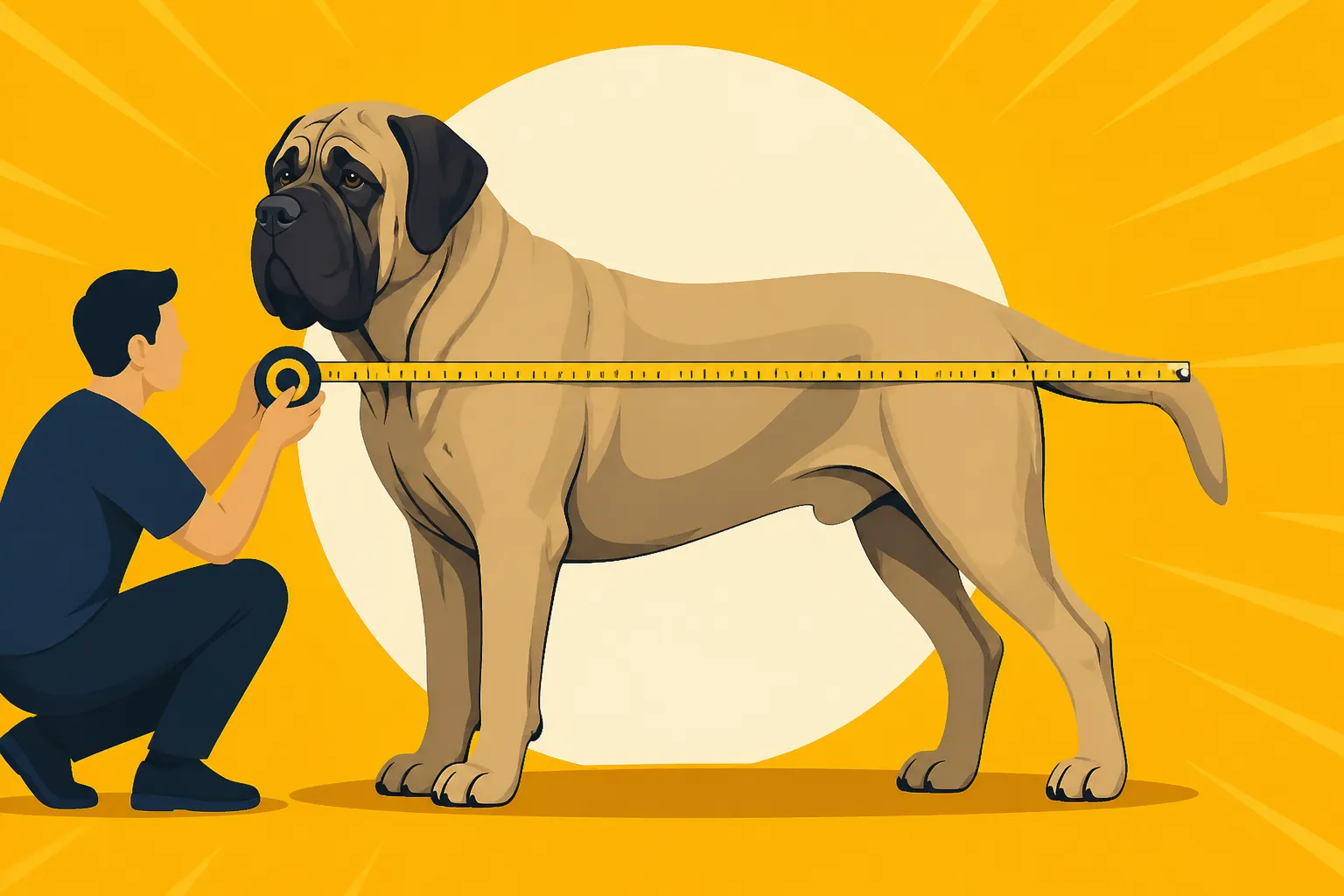
Zorba the Mastiff measured 8 feet 3 inches from nose to tail, or about 2.51 metres. That striking figure describes his full length, not his height at the shoulder or the length of his torso alone. Here’s how to interpret the measurement, what it tells us about Zorba, and why it shouldn’t be treated as a typical Mastiff size.
Zorba’s nose-to-tail measurement
The recorded length was 8 feet 3 inches
The commonly reported nose-to-tail measurement for Zorba is 8 feet 3 inches, equivalent to 99 inches or approximately 2.51 metres. It is an overall length measurement: the distance from the front of the dog to the end of his tail. It is not a measure of how much space his body occupies when he is standing, sitting, or curled up.
That distinction matters because dog measurements can sound interchangeable when they are not. A dog’s height is usually taken at the shoulder, while body length generally refers to a distance along the torso. Nose-to-tail length includes the head and tail, so it will be considerably greater than either a shoulder-height measurement or a back-length measurement.
If you’ve seen a different figure attached to Zorba, check what the number is meant to describe. A measurement of about 37 inches, for example, refers to his height at the shoulder in commonly repeated record descriptions, not his full length. The two figures describe different dimensions and can both be true.
| Measurement | Zorba’s commonly reported figure | What it describes |
|---|---|---|
| Nose to tail | 8 ft 3 in, about 2.51 m | Overall length from the front of the dog to the end of the tail |
| Height at the shoulder | About 37 in, about 94 cm | Height from the ground to the shoulder |
| Weight | About 343 lb, about 156 kg | Body weight, not a measurement of length |
Length is not the same as height or weight
It’s easy to picture a very large dog as simply “tall,” but Zorba’s famous length is a separate part of the story. A long dog is not necessarily the tallest dog, and a heavy dog is not necessarily the longest. Each measurement tells you something different about the animal.
Weight can also be a misleading shortcut when comparing giant dogs. Two Mastiffs may weigh similarly but differ in build, height, body condition, and proportions. A number on a scale does not tell you how long a dog is, and a nose-to-tail measurement does not tell you whether the dog is carrying a healthy amount of weight.
That’s why articles and record descriptions about Zorba are best read with the measurement label in mind. If the question is how far he measured from end to end, the answer is 8 feet 3 inches. For broader context about the breed’s build and size, see What a Mastiff Actually Weighs and How Much a Male Mastiff Weighs.
Who Zorba was and why his size became famous
Zorba was an unusually large English Mastiff
Zorba was an English Mastiff whose reported size made him famous well beyond the breed community. Descriptions of him often pair the 8-foot-3-inch length with a weight of about 343 pounds and a shoulder height of around 37 inches. Taken together, those figures help explain why he became so widely discussed: he was notable not just for one measurement, but for his exceptionally large overall scale.
For readers meeting his name for the first time, Who Zorba the Mastiff Was provides the broader background. His fame is tied to record-setting size, but he was still an individual dog—not a blueprint for what an ordinary Mastiff should look like. A famous outlier can capture the imagination, yet it is not a reliable guide to the normal size or health needs of the breed.
Zorba’s story also tends to get compressed into a single dramatic number. That makes sense: “8 feet 3 inches” is easy to remember and share. But the number is more useful when considered alongside the type of measurement, the dog’s other reported dimensions, and the fact that exceptional records are not the same as typical breed characteristics.
A record-setting dog is not a breed standard
Breed standards describe the characteristics breeders aim to preserve; they are not a promise that every dog will fall at the same size, nor do they encourage owners to pursue the largest possible dog. Individual Mastiffs vary, and size alone does not show whether a dog is thriving. Sound movement, appropriate body condition, and overall health matter far more than matching a record.
The popular question of whether the Mastiff is the biggest dog breed can also get muddled by the word “biggest.” People may mean tallest, heaviest, longest, or simply most massive-looking. Zorba’s length is remarkable, but it does not by itself settle comparisons across breeds or record categories. For that distinction, see Whether the Mastiff Is the Heaviest Breed and How a Mastiff's Weight Compares With a Saint Bernard's.
It’s also worth separating curiosity from expectation. It’s perfectly understandable to be amazed by a dog that measured more than eight feet from nose to tail. But a Mastiff owner shouldn’t use Zorba as a target for feeding, growth, or adult size. If you’re wondering how a Mastiff changes as it matures, Whether a Mastiff Fills Out After Two offers more relevant context than a record-holding dog’s measurements.
How to understand an extraordinary length measurement
The body position can affect an end-to-end measurement
A nose-to-tail measurement sounds straightforward, but it depends on how the dog is positioned and where the measurement begins and ends. A dog may stretch out, relax its tail, or shift its head while being measured. Those details can affect the result, especially when a dog is very large and even a small change in posture spans several inches.
That does not mean Zorba’s commonly reported figure should be dismissed. It means readers should understand what kind of measurement they are seeing and avoid treating every reported dog length as directly comparable. Unless two measurements use the same starting and ending points and a consistent method, a difference between them may reflect technique as well as a real difference in size.
This is one reason a single record figure can be more useful as a remarkable historical detail than as a practical measurement standard. It tells us the reported scale of Zorba, but it doesn’t tell us precisely how much floor space he needed in every position, how he fit in a vehicle, or how another Mastiff would compare in day-to-day life.
Length does not translate neatly into household space
An 8-foot-3-inch nose-to-tail measurement does not mean a dog needs a bed that is exactly that length. Dogs change position, curl up, sprawl, and hang a head or tail over the edge of their resting place. For a living dog, choosing a bed or planning a travel space is a practical fit question—not an attempt to recreate a record measurement.
If you’re shopping for a bed, use your own dog’s resting posture and the product’s listed dimensions rather than Zorba’s length as a guide. When comparing options on Chewy, check the usable sleeping area and the manufacturer’s size guidance, then compare those measurements with the space your dog actually occupies when stretched out. A dog who sleeps curled up may need a different shape from one who regularly sprawls across the floor.
The same idea applies to crates, vehicle space, and doorways. A dog’s standing height, turning space, and ability to enter comfortably can matter more than nose-to-tail length alone. If you use Chewy to browse beds or travel accessories, measure the area where the item will go at home or in the vehicle before choosing a size. That simple step helps avoid the frustrating discovery that a product is technically large but still awkward for your dog’s shape or your room layout.
What Zorba’s measurement means for Mastiff owners
Don’t use a record as a target for growth or feeding
When you live with a growing Mastiff, it can be tempting to treat size as the main measure of success. That pressure is understandable: giant-breed puppies grow quickly, and people often comment on how big they are. But trying to make a dog heavier or larger to resemble a record-holder can work against healthy development.
A Mastiff’s adult size is influenced by many factors, and the goal should be a healthy, appropriate body condition rather than maximum weight or length. For puppies in particular, steady development and veterinary guidance are more useful than comparisons with a famous adult dog. Zorba’s reported dimensions are a curiosity, not a feeding chart, growth target, or measure of whether your own dog is “big enough.”
If you’re buying food or supplies for a Mastiff, focus on the needs of the dog in front of you: age, body condition, activity, and any advice from your veterinarian. Chewy may be one place owners use to compare food formats or everyday supplies, but the important decision is choosing items that suit the individual dog—not trying to match Zorba’s scale.
Measure your own dog for the thing you need
For a bed, measure the dog while relaxed and stretched out, then compare that figure with the product’s usable sleeping surface. For a harness, follow the maker’s measurement instructions, which commonly focus on areas such as the chest and neck rather than total body length. For a vehicle, consider whether the dog can enter, turn, lie down, and travel safely; a nose-to-tail figure by itself won’t answer those questions.
It can help to write down measurements you use often and keep them with your dog’s records. If you’re comparing beds on Chewy, note the actual dimensions rather than relying only on a label such as “giant.” Labels are not always consistent between sellers, while measurements let you judge whether the bed will fit your dog and the space you have.
For general breed context, The Mastiff Against the Bullmastiff and the Cane Corso explores how different large breeds compare, while Whether Zorba Is Still the Heaviest Mastiff on Record addresses the record question more directly. In either case, remember that record categories and individual measurements are not substitutes for assessing a particular dog’s comfort and health.
Zorba’s reported nose-to-tail length remains remarkable: 8 feet 3 inches, or roughly 2.51 metres. The most useful way to read that number is simply as Zorba’s extraordinary full-length measurement—not his height, not a typical Mastiff’s expected size, and not a target for owners to pursue.
Disclaimer
This article is for general informational purposes only and does not constitute professional advice. Laws, prices and regulations vary by location and change over time. Consult a qualified professional for guidance on your specific situation.